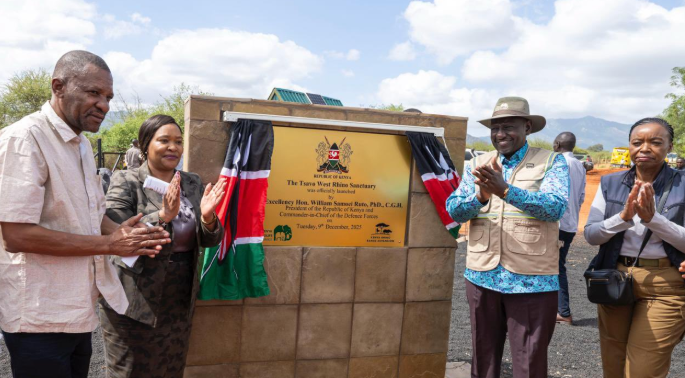
President William Ruto has positioned conservation as a key economic driver while launching the expanded Tsavo West Rhino Sanctuary, describing it as a major investment in both wildlife protection and job creation.
In a statement on Tuesday, December 9, Ruto announced that the initiative is projected to generate more than 18,000 jobs and create over $45 million (KSh5.8 billion) in conservancy and tourism-related revenue by 2030.

Read More
The President emphasized that the sanctuary represents more than just a conservation milestone, describing it as ‘a sovereign responsibility of global significance.’
"Our government is clear that natural capital is economic capital, and the Tsavo West Rhino Sanctuary stands firmly within our Bottom-Up Economic Transformation Agenda, the National Wildlife Strategy 2030, and the Black Rhino Recovery and Action Plan," Ruto stated.

The Tsavo West Rhino Sanctuary has undergone a remarkable transformation over four decades. Beginning with just three rhinos on a three-square-kilometer plot 40 years ago, the facility has expanded to cover 3,200 square kilometers, making it the world's largest rhino sanctuary.
The sanctuary now provides secure habitat for more than 200 rhinos, positioning the ecosystem as both a conservation hub and a major tourist attraction expected to draw more visitors to Kenya.

President Ruto stressed that conservation initiatives must deliver tangible benefits to local communities, noting that the sanctuary is already generating employment across multiple sectors.
"Conservation must also work for the people. The Tsavo West Rhino Sanctuary is already creating jobs in ranger deployment, surveillance, monitoring, fencing, roadworks, construction, and logistics," he said.

The President highlighted that the project is stimulating local economies through supply chains, transport services, community enterprises, and small businesses connected to the expanding wildlife economy.
"We are redefining conservation in Kenya, not as a cost to the taxpayer, but as a national investment class," the President declared.
The government plans to develop high-value tourism circuits across Tsavo and surrounding areas, establish enterprise zones linked to conservancies, and create research, training, and ecological technology opportunities for young Kenyans.

President Ruto also committed to strengthening security measures for endangered species within the sanctuary.
"We will keep deploying more protectors on the ground, and wider and longer-range eyes on our skies to monitor and protect our endangered species," he noted.