
Editor's Review
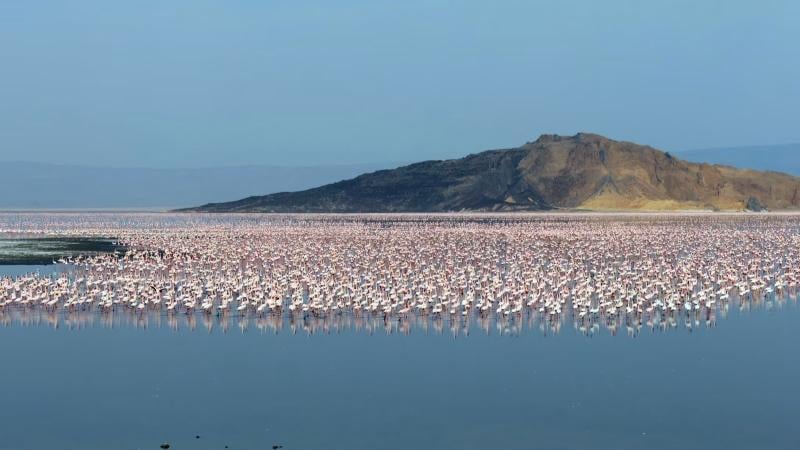
Kenya Wildlife Service (KWS), together with the National Museums of Kenya and other conservation partners, has launched a simultaneous flamingo census across seven Rift Valley lakes.
The Kenya Wildlife Service (KWS), together with the National Museums of Kenya and other conservation partners, has launched a simultaneous flamingo census across seven Rift Valley lakes to track the movements and population patterns of Lesser Flamingos.
In a statement on Monday, August 10, the agency said the exercise covers Lakes Logipi, Magadi, Bogoria, Nakuru, Naivasha, Elementaita and Baringo.
KWS highlighted the long-standing significance of Lesser Flamingos to Kenya's Rift Valley lakes, particularly Lakes Nakuru, Bogoria and Elementaita, where the birds have traditionally gathered in large numbers.
"For decades, millions of Lesser Flamingos have painted the shores of Lakes Nakuru, Bogoria, and Elementaita pink, creating one of the world's most spectacular wildlife experiences," the statement read.
KWS noted that changing climatic conditions are affecting water levels, food availability and habitat conditions across the Rift Valley lake system, influencing how flamingos move between different lakes.
Read More
"Today, a changing climate is influencing water levels, food availability, and habitat conditions across Kenya's Rift Valley lakes. In response, these remarkable birds continue to move between lakes in search of suitable feeding grounds, reminding us that nature is constantly adapting," the statement added.
KWS said the data collected during the census will play a role in implementing Kenya's National Recovery and Action Plan for the Lesser Flamingo, particularly in guiding habitat protection, research and broader conservation initiatives.
"The census findings will contribute to Kenya's National Recovery and Action Plan for the Lesser Flamingo, helping guide habitat protection, research, and conservation efforts across the Rift Valley lake system. Every flamingo counted brings us one step closer to safeguarding this iconic species and the wetlands it depends on," the statement further read.

KWS also emphasised that fluctuations in flamingo numbers are a natural occurrence, while maintaining that the Rift Valley lake system continues to offer some of the world's outstanding birding and wildlife experiences.
"While flamingo numbers naturally fluctuate between lakes, Kenya's Rift Valley remains one of the world's most remarkable birding destinations. From the breathtaking scenery of Lake Nakuru National Park to the tranquil beauty of Lake Elementaita and beyond, each lake offers a unique wildlife experience throughout the year," the statement noted.
Elsewhere, this comes days after KWS ruled out an infectious or transmissible disease as the cause of the deaths of 16 elephants in the Amboseli-Kimana-Kitenden ecosystem.
In a statement on Friday, August 7, KWS said preliminary investigations pointed to cyanide poisoning.
The 16 elephants died between June 24, 2026 and July 31, 2026 across the ecosystem.
According to KWS, the dead elephants mainly comprise adult females and calves that showed weakness and partial paralysis in their limbs.
"Importantly, findings to date do not indicate an infectious or transmissible disease," the service stated.
KWS noted that it deployed veterinary and scientific teams from Nairobi, Tsavo and Amboseli immediately after the first case was reported on July 24.
The teams conducted post-mortem examinations on the elephants, collected samples and intensified surveillance.
The service also said it is working with the Government Chemist and the University of Nairobi to carry out toxicological, microbiological and other laboratory analyses.
"KWS is working with the Government Chemist and the University of Nairobi to undertake toxicological, microbiological and related laboratory analyses of samples collected from the dead elephants," the statement read.
KWS mentioned that laboratory findings by the University of Nairobi indicate that cyanide poisoning is the most likely cause of the elephant deaths.
However, the service said it is awaiting the completion of confirmatory tests to verify the findings and determine the source and pathway of exposure.
"KWS is awaiting completion of confirmatory testing to align laboratory findings with individual case records, and to trace the exposure pathways and origin," KWS stated.

 (1)-1791708588-md.jpg)
 (1)-1791175033-md.jpg)
-1791699761-md.jpg)
-1791696120-md.jpg)

 (1)-1791708588-sm.jpg)
 (1)-1791175033-sm.jpg)