Editor's Review
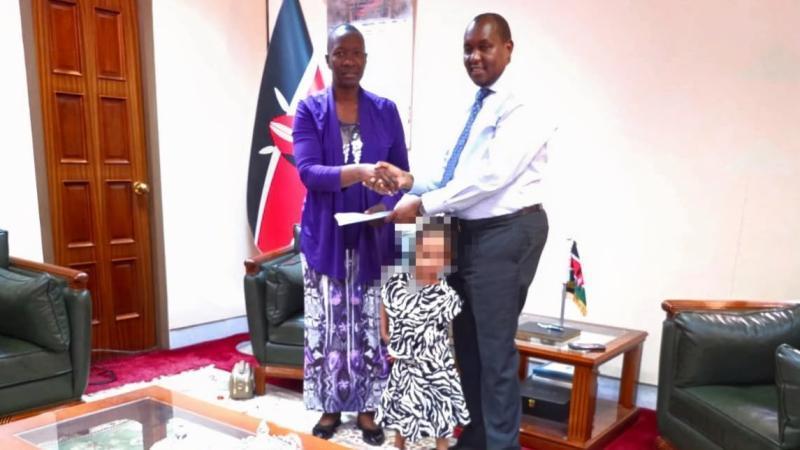
The Embassy of Kenya in Riyadh has traced four-year-old Baby Precious Wambui in Saudi Arabia and facilitated her release as she begins her journey back to Kenya.
The Embassy of Kenya in Riyadh has traced four-year-old Baby Precious Wambui in Saudi Arabia and facilitated her release as she begins her journey back to Kenya.
In a statement on Sunday, August 23, the Embassy said the child had remained connected with her mother virtually through friends.
Ambassador Joseph Masila facilitated her release following efforts by the Kenyan mission to trace and document her for repatriation.
"Distance and time may separate people, but genuine love keeps hearts connected. This has been the story of Baby Precious Wambui, aged four years and her mother who have been connecting virtually through friends.
"Today, 23 August 2026, Ambassador Joseph Masila facilitated the release of Baby Precious Wambui who was successfully traced by the Embassy of Kenya in Riyadh and is now on her way home to Kenya for reunification with her family," the statement read.
Read More
The Embassy described the child's return as a significant family reunion, emphasizing the enduring bond between a mother and her daughter despite the challenges of separation.
"This reunion is a beautiful reminder that family bonds are powerful and enduring. No matter the distance, challenges or time spent apart, the love between a mother and her daughter remains a precious connection that can never truly be broken," the statement added.

The mission said the successful repatriation was made possible through coordination between Kenyan government authorities, Saudi Arabian authorities and Kenyans living in the diaspora.
"This success story, is the result of close coordination between the State Department for Diaspora Affairs, the authorities of the Kingdom of Saudi Arabia and Kenyans in the Diaspora, whose support was instrumental in facilitating her safe repatriation.
"It reflects the Embassy’s continued commitment to protecting and assisting Kenyans in the Kingdom, particularly vulnerable children and families. We remain grateful to all who supported the tracing, documentation and repatriation process," the statement further read.
This comes months after Kiambu Senator Karungo Thang'wa criticized the government for alleged inaction toward undocumented Kenyans stranded in Saudi Arabia.
In a statement on Sunday, November 16, 2025, the senator claims he witnessed firsthand the deplorable conditions in which Kenyan mothers and children are forced to live.
Thang’wa pointed out a disconnect between diplomatic assurances made by the Ministry of Foreign and Diaspora Affairs and the realities Kenyans are enduring in the Gulf Kingdom.
"The Ministry of Foreign and Diaspora Affairs speaks of pathways, frameworks, committees, and mechanisms. But while in Saudi Arabia, I came face-to-face with Kenyan mothers sleeping outside on the cold pavements with their children, undocumented, distressed, and abandoned. No government statement, however well-written, can neutralize the reality I saw with my own eyes. The suffering is real. The neglect is real," he said.
Thang'wa further reveals troubling figures shared by the ministry regarding the status of documentation efforts for Kenyan children.
"The Ministry admits that 707 DNA samples were collected and only 110 birth certificates were processed. This means over 500 Kenyan children remain in limbo, undocumented and unprotected," he added.
Thang’wa added that many of the affected mothers have waited years after providing DNA samples but have yet to receive any feedback.
He insisted that blaming the mothers is unjust, especially given the systemic deficiencies that have failed them at every turn.
"You cannot blame a stranded mother for being afraid. You cannot blame a homeless woman for lacking transport. You cannot blame victims when the system has already failed them.
"Knowing this, it is misleading to imply that mothers are simply unwilling to register. They are unable, not unwilling, because the system offers them no safe pathway," he noted.