
Editor's Review
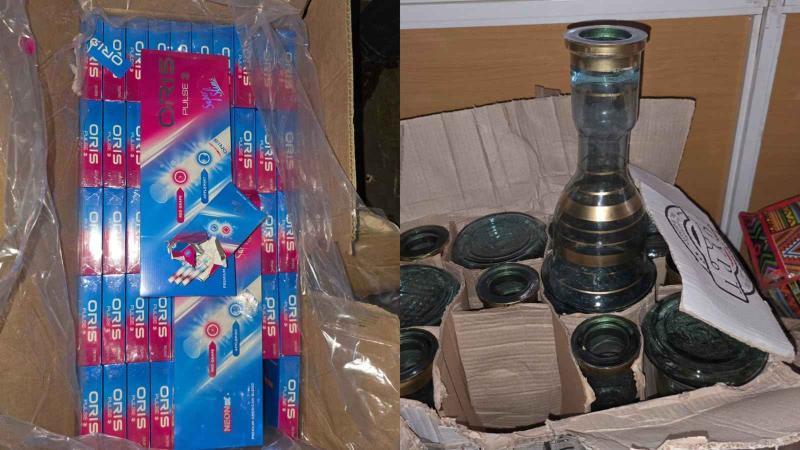
The Kenya Revenue Authority (KRA) has seized smuggled cigarettes, shisha tobacco and powdered milk valued at Ksh46.77 million in an enforcement operation.
The Kenya Revenue Authority (KRA) has seized smuggled cigarettes, shisha tobacco and powdered milk valued at Ksh46.77 million in an enforcement operation targeting illicit goods entering the country.
In a statement on Friday, September 18, the authority said the seizure has also prevented the loss of millions of shillings in government revenue, with taxes amounting to Ksh29.177 million at risk.
"Our enforcement officers have seized smuggled cigarettes, shisha tobacco and powdered milk worth Ksh46.77 million, with Ksh29.177 million in taxes at risk," the statement read.
KRA said its enforcement officers intercepted the goods after discovering that they had been concealed in compartments aboard a passenger bus operating along the Uganda-Kenya route.
The authority said the concealment was intended to facilitate the movement of the goods without detection by enforcement officers.
Read More
"The goods were hidden in concealed compartments aboard a passenger bus along the Uganda, Kenya route.
"We remain committed to protecting public health, legitimate businesses and government revenue," the statement added.

This comes days after seven suspects were arrested after detectives from the Directorate of Criminal Investigations (DCI) raided a godown in Canaan area near Infinity Industrial Park in Kasarani, uncovering an alleged counterfeit maize flour repackaging operation.
In a statement on Tuesday, September 15, the agency said the operation followed intelligence received by detectives concerning a racket suspected of flooding the Kenyan market with counterfeit maize flour products.
The DCI said the raid exposed a large-scale operation involving the repackaging and redistribution of maize flour using fake labels designed to deceive consumers.
"Acting on credible intelligence, detectives stormed the premises and unearthed a full-blown repackaging operation, walking away with thousands of counterfeit packets and seven suspects in tow," the statement read.
According to investigators, the godown had allegedly been converted into a covert facility where different maize flour brands were repackaged and redistributed using labels resembling those of genuine products.
"Investigations established that the godown had been transformed into a covert factory of fraud, where assorted maize flour brands were being illegally repackaged and redistributed under fake labelling, deceiving unsuspecting consumers into buying products that were not what they claimed to be," the statement added.
According to the DCI, those arrested include Felix Kiprop, an employee of SARA Flour Brand, and Cynthia Nakoli, a salesperson attached to the same brand.
Also arrested were loaders Joseph Kariuki and Victor Omondi Opiyo, driver Daniel Ngugi, as well as Maria Ngui and Samuel Kimilu, who were apprehended at the scene as detectives dismantled the operation.
During the raid, detectives recovered 3,682 packets of a popular corn maize flour brand valued at approximately Ksh312,120.
Hundreds of packets bearing three other well-known flour brands were also recovered, pushing the total value of the suspected counterfeit products into hundreds of thousands of shillings.
The DCI said the items recovered at the godown pointed to an organised operation equipped to produce and distribute counterfeit products on a large scale.
"The scene told the story of a well-oiled counterfeiting enterprise: stacks of empty packaging bearing the branding of several genuine maize flour companies, a Hyundai lorry, Registration No. KBR 092K, caught red-handed being loaded with the illicit products, and an array of industrial processing and packaging machinery, weighing equipment, bag-sealing tools, and date and batch marking stamps used to imprint false product information onto fake packaging, all pointing to a syndicate built to deceive on an industrial scale," the statement noted.




-1791630166-md.jpg)


-1791630166-sm.jpg)