
Editor's Review
The helicopter was conducting a low-level flight along a cliff face for sightseeing and photography when its landing-gear skid struck a protruding rock.
Kenya's Aircraft Accident Investigation Department (AAID) has released a preliminary report detailing the sequence of events behind the August 19 helicopter crash on Mount Ololokwe, Samburu County, that killed all seven people on board.
In its preliminary report released on Friday, September 18, AAID said the probe was still on, with the investigators yet to establish the probable cause of the crash.
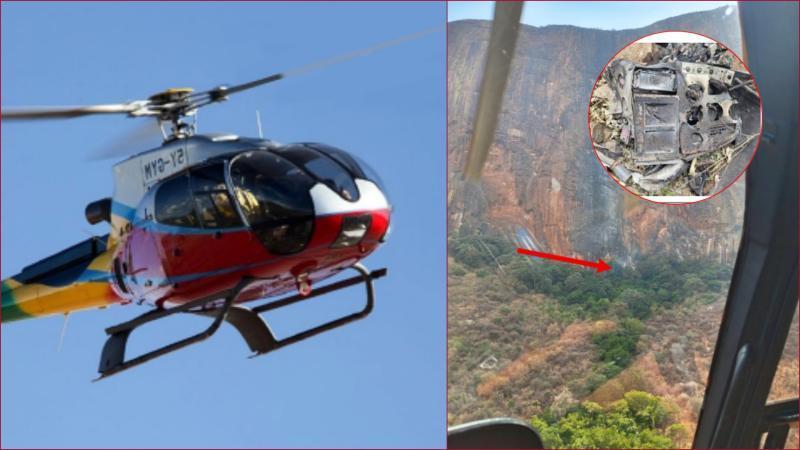
The Airbus EC130 B4 helicopter, registration 5Y-GYM and operated by Lady Lori (Kenya) Limited, struck a protruding rock formation near the summit of Mount Ololokwe while maneuvering at a low level during a scenic flight, according to the report.
The impact sheared off the landing-gear assembly, after which the fuselage slid down the mountainside and over a cliff, coming to rest roughly 1,196 feet from the point of impact.
Weather conditions at the time were recorded by the Kenya Meteorological Department as east-southeasterly winds at 120 degrees with surface speeds above 3.9 knots, visibility of 10 kilometres or greater, and a low-level cloud layer at approximately 2,400 feet above ground level.
Read More
The report noted that atmospheric data showed positive relative vorticity exceeding a threshold associated with a well-defined low-pressure system or active frontal boundary, though no METAR station data was available for the mountain itself.

Investigators documented two separate wreckage sites: one on the steep slope measuring roughly 25 by 50 metres, marking the initial point of impact, and a second at the base of the cliff measuring approximately 25 by 15 metres, where the main wreckage came to rest.
A landing gear skid, a door gas strut, and the helicopter's left cargo door were recovered at varying distances from the point of impact, with paint transfers on nearby rocks indicating the fuselage had struck the terrain while sliding down the slope.
"The remaining wreckage fell down the cliff and was destroyed by impact forces and the ensuing fire," the report states, adding that the main rotor blades remained attached to the mast despite being broken, while the tail rotor and boom were the only sections recovered largely intact.
All seven occupants, the pilot and six passengers, were confirmed dead, with their remains flown to Lee Funeral Home in Nairobi for post-mortem examination, DNA testing and toxicology screening in collaboration with the National Police Service.
The report noted that the injuries sustained "were consistent with the helicopter's deceleration forces and impact attitude," and concluded the crash was not survivable, as seatbelts and harnesses on board had been destroyed by the post-crash fire.
Rescue efforts were hampered by the terrain.
The crash site was inaccessible by road or air, forcing first responders and ground rescue teams to reach the wreckage on foot. Investigators also noted that the helicopter's emergency locator transmitter, last self-tested in May 2026, failed to activate on impact, despite its battery not being due to expire until February 2027.
The report additionally raised questions over the aircraft's onboard recording systems.
The helicopter, which was not required to carry flight recorders under Kenya Civil Aviation Authority regulations for its category, was fitted with a Thales Engine Electronic Control Unit and Vehicle and Engine Multifunction Display, both of which "sustained severe thermal damage from the post-crash fire, rendering their internal electronic memory unrecoverable."
A Spidertracks satellite tracking unit aboard the aircraft, however, had relayed a signal every 10 seconds during the flight, with its last transmission logged moments before the crash.
The AAID said the ongoing investigation would analyse all documented evidence "to establish the findings, conclusions, probable causes, or contributing factors, and to issue any necessary safety recommendations to prevent future accidents."



-1791630166-md.jpg)




-1791630166-sm.jpg)