Editor's Review
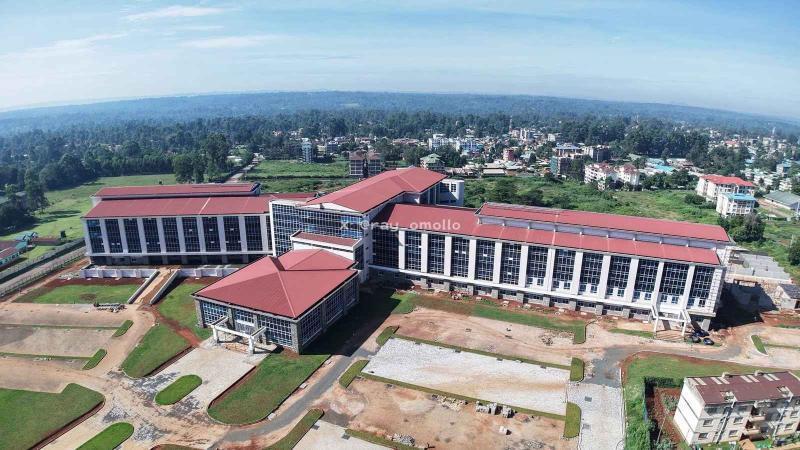
The near completion of the Kakamega County Teaching and Referral Hospital in Lurambi marks a significant step in efforts to expand access to specialised and quality healthcare.
The near completion of the Kakamega County Teaching and Referral Hospital in Lurambi marks a significant step in efforts to expand access to specialised and quality healthcare.
In an update on Tuesday, September 29, Interior Principal Secretary Raymond Omollo said the project is part of broader reforms supporting the country’s pursuit of Universal Health Coverage (UHC).
"Kenya's pursuit of Universal Health Coverage (UHC) is being supported by reforms that pair progressive health policies with the infrastructure needed to deliver quality and accessible care," he wrote.

The 350-bed Level 6 facility, whose construction stalled for more than four years, is scheduled for completion by December 2026.
Read More
The project regained momentum after the County Government handed it over to the National Government, with Kenya Defence Forces (KDF) engineers subsequently taking charge of the construction works.
"The project regained momentum after the County Government formally handed it over to the National Government, following the intervention and political goodwill of President William Samoei Ruto," Omollo added.

According to Omollo, the KDF engineers took over the works and helped revive the stalled development, paving the way for the facility to move towards completion.
The hospital has been designed as a regional centre of excellence, with capacity to provide a wide range of specialised medical services to patients from Kakamega and the wider western Kenya region.
"Designed as a regional centre of excellence, the hospital will offer specialised services, including oncology treatment, maternal and neonatal care, renal services, intensive care, advanced diagnostics and emergency response," he further said.

Omollo said the facility will feature radiotherapy bunkers and linear accelerators for cancer treatment, alongside theatres, a neonatal intensive care unit, haemodialysis services and blood banking facilities.
The hospital is also expected to contribute to the training of healthcare professionals by supporting medical education and practical training at Masinde Muliro University of Science and Technology and other institutions.
"The facility will also support medical training at Masinde Muliro University of Science and Technology and other institutions, while creating an estimated 5,000 jobs and stimulating the local economy," he noted.

Elsewhere, the Kakamega Airstrip in Shinyalu Constituency is moving closer to completion as Phase II of its rehabilitation and expansion advances.
In an update on Thursday, September 24, Omollo said the expansion was part of efforts to improve transport and connectivity infrastructure linking people, markets and opportunities across the country.
"To reimagine Kenya Beyond Vision 2030, we must also reimagine the transport and connectivity infrastructure that links people, markets and opportunities," he wrote.
According to Omollo, the Phase II project is being implemented under the Kenya Airports Authority (KAA) and is intended to position Kakamega Airstrip as a modern regional aviation hub.
The expansion will extend the existing 1.2-kilometre runway to 2 kilometres, allowing the facility to accommodate larger turboprop aircraft and regional commercial jets.
Omollo said construction had reached the stage where runway formation works and preparations for the asphalt wearing course were underway as the project approached the final surfacing stage.
"Construction is progressing, with the runway formation works and preparation for the asphalt wearing course underway, as the project moves towards final surfacing," he added.
Omollo said the second phase builds on works undertaken during Phase I, which included the rehabilitation of the runway, taxiways and apron.
The project also incorporates additional safety and operational features aimed at improving the airstrip's capacity.
"The phase also builds on the rehabilitation of the runway, taxiways and apron undertaken under Phase I, with enhanced safety features including Runway End Safety Areas, obstacle controls, airfield lighting, navigational markings and improved support facilities," he further said.

 (1)-1791178178-md.jpg)

 (1)-1791178178-sm.jpg)