Editor's Review
Defence Forces Memorial Hospital (DFMH) has recorded a major medical milestone after conducting its first-ever red blood cell exchange procedure.
Defence Forces Memorial Hospital (DFMH) has recorded a major medical milestone after conducting its first-ever red blood cell exchange procedure.
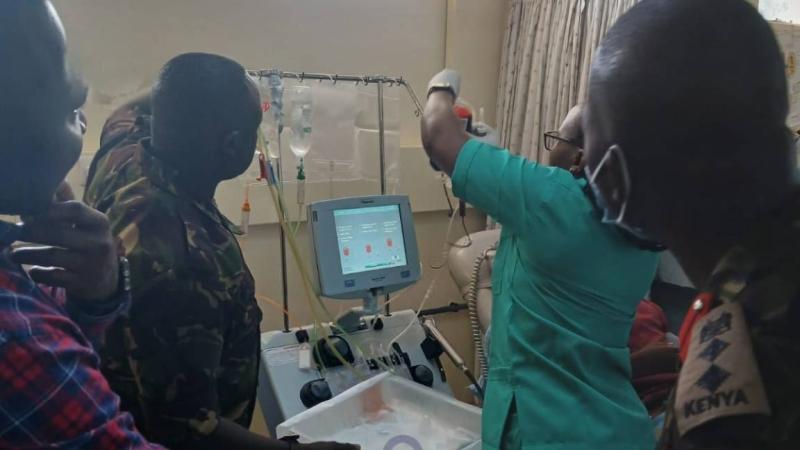
In a statement on Monday, October 5, the Kenya Defence Forces (KDF) said the procedure was performed at the hospital’s Renal Unit on Friday, October 2, using the newly acquired Spectra Optia® apheresis system.
According to the Force, the procedure involved a 15-year-old female patient living with sickle cell disease.
KDF said the successful procedure marked an important development in the hospital’s provision of specialised, technology-enabled medical care.
"Defence Forces Memorial Hospital (DFMH) has achieved a major medical milestone after successfully conducting its first red blood cell exchange using the newly acquired Spectra Optia® apheresis system," the statement read.
Read More
According to KDF, the red blood cell exchange was made possible through the hospital’s new apheresis capability, which allows clinicians to process blood selectively and carry out specialised therapeutic procedures.
Apheresis is an advanced blood-processing procedure that separates specific components of a patient’s blood while returning the remaining components to the body.
The technology can therefore be used to tailor treatment to particular medical conditions.
In a red blood cell exchange, abnormal or sickled red blood cells are removed from a patient’s circulation and replaced with compatible donor red blood cells.
The procedure reduces the proportion of sickled cells in the bloodstream and can form part of specialised management for patients with sickle cell disease.
KDF said the successful procedure would broaden DFMH’s ability to manage complex blood disorders and deliver specialised interventions to eligible patients.
"Its successful completion marks an important expansion of DFMH’s capacity to manage complex blood disorders through specialised and technology-enabled care," the statement added.
KDF said the acquisition of the Spectra Optia® system is also expected to support the hospital’s ability to undertake additional therapeutic apheresis procedures and strengthen advanced transfusion services.
"The introduction of the capability at DFMH represents more than the successful completion of a single procedure.
"It expands the hospital’s ability to provide specialised haematological interventions within the KDF healthcare system, enabling eligible patients who require red blood cell exchange to access the service at the facility," the statement explained.

KDF noted that the new equipment provides a foundation for the progressive introduction of other specialised procedures at the hospital.
"The acquisition of the Spectra Optia® system also provides a platform for the progressive development of other therapeutic apheresis procedures and advanced transfusion support," the statement further read.
Additionally, the Force said the development is expected to benefit KDF personnel, their families and other eligible beneficiaries who require specialised medical treatment.
"For KDF personnel, their families and other eligible beneficiaries, the new capability enhances access to advanced medical treatment while strengthening continuity of care within the military health system," the statement noted.
This comes months after Kenyatta National Hospital (KNH) achieved a major breakthrough after successfully carrying out the country’s first Minimally Invasive Esophagectomy (MIE).
In a statement on Wednesday, July 8, the hospital said the landmark operation was performed on June 30 on a 43-year-old patient who had been diagnosed with esophageal cancer.
According to KNH, before undergoing surgery, the patient received chemotherapy and radiotherapy as part of a treatment plan designed to shrink the tumour.
Following further medical evaluation by a multidisciplinary team, doctors determined that the patient was suitable for curative surgery using a minimally invasive technique aimed at completely removing the cancer.
Unlike traditional open surgery, which involves large incisions in the chest and abdomen, a Minimally Invasive Esophagectomy is performed through several small cuts using laparoscopic instruments and high-definition imaging.
During the operation, surgeons removed the diseased esophagus, reshaped the patient’s stomach into a tube, and repositioned it into the chest before connecting it to the throat to create a new food passage.
According to KNH, the minimally invasive approach offers several advantages over conventional surgery, including reduced blood loss, less pain after the operation, smaller scars, fewer respiratory complications and faster recovery.
The hospital said during the historic procedure, the patient experienced minimal blood loss and did not require a blood transfusion.
KNH noted that while recovery from conventional open esophagectomy can take around two weeks due to the large surgical incisions, patients who undergo the minimally invasive procedure generally recover much faster.
After spending six days in the Critical Care Unit (CCU), the patient was transferred to the general ward.