
Editor's Review
The National Assembly Committee on Cohesion and Equal Opportunities raised the concerns during a meeting with Prisons Service Commissioner General Patrick Aranduh.
The Kenya Prisons Service (KPS) has come under scrutiny over ethnic representation in its workforce, with the National Assembly Committee on Cohesion and Equal Opportunities calling on the agency to address disparities in recruitment and ensure fair employment opportunities for minority and disadvantaged groups.
The Committee raised the concerns during a meeting with Prisons Service Commissioner General Patrick Aranduh, urging the agency to use its nationwide network of correctional facilities to promote diversity in employment.
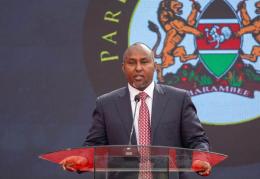
Committee Chairperson, Mandera West MP Adan Yusuf Haji, argued that the Service had a distinct advantage over other government institutions because it operates facilities across all counties, making it easier to recruit officers from different communities and comply with constitutional requirements.
"With prisons in all counties, I don't expect the Agency not to comply with the constitutional requirements of employment diversity," he said.
The committee's concerns emerged after Aranduh presented a report detailing the Service's workforce composition, which showed that one community accounted for a disproportionately high number of employees.
Read More
The report also exposed a shortfall in the recruitment of persons living with disabilities (PLWDs), with the Service yet to meet the statutory requirement that they constitute at least five per cent of its workforce.
According to the figures presented to the lawmakers, KPS had 33,427 officers, including 7,234 Kalenjins and 5,360 Kikuyus, prompting questions about the criteria used to recruit personnel from different ethnic communities.
Committee members challenged the Service to ensure that communities living in areas where prisons are located also benefit from employment opportunities, rather than allowing recruitment patterns to disadvantage certain groups.

Teso North MP Oku Kaunya questioned whether the recruitment process was being conducted fairly, arguing that the existing figures raised concerns about equal representation.
"Which criteria are you using to hire officers during recruitment that only favour one community at the expense of the others?" he posed.
Aranduh told the committee that the Service had already submitted its recruitment requests and was awaiting approval and confirmation of the recruitment dates.
"We have forwarded our requests for recruitment and we are waiting for approval and dates. We will use the exercise to ensure we correct ethnic imbalances in our employment," he said.
Despite the concerns over ethnic diversity and disability inclusion, Aranduh told the lawmakers that the Service had achieved gender balance in its workforce, providing figures showing the distribution of male and female officers.
"Out of the 33,427 staff establishment, we have 25,227 males, translating to 75 per cent, and 8,200 females, representing 24.5 per cent," he explained.
Elsewhere, Members of the National Assembly have thrown their weight behind a proposal seeking to expand employment opportunities for National Youth Service (NYS) graduates by placing them in government institutions and private security companies.
The Motion, sponsored by Kilifi County MP Gertrude Mbeyu, calls for a formal policy to guide the recruitment and deployment of NYS-trained youths as security officers in public institutions.
Approximately 18,000 youths graduate from the service annually, even as government agencies continue to contract private security firms to complement protection provided by uniformed officers.
Mbeyu argued that the skills acquired through NYS training could help address youth unemployment while strengthening security services across government institutions.
The graduates receive training in discipline, security awareness, public service ethics and emergency response, making them potential candidates for security-related jobs.
Under the proposed framework, the National Government would establish guidelines to facilitate youth employment in accordance with Article 55 of the Constitution.
The plan also seeks to give NYS graduates priority when ministries, departments and agencies recruit personnel to provide supplementary security services.
Additionally, the Motion proposes clear rules governing the division of responsibilities between NYS graduates and private security firms.
These would cover recruitment, deployment, remuneration, training and career advancement.