
Editor's Review
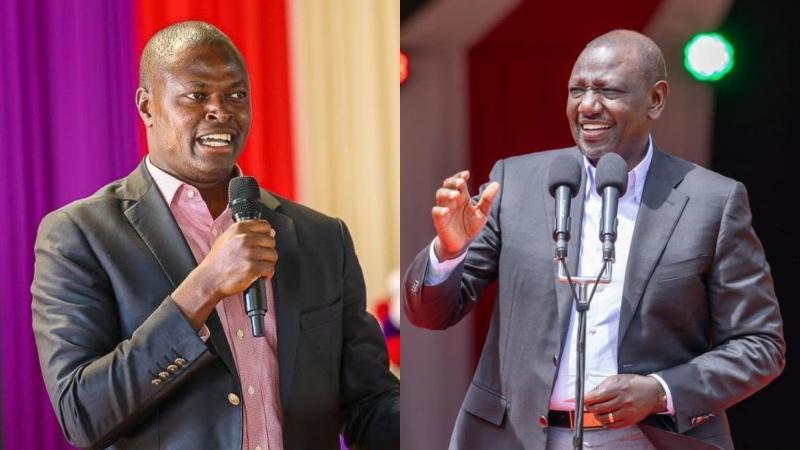
Kiharu MP Ndindi Nyoro has alleged that President William Ruto and Aliko Dangote are working together in a business arrangement aimed at taking control of the Kenya Pipeline Company (KPC).
Kiharu MP Ndindi Nyoro has alleged that President William Ruto and Nigerian billionaire Aliko Dangote are working together in a business arrangement aimed at taking control of the Kenya Pipeline Company (KPC).
In a statement on Thursday, October 22, the lawmaker outlined an alleged plan to acquire majority ownership of the petroleum infrastructure company.
Nyoro maintained that the relationship between the President and Dangote extended beyond public engagements, pointing to what he described as their shared business interests.
"By now and through earlier posts on this page, it must be clear that President William Ruto and Dangote are working together in business," he wrote.
Nyoro claimed that the process had already begun, alleging that Ruto had instructed chief executive officers of public institutions holding KPC shares to sell their stakes to a private investor.
Read More
He argued that the transactions had resulted in a company associated with Dangote East African Petroleum Refinery acquiring a significant shareholding from several institutions, including pension funds.
"That is how a company associated with Dangote East African Petroleum Refinery ended up buying 24.76% from NSSF, PSSF, PCF and others at a LOSS. Pensioners lost money for President William Ruto to make money," he added.
Nyoro alleged that the acquisition of the 24.76 per cent stake was only the first phase of a broader plan to secure majority ownership of KPC.
According to the MP, the ultimate target was to obtain at least 51 per cent of the company's shares, with the possibility of increasing the stake to approximately 75 per cent if the other parties involved did not exercise their rights to maintain their shareholding.
Nyoro further claimed that public institutions, including the National Social Security Fund (NSSF), could face pressure to sell their remaining stakes to the same private investor.
He identified a proposed rights issue as another avenue through which the alleged takeover could be advanced, arguing that the process would allow the investor to increase its shareholding if existing shareholders declined to participate.
"The assurance Dangote has been given is that President Ruto will instruct Kenya Pipeline to open a share sale of KPC shares through a Rights issue. All this was part of the Conditions Precedent. They are also exploring Private Placement but would raise Market related questions and judicial actions," he further said.

Nyoro alleged that the government could decline to take up its allocation in the proposed rights issue, citing a lack of funds, thereby creating an opportunity for the investor to acquire additional shares.
He claimed that the government's allocation of 35 per cent in the rights issue could subsequently be taken up by Dangote's business interests, while also alleging that the President had personal interests in the arrangement.
Nyoro further claimed that NSSF could also decline to exercise its rights if it had not already disposed of its remaining shares.
He alleged that efforts could be made to persuade Ugandan President Yoweri Museveni and the Ugandan government not to participate in the rights issue.
The MP outlined two possible outcomes depending on Uganda's decision, arguing that the investor's final shareholding would depend on whether the Ugandan government exercised its rights.
"If President Museveni refuses to play ball, the Dangote/William Ruto consortium will end up with between 51% to 58% of Kenya Pipeline. If he does, their target is approximately 75% of KPC," he claimed.
Nyoro warned that the proposed arrangement could significantly reduce government ownership of the pipeline company if the state and other existing shareholders failed to participate fully in the rights issue.
He claimed that the government's stake could be diluted to slightly below 20 per cent, while NSSF's shareholding could also decline if the fund retained its shares but failed to take up its allocation.
The MP added that Uganda could protect its investment by exercising at least part of its rights, potentially preventing further dilution of its stake in the company.
Nyoro said the alleged plans were expected to begin in earnest, calling for greater transparency regarding the ownership of the company associated with Dangote's refinery project and the terms of the investment agreement.
He argued that the public should be allowed to examine the shareholding structure of Dangote East African Petroleum Refinery and the agreement governing its investment in Kenya's petroleum infrastructure sector.
The MP also questioned the government's handling of the negotiations, alleging that the interests of public officials involved in the process could conflict with their responsibility to protect the interests of Kenyans.
"The problem here is that the same team that should be looking at the welfare of Kenyans as elected leaders of Government are also on the other side of the table as Shareholders.
"That’s why the government is adamantly refusing to share it with Kenyans. It is just crap at best and no Kenyan would stand the terms," he concluded.
Meanwhile, Lamu Port has received its second major shipment of heavy construction machinery destined for the Dangote East Africa Refinery project.
In a statement on Wednesday, October 21, the Kenya Ports Authority (KPA) said the latest delivery highlighted the growing role of Lamu Port in supporting major energy and transport infrastructure projects across East Africa.
"Following the Dangote East Africa Refinery project’s groundbreaking last month, the port of Lamu successfully completed the offloading of its second major shipment of heavy construction machinery, signalling accelerated momentum for East Africa's expanding energy and transport ecosystem," the statement read.
According to KPA, the shipment was transported aboard the vessel MV Great Prosperity, which completed the discharge of more than 8,000 metric tons of machinery and equipment.
Caleb Nthusi, an Operations Executive at Inchcape Shipping and the vessel’s local agent, confirmed that the delivery marked the initial phase of a broader logistics pipeline expected to support construction activities at the refinery.
According to Nthusi, more shipments carrying heavy construction equipment were expected to arrive through Lamu Port in the coming months to sustain the ongoing works.
"According to Nthusi, additional fleets carrying heavy equipment are scheduled to arrive through the Port of Lamu over the coming months to sustain ongoing construction," KPA further said.

 (1)-1792651348-md.jpg)


-1792658467-sm.jpg)

 (1)-1792651348-sm.jpg)