Editor's Review
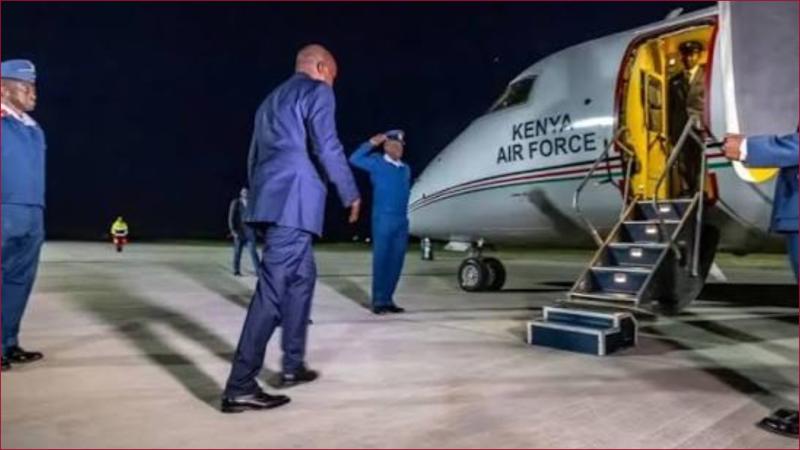
Kindiki departed Nairobi Saturday morning aboard a Kenya Air Force plane.
Deputy President Kithure Kindiki departed Nairobi Saturday morning, October 24, for Addis Ababa.
He landed at Bahir Dar Dejazmach Belay Zeleke International Airport aboard a Kenya Air Force Fokker 70 and was received by Prime Minister Abiy Ahmed.
Kindiki is in Kenya's northern neighbour to attend the 12th Tana High-Level Forum on Security in Africa.
After receiving him, Abiy said he held a brief bilateral meeting on matters of mutual interest before the annual forum began.
“I was pleased to receive Kenya’s Deputy President, Kithure Kindiki, ahead of the 12th Tana High-Level Forum on Security in Africa, where we held a brief bilateral meeting on matters of mutual interest,” Abiy said.
Read More
The prime minister did not give details of what the two leaders discussed.
Kenya and Ethiopia are neighbours and partners in the Horn of Africa, and security and regional cooperation are regular topics in their talks.
The forum runs from October 23 to 25 in Bahir Dar, Ethiopia, and is organised by the Tana Forum Secretariat and the Institute for Peace and Security Studies (IPSS) at Addis Ababa University.

This year’s theme is “Pathways to Peace in Africa: Economic Sovereignty and Geopolitical Transformation”.
Ghana’s President John Mahama is among the leaders at the meeting.
He is the chairperson of the Tana Forum Board.
The board’s other members include former Kenyan president Uhuru Kenyatta, former Nigerian president Goodluck Jonathan, Malawi’s former president Joyce Banda, and the Central African Republic’s former president Catherine Samba-Panza.
The Tana High-Level Forum on Security in Africa is an annual meeting that brings together African leaders and stakeholders to explore African-led security solutions.
It complements formal meetings of African heads of state and government by assembling them in an informal, collaborative setting.
The forum was established in 2012 in response to the African Union’s 2009 Tripoli Declaration, which called for African-led approaches to peace and security.
Its organisers say it is modelled on gatherings under the baobab tree. It offers room for panel discussions, interaction with the floor and bilateral talks, so participants can share views and experiences in an open and result-oriented manner.
It also combines academia and research with real-world, real-time experience, which its organisers say produces action-oriented and policy-relevant discussion. It promotes African-led solutions by encouraging strategic and proactive management of continental peace and security issues.
This year’s discussions will examine how economic sovereignty and geopolitical transformation can support sustainable peace, how Africa can turn its natural wealth and digital advantage into inclusive industrial wealth, and how to counter illicit economies that undermine governance and peace.
Side events on the margins of the forum cover trade for peace, international humanitarian law, climate change and security, and illicit money flows in the Sudan and South Sudan conflicts.