
Editor's Review
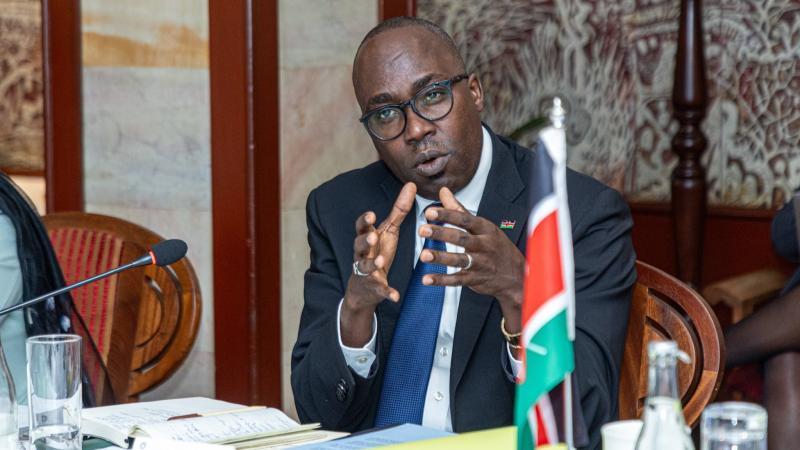
Foreign Affairs Principal Secretary Korir Sing’Oei has weighed in on a Saudi Arabian court's decision to sentence a Kenyan woman to 100 lashes for giving birth outside marriage.
Foreign Affairs Principal Secretary Korir Sing’Oei has weighed in on a Saudi Arabian court's decision to sentence a Kenyan woman to 100 lashes for giving birth outside marriage.
In a statement on Wednesday, November 11, PS Sing’Oei expressed sadness over the sentence, saying the punishment would constitute inhuman treatment under Kenyan law.
Join our WhatsApp Channel for the latest news updates.
However, the Foreign Affairs PS acknowledged Saudi Arabia's sovereignty and judicial system.
PS Sing’Oei said Kenya would continue engaging with Saudi officials on matters relating to judicial enforcement.
Read More

“Saddened by what would constitute ‘cruel and inhuman’ punishment under our jurisdiction, but respectful of the sovereignty of Saudi legal system.
“We shall continue to work with our counterparts on these complex arenas of judicial enforcement,” PS Sing'Oei wrote.
The Kenyan woman identified as Esther Wanja Muthoni was sentenced to 100 lashes after a Saudi court found her guilty of siring outside wedlock.
The 40-year-old, who was working as a domestic worker, was handed the sentence in October.
Muthoni became pregnant following a relationship with an Egyptian national who later left Saudi Arabia.
She gave birth to her son, Abudy, in August 2025 while working as a domestic worker.
Muthoni and her son were taken to the hospital after a supervisor discovered the newborn.
The Kenyan woman was subsequently detained by the police for questioning over the pregnancy.
She was later prosecuted and convicted by a Saudi court, which imposed the 100-lash punishment as prescribed under Islamic Sharia Law.
This comes weeks after a report by the United States Department of State revealed that more than 500,000 Kenyans are currently working in the Middle East, where the majority are domestic workers.
The report noted that most of the Kenyans got the jobs on a visa sponsorship system, which is common in Bahrain, Jordan, Kuwait, Lebanon, Saudi Arabia, and the UAE.
The findings also established that returning Kenyan migrant workers, people experiencing homelessness, and people with mental health conditions are vulnerable to trafficking due to a lack of available assistance.
According to the report, corruption and complicity in trafficking crimes remained significant concerns inhibiting law enforcement action.
The report further disclosed that at least 274 Kenyan workers died in Saudi Arabia in the last five years.
"In 2025, media reported at least 274 Kenyan migrant workers, mostly women, died in Saudi Arabia in the past five years; at least 55 Kenyan workers died in 2024, twice as many as the previous year," the statement read.



-1786429775-md.jpg)



-1786429775-sm.jpg)