
Editor's Review
A 1,200-acre EPZ nearing completion in Murang’a County is set to transform the region’s industrial economy through manufacturing, agro-processing, investment and job creation.
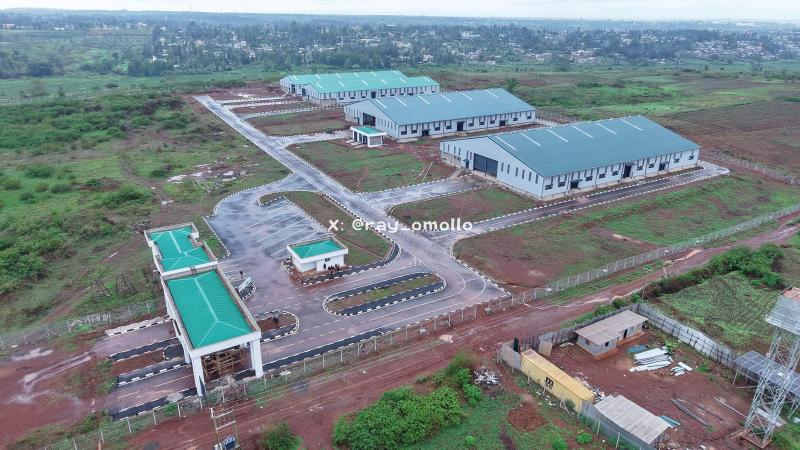
A 1,200-acre Export Processing Zone (EPZ) nearing completion in Murang’a County is set to transform the region’s industrial economy through manufacturing, agro-processing, investment and job creation.
In a statement on Wednesday, November 18, Interior Principal Secretary Raymond Omollo said the government’s Export Processing Zones programme was expanding economic opportunities across the country by leveraging resources available in different regions.
Join our WhatsApp Channel for the latest news updates.
"Kenya's Export Processing Zones programme is opening new economic frontiers, enabling every region to harness its unique natural resources, build sustainable economic lifelines and participate in export-led growth," he wrote.

Read More
Omollo said the initiative was also intended to ensure that economic growth extended beyond major urban centres by creating employment opportunities and attracting investments across the country.
"Beyond creating jobs and attracting investment, this approach gives every part of the country an opportunity to prosper from its own strengths, bringing the spirit of 'Mbele Pamoja' to life," he added.

The Kabati EPZ covers 1,200 acres, with 500 acres designated for manufacturing, warehousing and export infrastructure, while the remaining 700 acres will accommodate supporting amenities.
"The development allocates 500 acres to manufacturing, warehousing and export infrastructure, with another 700 acres reserved for supporting amenities, including housing, healthcare, hospitality and education," he further said.

Strategically located approximately two kilometres off the Nairobi-Nyeri Highway and about 85 kilometres from Nairobi, the zone is expected to benefit from established transport networks and proximity to Jomo Kenyatta International Airport (JKIA).
The location also provides access to a ready workforce, making it an attractive destination for manufacturers and investors seeking to establish industrial operations in the region.
Four modern manufacturing warehouses have already been completed, paving the way for businesses to begin setting up operations as the development progresses towards full completion.
Planned investments at the facility include solar panel assembly, textile and garment manufacturing, industrial laundry and agro-processing facilities.

The agro-processing component is expected to focus on agricultural products such as tea, coffee, macadamia, avocados, fruits and vegetables, creating opportunities to add value to locally produced commodities before they enter domestic and international markets.
The project is also expected to strengthen the connection between agriculture and manufacturing by providing infrastructure for processing and exporting products sourced from the region.
"Once fully operational, the zone is expected to generate between 15,000 and 20,000 direct jobs, positioning Murang'a as a major industrial and export gateway," Omollo concluded.

Meanwhile, the Rodi Kopany Economic Stimulus Programme (ESP) Market in Homa Bay County is nearing commissioning, with final landscaping underway ahead of its official opening.
In a statement on Tuesday, November 17, Interior Principal Secretary Raymond Omollo highlighted the strategic importance of the market, noting that its location connects traders and customers from several neighbouring towns.
"Rodi Kopany's position as a busy junction town brings together traders and customers from Homa Bay, Oyugis, Ndhiwa and Rongo, making it an important centre of commercial activity," he wrote.
Omollo said the construction of the market had reached completion, with the remaining work focused on preparing the facility for commissioning.
"The completed Rodi Kopany Economic Stimulus Programme (ESP) Market, now undergoing final landscaping ahead of commissioning, is set to give this activity a modern, well-organised space," he added.
According to Omollo, the facility is expected to accommodate hundreds of small-scale traders, providing an alternative to informal open-air stalls while offering better working conditions.
"The facility will provide hundreds of small-scale traders with a secure, all-weather trading environment, replacing the limitations of informal open-air stalls with better conditions for business," he further said.
According to Omollo, among the key facilities are fish-processing kilns and cold storage infrastructure intended to support traders dealing in fish from Lake Victoria by improving preservation and handling.
He explained that the market would also have water and sanitation infrastructure to support its daily operations.
"Fish-processing kilns and cold storage facilities will support the preservation and handling of fish from Lake Victoria, helping traders reduce post-harvest losses and improve the value of their products.
"A 96,000-litre water storage tank, internal plumbing, a septic system and modern ablution blocks will provide essential services for a cleaner and more functional marketplace," he noted.



-1794991993-md.jpg)




-1794991993-sm.jpg)