-1789385357-xl.jpeg)
Editor's Review
The project has an officially published contract value of ¥37.76 million, translating to approximately Ksh728 million to Ksh771 million.
A Ksh700 million-plus mobile television studio in China is combining 4K broadcasting, artificial intelligence, advanced replay systems and network-based production technology to deliver live coverage of major sporting events.
The high-tech Outside Broadcast (OB) truck belongs to Ningbo Broadcasting & Television Group, a major state-owned media company based in Ningbo, Zhejiang Province.
The semi-trailer is designed to operate as a mobile production studio, particularly for football and basketball matches as well as other major live events.
The project has an officially published contract value of ¥37.76 million, translating to approximately Ksh728 million to Ksh771 million.
Read More

The truck was publicly showcased at the Beijing International Radio, TV & Film Exhibition (BIRTV) in Beijing on August 19, 2026, through a collaboration between Sony China and Ningbo Broadcasting & Television Group.
At the centre of the system is a 4K ultra-high-definition IP production platform that allows video, audio and control signals to be managed through a network-based production system.
This gives the production team greater flexibility in routing signals and integrating the truck with other broadcast facilities.
The truck also uses a dual Software-Defined Networking (SDN) architecture, comprising a main production network and a mobile electronic field production network.
The arrangement allows signals to be managed between the main OB truck and mobile production units.

One of the features that sets the system apart is its use of artificial intelligence in sports production.
AI-enabled cameras can identify and follow players during matches, including tracking their faces as they move around the playing area.
The technology is designed to help maintain a player's image within the camera frame without requiring an operator to manually follow every movement.
The camera configuration gives the truck 17 production channels, including 12 Sony HDC-3500 main cameras, two Sony HDC-5500 cameras, one Sony HDC-F5500V specialty camera and two Sony BRC-AM7 robotic cameras.
The different cameras provide production teams with multiple angles and specialised shots that can be combined into the final live broadcast.

Inside the truck, dedicated workstations handle different stages of production.
At the vision control and camera-control station, operators work with Sony TRIMASTER EL OLED reference monitors and LCD preview displays.
Multiple Sony RCP-1500 and RCP-3500 Remote Control Panels allow engineers to make real-time adjustments to camera settings, including exposure, white balance, black level, and flare.
A computer workstation is also used for functions such as router control and tally management, giving technical staff an overview of the signals moving through the production system.

Another section is dedicated to replays and slow-motion production, a crucial part of modern sports broadcasting.
The system features three EVS XTVIA servers and EVS LSM Live Slow Motion controllers, allowing operators to capture key moments from a match and immediately replay them at different speeds.
The replay section can be used to produce slow-motion footage, highlight packages and instant replays while a football or basketball match is still underway.
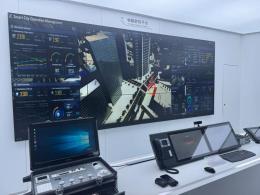
Large Sony multi-viewer displays provide operators with simultaneous views of multiple feeds, timecodes and clipping information.
The screens can show live sporting action alongside other production and test signals.

At the heart of the operation is the main production gallery, where the various camera feeds are selected, mixed and assembled into the programme that viewers eventually see.
The truck uses a Sony MLS-X1S vision switcher with multiple mix/effect capabilities.
Its control surface contains numerous cross-point buttons, transition controls and production functions used by vision mixers during live broadcasts.
The switcher is positioned opposite a large monitor wall displaying multiple sources at the same time.
The screens can carry feeds from different cameras, programme and preview channels, replay systems and test signals.

The production environment also contains extensive technical racks housing signal-processing equipment, frame synchronisers, patch bays and audio-video routing systems.
Audio production is supported by a Lawo MC2 96 console and Tascam Sonicview 16, while a Riedel Artist-1024 intercom system provides communication between members of the production team.
The truck's interior has been designed to support long periods of live production.
Acoustic perforated panels help control sound inside the working areas, while integrated lighting provides illumination without interfering with the monitor displays.
Recessed lighting beneath workstations and monitor walls, organised cable management and carefully positioned equipment also help create an environment in which operators can monitor multiple feeds while working on a live broadcast.
Beyond television transmission, the system is designed to support the growing connection between traditional broadcasting and digital media.
Its IP architecture allows the production operation to connect with other facilities and distribution systems, while its design supports the delivery of content to television, online platforms, and other digital channels.

Ningbo Broadcasting & Television Group
Ningbo Broadcasting & Television Group was established on March 28, 2003, and is directly affiliated with the Ningbo municipal government.
The group operates as a comprehensive media organisation combining broadcasting, television, digital media, technology, and cultural businesses.
Ningbo Broadcasting & Television Group operates both traditional and digital media.

Its principal platforms include Ningbo Television, Ningbo People's Radio, the Ningju client, and other internet and new-media platforms. The television operation currently carries four main channels, while its radio operation includes several FM frequencies.
The group has also established companies and units involved in film and television production, advertising, mobile digital television, media technology, wireless-city services, cultural development and tourism and convention activities.
Its official organisational information lists 10 subordinate units.
Ningbo Broadcasting & Television Group is not simply a local television station. It functions as a broader media and technology organisation covering different parts of the production and distribution chain.
According to the group, its responsibilities include producing and broadcasting news, entertainment, cultural and public-service programmes, operating transmission networks, developing broadcasting technology, managing media assets and providing emergency information to the public during disasters and other emergencies.
Its organisational structure includes separate broadcast media and television media divisions, alongside departments dealing with technology, production, media-asset management, film and television development and cultural industries.
The group has been involved in broadcasting major sporting events in Ningbo.
It has reported handling 58 games across 27 events, with the resulting content generating more than 1.1 billion online views and communications across different platforms.
The group has 30 internal departments and 10 subordinate institutions and companies.

It is a public institution directly under the Ningbo municipal government, with an organisational level equivalent to a bureau-level institution. Its officially disclosed registered capital is 219.884 million yuan.
The group's headquarters moved to 5 Fengzhu Road in Ningbo High-Tech Zone, with the relocation taking place in 2024.
-1789385357-md.jpeg)