Editor's Review
Kenya is among the East African countries set to benefit from a new KSh150 million (€1 million) funding boost from Germany.
Kenya is among the East African countries set to benefit from a new KSh150 million (€1 million) funding boost from Germany aimed at strengthening the region’s response to the ongoing Ebola threat.
The funding commitment was announced on Thursday, June 4, following the 8th Extraordinary Meeting of the East African Community (EAC) Sectoral Council of Ministers of Health, which was held virtually from June 1 to June 2.
According to EAC, the meeting brought together health ministers from EAC partner states to review ongoing Ebola response measures and regional health security initiatives.
"The meeting considered resource mobilization efforts to support the Ebola response. Ministers welcomed a commitment by Germany’s Development Bank (KfW) to reallocate EUR 1 million to support the deployment of mobile laboratories, procurement of diagnostic supplies and training of laboratory personnel," the statement read.
The ministers noted that efforts are underway to secure additional financial support to bolster the region’s preparedness and response capacity against disease outbreaks.
Read More
"They also noted ongoing efforts by the EAC Secretariat and German development cooperation agency, GIZ, to mobilize additional funding in support of the Ebola response and to further strengthen pandemic preparedness in the region," the statement added.
According to EAC, the funding will also support the deployment and operation of mobile laboratories that have already been provided to EAC member states under a regional laboratory strengthening initiative.
"The EAC mobile laboratories were provided to Partner States under the EAC Regional Network of Reference Laboratories Project supported with funds from the Government of Germany, through the German Development Bank KFW and with technical supports from Bernhard Nochted Institute for Tropical Medicine (BNITM), Germany’s largest institution for research, teaching, consulting and care in the field of tropical diseases and emerging infectious diseases," the statement further read.

The meeting further reviewed progress under the EAC Pandemic Preparedness Project, which seeks to enhance regional capacity to respond to public health emergencies through a coordinated One Health approach that integrates human, animal and environmental health expertise.
"The Ministers welcomed the progress made under the EAC Pandemic Preparedness Project (PanPrep), supported by the Governments of Germany and the European Union, which has established a regional pool of more than 180 multidisciplinary experts operating under a One Health approach," the statement noted.
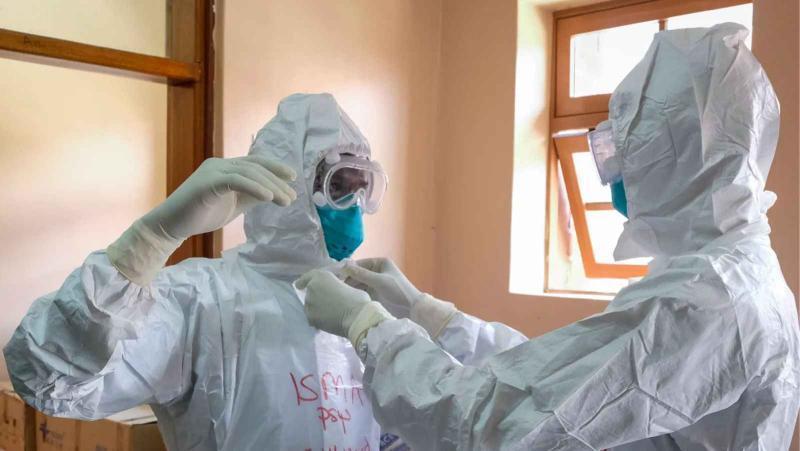
Meanwhile, Health Cabinet Secretary Aden Duale has confirmed that the World Health Organisation has issued Kenya with 1,000 Ebola Personal Protective Equipment (PPE)kits.
Speaking at the National Assembly on Wednesday, June 3, he stated that the kits were already in the country and were part of the Ebola preparedness procedure.
Duale added that the kits were distributed across the established Ebola isolation and treatment facilities.
"In infection prevention and control, the WHO has provided 1,000 Ebola PPE Kits, which are available in the country and being pre-positioned to support preparedness activities," the CS stated.
Duale confirmed that the Ministry of Health had established 23 other isolation and treatment facilities across the country, other than the one at the Laikipia Air Base.
He disclosed that the Kenyatta National Hospital (KNH) and the National Police Service Hospital would be used to handle affected patients at the national level.
"At the National Level, the Kenyatta National Hospital has prepared an 8-bed isolation and treatment unit and completed a dry run of how the index case would be handled. The facility has a separate waste management system to support the safe handling of infectious waste."
"The NPS Hospital has been assessed, and has 49 beds ready for activation as part of the surge isolation capacity," he added.
Duale confirmed that 29 counties had identified designated isolation and treatment sites, which will be used once they are approved to have certified set requirements.
He added that the government did not just set up the isolation centres for American citizens and confirmed that the facilities would also be used for the treatment of Kenyans.