Editor's Review
The government has outlined progress on a range of infrastructure, health, agriculture and education projects across the Nyanza region.
The government has outlined progress on a range of infrastructure, health, agriculture and education projects across the Nyanza region.
The update details ongoing and completed projects in Kisumu, Siaya, Homa Bay and Migori counties, with a focus on roads, water supply, healthcare, agriculture and technical education.
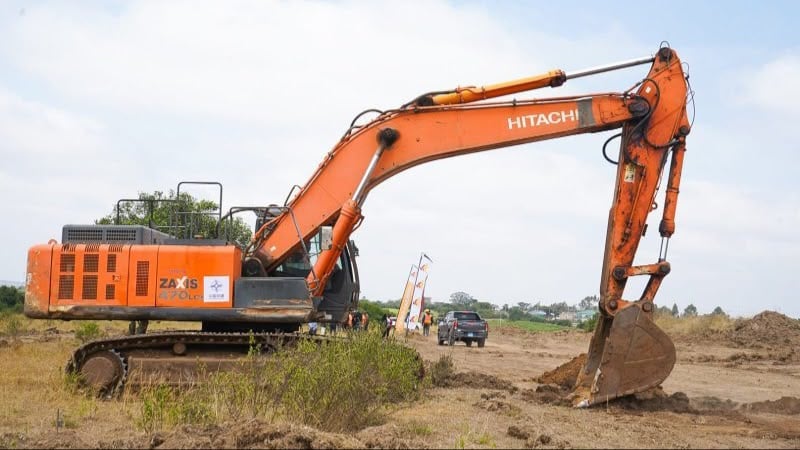
Among the flagship infrastructure initiatives are bitumen road upgrades on the Ruga-Lala (D1335), Holo-Lela, Karabok-Adiedo and Rusinga Island Ring Roads.
The government has also commissioned the Sondu Maji Safi Water Project in Nyakach and is pursuing the Naivasha-Kisumu-Malaba Standard Gauge Railway (SGR) extension.
According to the report, these projects are expected to improve market access for farmers and traders, provide reliable clean water to households in Nyakach, and strengthen tourism and fisheries activities around Rusinga Island.
Read More
The report indicates that Homa Bay County has 298 kilometres of roads valued at Ksh17 billion, with an additional 78 kilometres planned at a cost of Ksh5.6 billion.
The 18-kilometre Karabok-Adiedo Road is valued at Ksh925 million, while Kisumu road upgrades are estimated at Ksh5 billion.
A separate development package for Migori County is valued at Ksh695 million.
The Holo-Lela Road project was flagged off on March 21, 2026 and is currently under construction, while the Rusinga Island Ring Roads were commissioned a day later.
The Sondu Maji Safi Water Project has also been commissioned.
In the health sector, the government highlighted improvements at the Jaramogi Oginga Odinga Teaching and Referral Hospital (JOOTRH), expansion of Social Health Authority (SHA) access for informal workers, fishers and rural families, deployment of Community Health Promoters (CHPs), and health-service support through Migori’s Ksh695 million development package.
The report notes that specialist healthcare services that previously required referrals to Nairobi are increasingly becoming available within the region.
Patients requiring open-heart surgery can now access treatment in Kisumu, while sickle-cell patients can receive apheresis treatment at a public hospital.
JOOTRH has acquired several specialised medical devices, including the Essence Perfusion heart-lung machine, the Spectra Optia Apheresis Machine and endoscopy and laparoscopy equipment.
By July 2026, the hospital had installed the heart-lung machine for open-heart surgery.
The Spectra Optia Apheresis Machine was commissioned in January 2026, while additional endoscopy equipment has also been acquired.

The government also highlighted reforms in the agriculture sector, particularly the leasing of Nzoia, Chemelil, Sony and Muhoroni sugar factories to private operators under 30-year Public-Private Partnership agreements.
The initiative is intended to revive milling operations and ensure timely payments to farmers.
Other agricultural interventions include the distribution of subsidised fertiliser across Kisumu, Siaya, Homa Bay and Migori counties, expansion of the Ahero and West Kano irrigation schemes, and support for the modernisation of Siaya County’s Madiany Cotton Ginnery.
According to the report, the sugar sector reforms are expected to provide cane farmers with prompt and reliable payments after years of factory debt and stalled harvests.
Fertiliser subsidies are intended to lower production costs, while irrigation expansion aims to reduce dependence on rainfall for rice and mixed-crop farming.
Cotton farmers are also expected to benefit from improved processing capacity at the Madiany Ginnery.
The government says it wrote off more than Ksh117 billion in historical sugar-sector debt and injected an additional Ksh2.5 billion to clear arrears owed to farmers and workers, benefiting more than 60,000 sugarcane farmers.
The report further states that approximately Ksh17 million has already been invested in the Madiany Ginnery modernisation project, with another Ksh30 million earmarked for the initiative.
The four sugar factories were leased in May 2025 and had resumed crushing cane by January 2026.
Elsewhere, in education, the government cited the elevation of the Siaya Institute of Technology to Siaya National Polytechnic, the commissioning of the Seme Teachers Training College, recruitment of teachers, upgrades at technical institutions including the Ramogi Institute of Advanced Technology, and the establishment of Higher Education Fund (HEF) application desks at Huduma Centres.
The initiatives are aimed at increasing access to market-relevant training opportunities in engineering, agriculture, business and technology within the region.
The report says additional teachers are helping improve learner-to-teacher ratios, while HEF desks are making higher education financing more accessible to families without reliable internet access.
Training programmes at the newly elevated Siaya National Polytechnic have expanded across four key areas.
The report further states that approximately 75 per cent of former students at the institution report earning regular income from careers related to their studies.