
Editor's Review
Nairobi County has stepped up preparations for the expected El Niño rains after identifying 227 flood hotspots across 17 sub-counties.
Nairobi County has stepped up preparations for the expected El Niño rains after identifying 227 flood hotspots across 17 sub-counties.
According to a statement on Monday, August 17, the preparedness plan brings together several government agencies as the county begins implementing Ksh2.4 billion in drainage and flood-mitigation projects.
The coordination framework brings together the Kenya Red Cross, Kenya Urban Roads Authority (KURA), Kenya National Highways Authority (KeNHA), National Disaster Management Authority, Nairobi County Disaster Management Team, Environment Department, Nairobi Rivers Commission and other agencies.
Governor Johnson Sakaja said the involvement of multiple agencies would enable the county to prepare in advance, coordinate operations and respond more effectively to emergencies.
"This calls for us to prepare together, act early and protect lives and property," he said.
Read More
The county has set aside Ksh2 billion of the Ksh2.4 billion allocation for drainage and flood-control works covering 19 roads identified as vulnerable to flooding.
The projects are at an advanced stage, with tenders awarded and contractors expected to begin work once the remaining administrative processes are completed.
The drainage programme is intended to complement existing efforts under the Nairobi Regeneration Programme while addressing recurring flooding along roads and other essential infrastructure.
Sakaja said the investment is intended to provide a lasting solution to Nairobi’s persistent flooding problem by improving the city’s drainage system.
"The Ksh2 billion will support a comprehensive drainage overhaul that complements the ongoing Nairobi Regeneration Programme. Our goal is to permanently address the flooding challenges that have affected the city for many years," he added.
The 227 hotspots identified by the multi-agency teams will serve as key areas for preparedness measures, deployment of equipment and resources, as well as emergency interventions.
The assessment covers locations with blocked or undersized drainage systems, areas requiring desilting and waste removal, and river corridors and waterways vulnerable to obstruction.
The teams have also flagged roads and major transport routes prone to flooding, together with locations where heavy rains could restrict emergency access.
Communities considered vulnerable to the effects of flooding will receive particular attention, including areas that may require early warnings, evacuation, temporary shelter and relief assistance during emergencies.

To streamline the response, the county has divided the multi-agency operation into five sub-committees responsible for Infrastructure and Drainage; Emergency Response and Evacuation; Shelter and Relief; Security and Traffic; and Communication.
The Infrastructure and Drainage committee will oversee the clearing and improvement of drainage networks, rivers and other essential infrastructure. The Emergency Response and Evacuation committee will coordinate rescue operations, rapid response and evacuation whenever flooding emergencies arise.
The Shelter and Relief committee will prepare safe accommodation facilities and coordinate the provision of food, water, medical care and other essential assistance to affected residents.
Meanwhile, the Security and Traffic committee will manage security, traffic and access for emergency teams, while the Communication committee will coordinate early warnings, public alerts and timely updates to residents.
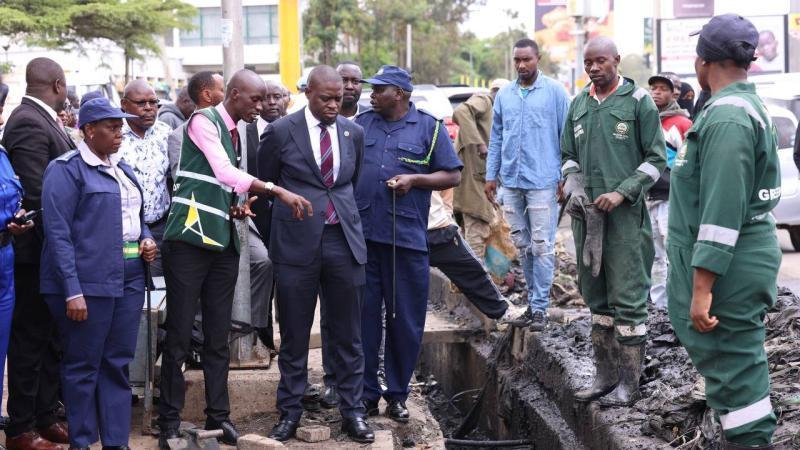
The county is also deploying personnel, machinery and other resources to clear blocked drainage channels, remove accumulated silt and waste, and improve emergency response capacity in the areas identified as most vulnerable.
Meanwhile, the government has outlined the progress of ongoing Nairobi River Basin regeneration works, with multiple projects being implemented along different sections of the river corridor.
In an update on Tuesday, August 18, Interior Principal Secretary Raymond Omollo said the works include drainage and sewerage interventions, river rehabilitation, solid waste removal, wastewater treatment expansion and development of public amenities.
The PS said the programme is part of a broader vision to transform Nairobi into a modern, liveable city while protecting the environment and restoring the river system.
"The transformation of Nairobi into a smart, modern and liveable city is deeply intertwined with environmental conservation.
"This vision is being realized through the Nairobi River Basin Regeneration Programme, which is restoring the river system into a cleaner, safer and greener public asset while renewing the urban spaces and communities along its banks," he wrote.
At Globe Roundabout, major drainage works and river-sewage separation are underway, alongside preparations for the development of a future public recreation space.
In Baba Dogo, a pedestrian bridge has been completed, while sections of the 27-kilometre twin trunk sewer are currently being laid.
In Lucky Summer, the river is undergoing widening, deepening and dredging, with gabions being installed to reinforce the riverbanks and riparian areas being cleared.
At Dandora, sewer trenches are being excavated, wastewater treatment infrastructure is being expanded and measures are being initiated to tackle pollution around the dumpsite.
Ngomongo is also undergoing intensive solid waste removal and restoration of drainage channels.
In Kamukunji, riparian encroachments have been removed, while a community centre, sports field and spectator facilities have been completed.
At Gikomba, riverbanks are being cleared and levelled to create space for a more organised market environment.
The expansion of the Kariobangi wastewater treatment plant is also progressing as part of efforts to strengthen pollution control downstream.
According to Omollo, the programme has also created employment opportunities for young people living in communities along the river corridor.
"Through the ClimateWorX Mtaani Initiative, thousands of young people, particularly from the settlements along the river corridor, have secured employment in clean-up, rehabilitation and environmental restoration activities," he added.

 (1)-1792314340-md.jpg)

-1792312118-md.jpg)

 (1)-1792314340-sm.jpg)