
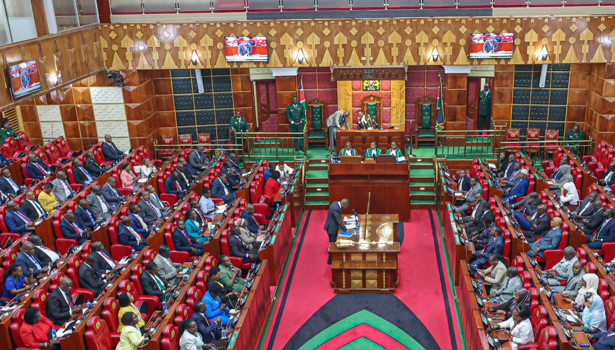
Editor's Review
Justin Muturi has called on Members of Parliament to push for the immediate tabling of the Election Amendment Bill, 2024, which has remained under consideration in Parliament for 17 months.
Democratic Party of Kenya (DPK) Party Leader Justin Muturi has called on Members of Parliament to push for the immediate tabling of the Election Amendment Bill, 2024, which has remained under consideration in Parliament for 17 months.
In a statement on Wednesday, August 26, Muturi said the prolonged delay was unacceptable, arguing that the Bill arose from the National Dialogue Committee (NADCO), a bipartisan process that followed extensive public participation and was intended to address key electoral and governance concerns.
"This is a personal plea to Members of Parliament to demand the immediate tabling of the Election Amendment Bill, 2024, on the floor of the House.
"It must not be forgotten that the National Dialogue Committee (NADCO) emerged from a highly acrimonious political process and a bipartisan, multilaterally supported initiative that involved wide public participation," the statement read.
Muturi questioned why legislation arising from the dialogue process had remained in a parliamentary committee for such an extended period.
Read More
He warned that the continued delay could raise questions beyond ordinary legislative procedures.
"Its recommendations therefore carry a national obligation. How can a Bill arising from such a process remain in committee for 17 months? At what point does prolonged inaction cease to be ordinary legislative delay and become a glaring question of sabotage?" he posed
Muturi further called on Parliament to explain the circumstances surrounding the delay and urged multilateral partners who supported the dialogue and electoral reform process to also seek answers.
"Parliament must provide answers, and the multilateral partners who supported the dialogue and electoral reform process should equally demand an explanation," the statement further read.

Muturi said Parliament now has the responsibility to ensure that the Bill is considered before the Independent Electoral and Boundaries Commission (IEBC) awards its technology tender.
He argued that the necessary legal safeguards should be established before major technological and vendor commitments are made for the 2027 General Election.
"The immediate responsibility now lies with Parliament. Members should demand that Speaker Moses Wetang’ula facilitate the Bill’s consideration before the IEBC technology tender is awarded. The law should establish the necessary safeguards before major technological and vendor commitments are made for the 2027 election," the statement noted.
Muturi also challenged President William Ruto to demonstrate his commitment to an electoral process that is transparent, verifiable and credible.
"President Ruto, who is also a UDA Presidential Candidate, should, in turn, demonstrate his commitment to a transparent, verifiable and credible election by assenting to the legislation if Parliament passes it," the statement added.
Muturi concluded by urging Parliament to act without further delay, saying the country needs concrete action to strengthen the electoral framework ahead of the 2027 elections.
"The country does not need another explanation for delay; it needs action. The Bill must come to the floor now, while there is still time to strengthen the electoral framework before 2027," the statement concluded.
Elsewhere, this comes a day after Members of Parliament backed proposed changes to regulations governing constituency and county offices, including measures aimed at protecting lawmakers from personal financial liability arising from staff disputes and administrative lapses.
The reforms were reviewed by the National Assembly’s Committee on Delegated Legislation during a session on Tuesday, August 25.
The committee, chaired by Ainabkoi MP Samuel Chepkonga, considered amendments proposed by the Parliamentary Service Commission (PSC), which seek to update rules that have remained largely unchanged since 2005.
One of the major changes involves the employment terms of staff working in MPs’ constituency and county offices.
Under the proposed regulations, employees would move from five-year contracts to one-year renewable contracts, giving MPs greater discretion over the management of their offices and personnel.
During the committee proceedings, Chepkonga stressed the importance of MPs having authority over their staff, arguing that lawmakers should have the ability to determine who works in their offices.
He indicated that members who disagreed with their employer’s decisions would have to wait until the next contract period.
The proposed regulations also seek to address concerns over the personal liability of MPs in employment-related disputes.
Under the existing arrangement, court awards arising from wrongful dismissal cases could result in an MP’s salary or personal funds being targeted to settle the claims.
Under the new framework, however, financial awards arising from such disputes would be paid from the relevant constituency or county office allocation instead of being recovered from an individual MP.


 (1)-1791708588-md.jpg)
 (1)-1791175033-md.jpg)
-1791699761-md.jpg)
-1791696120-md.jpg)


 (1)-1791708588-sm.jpg)
 (1)-1791175033-sm.jpg)