Editor's Review
President William Ruto has outlined four major challenges his administration inherited in the education sector after taking over the government in 2022.
President William Ruto has outlined four major challenges his administration inherited in the education sector after taking over the government in 2022.
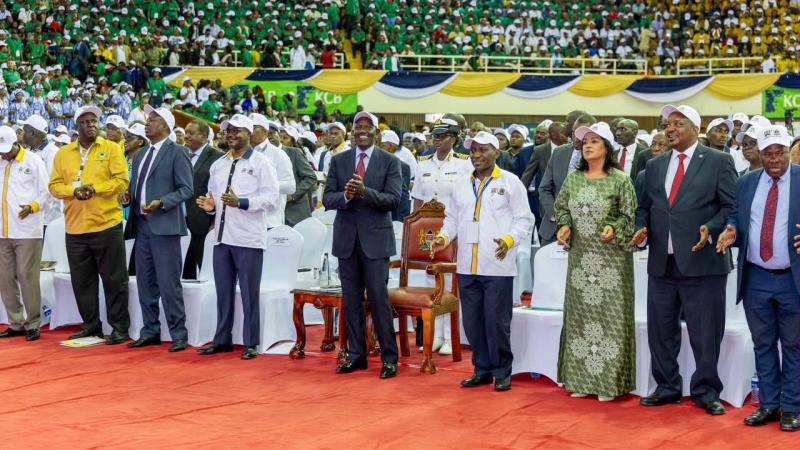
Speaking on Monday, October 5, Ruto said the education system was facing a shortage of teachers, uncertainty over the transition to Competency-Based Education (CBE), inadequate infrastructure for Junior School and a severe financial crisis in public universities.
"When we assumed office, we inherited an education system burdened by years of unresolved challenges and difficult decisions that had been postponed for far too long.
"We chose not to postpone them again. We chose to confront them, make the difficult but necessary decisions, and do what is right for the next generation," he said.
Ruto said the country had a shortage of 116,000 teachers after recruitment failed to keep pace with rising enrolment.
Read More
He said his administration had since taken steps to expand the teaching workforce.
"In the past four years, we have brought 100,000 new teachers into our classrooms. A further 20,000 will join by December, bringing the total to 120,000; the largest expansion of the teaching workforce in our nation's history," he stated.
Ruto added that the government had also allocated additional funds to improve the terms of service for teachers who had been working on contracts.
"This year's budget also provides Ksh4.9 billion to move 20,000 contract teachers, who have served for two years, to permanent and pensionable terms from January 2027," he added.
On the transition to Competency-Based Education, Ruto said the government moved to address uncertainty among parents, teachers and schools over the implementation of the new system.
He said the Presidential Working Party on Education Reform was appointed within weeks of his administration taking office, with its recommendations informing subsequent decisions on the transition.
"Acting on recommendations, we domiciled Junior School in our existing primary schools, allowing children to continue learning close to home and giving parents, teachers, and schools certainty about the transition," he further said.

Ruto said the transition had since progressed, with the pioneer CBE class entering Senior School and more than 220,000 teachers undergoing retooling for the new education system.
"That transition has now moved forward. This year, the pioneer CBE class entered Senior School, and more than 220,000 teachers have been retooled for Competency-Based Education," he noted.
Ruto said the government had further allocated Ksh952 million in the current budget for capacity development to prepare teachers for new learning areas under the system.
He also identified inadequate classrooms and laboratories as another challenge that required urgent intervention as Junior School was being introduced.
Ruto said the government worked together with the National Government-Constituencies Development Fund to expand learning infrastructure across the country.
"Together with the National Government-Constituencies Development Fund, we have built more than 23,000 classrooms across Kenya and are equipping 1,600 laboratories to support science and the new Senior School pathways," he said.
On higher education, Ruto said years of underfunding had left public universities facing severe financial difficulties.
He noted that universities expected to receive 80 per cent of the cost of teaching each student but were receiving about 40 per cent.
According to Ruto, the resulting deficits left 23 of the country’s 40 public universities technically insolvent and at risk of closure.
He said his administration responded by changing the university financing system and increasing funding to higher education.
"We replaced the old financing arrangement with the Student-Centred Funding Model, so that support follows the learner according to need and merit. Funding for universities has increased from Kshh44 billion in 2022 to Ksh82 billion in the last financial year," he stated.
At the same time, Ruto has directed the Ministry of Education to review the amount of capitation allocated to schools.
He said the current school capitation amounts were last reviewed in 2015.
"The last time school capitation was reviewed was in 2015. The Ksh22,000 for our secondary schools was reviewed in 2015, and the Ksh14,000 for JSS was also done in 2015," he stated.
Ruto instructed the Ministry of Education and other stakeholders to begin the review of capitation after the completion of the tertiary placement and funding process.
"Since 2015, so much has happened. So, my instruction to the Ministry of Education and all the stakeholders, including TSC, immediately we finish the tertiary placement and funding bill, we will embark on reviewing the amounts that are required for teaching our children," he added.
Ruto said the Ministry of Education should increase the capitation rates to ensure schools have adequate resources to educate learners.
"I believe we need to review that Ksh22,000 upwards, Ksh14,000 upwards and the Ksh2,300 upwards to make sure that there are adequate resources to teach our children in school," he further said.