
Editor's Review
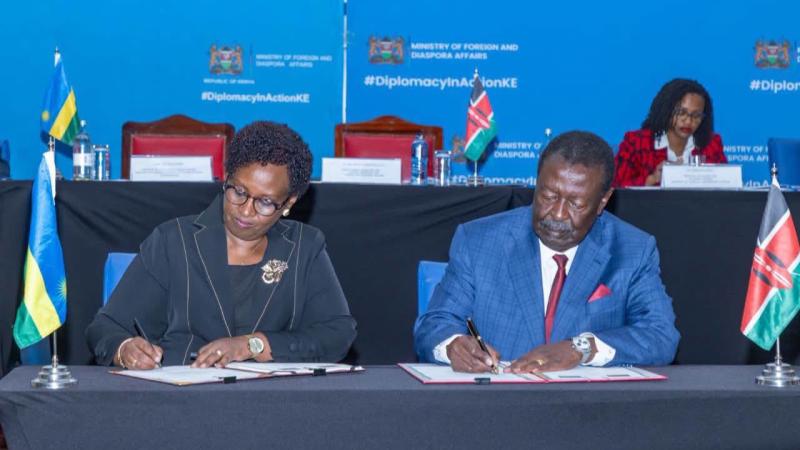
Kenya and Rwanda have signed nine bilateral agreements aimed at strengthening cooperation in security, justice, housing and other areas of mutual interest.
Kenya and Rwanda have signed nine bilateral agreements aimed at strengthening cooperation in security, justice, housing and other areas of mutual interest.
In a statement on Wednesday, October 7, Prime Cabinet Secretary Musalia Mudavadi said the agreements were concluded during the 10th Session of the Kenya-Rwanda Joint Permanent Commission for Cooperation.
He said the agreements were signed following discussions with Rwanda’s Minister of State for Foreign Affairs and International Cooperation, Dr. Usta Kayitesi.
"Together with Dr. Usta Kayitesi, Minister of State for Foreign Affairs and International Cooperation, we concluded the 10th Session of the Kenya-Rwanda Joint Permanent Commission for Cooperation with the signing of nine bilateral agreements," he wrote.
According to Mudavadi, the agreements cover several sectors, including security and justice, immigration, housing and urban development, water and irrigation, local governance, political consultations and diaspora affairs.
Read More
He said the agreements would deepen coordination between Kenya and Rwanda while strengthening institutions and creating opportunities for citizens of both countries.
"They strengthen cooperation across security and justice, immigration, housing and urban development, water and irrigation, local governance, political consultations and diaspora affairs," he added.
Mudavadi said the strengthened partnership would have direct benefits for Kenyans and Rwandans by facilitating closer cooperation and creating an environment for people to live, work and conduct business across the region.
"For Kenyans and Rwandans, this means closer coordination between our countries, stronger institutions, safer communities and greater opportunities for our people to live, work, do business and prosper across our region," he further said.

Mudavadi said the next step would be to ensure the agreements move beyond signing ceremonies and are implemented effectively to deliver practical benefits to citizens.
"The agreements are signed. Our focus now is implementation and ensuring this partnership delivers tangible results for our people," he concluded.
This comes weeks after Rwanda received its first consignment of 40,000 metric tonnes of refined petroleum products through a new supply route using Kenya’s port, pipeline and transport infrastructure.
Speaking on Tuesday, September 29, Energy Cabinet Secretary Opiyo Wandayi said the consignment, which arrived aboard MT Sea Wolf at Kipevu Oil Terminal 2 at the Port of Mombasa, is Rwanda National Energy Company’s (RNEC) maiden cargo.
He said the arrival of the vessel demonstrated Kenya’s readiness to serve as Rwanda’s gateway to international energy markets through the Northern Corridor.
"It is a moment of immense pride for me, as Cabinet Secretary of Energy and Petroleum, to join you at Kipevu Oil Terminal 2 this morning to witness this historic occasion," he said.
Wandayi said the June agreement had established the basis for Kenya to support Rwanda’s energy security by providing access to its port and petroleum infrastructure.
On June 29, the two governments signed framework documentation on the importation of bulk refined petroleum products for Rwanda.
Wandayi said the arrival of MT Sea Wolf confirmed that Kenya was prepared to become Rwanda’s preferred route for petroleum imports through the Northern Corridor.
He said the agreement was expected to significantly increase petroleum volumes transported through Kenya to Rwanda in the coming years.
"For Kenya, this is about more than a single cargo. This framework is projected to grow the volume of petroleum products moving through our Northern Corridor to Rwanda tenfold over the coming years.
"That is a vote of confidence, not just in a pipeline or a port, but in Kenya as a nation, in our institutions, our regulatory environment and our ability to deliver on our word," he added.
Wandayi said the Kenya Ports Authority (KPA) would play a central role in ensuring the efficient handling of petroleum cargo arriving through the route.
"A gateway is only as strong as the institutions that run it. KPA stands at the front line of this route. From berthing vessels such as MT Sea Wolf to the safe and efficient discharge of their cargo, it ensures that product moves reliably from ship to shore," he further said.