
Editor's Review
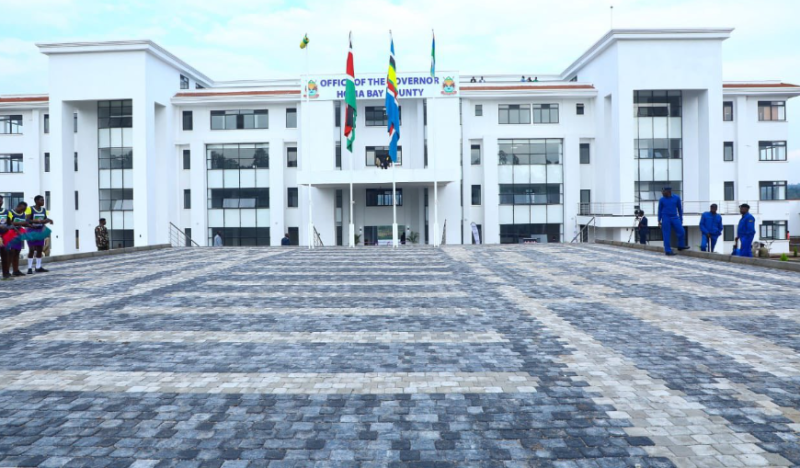
Homa Bay County Government and the County Assembly have been ordered to disclose information concerning the construction of the new county headquarters following two rulings by the Ombudsman.
Homa Bay County Government and the County Assembly have been ordered to disclose information concerning the construction of the new county headquarters following two rulings by the Commission on Administrative Justice (CAJ).
In a statement on Friday, October 9, Katiba Institute welcomed the decisions which directed the two institutions to release records relating to the project after failing to respond to a request for information submitted in March 2025.
"Katiba Institute welcomes two rulings by the Commission on Administrative Justice (CAJ), delivered on 8 October 2026, directing the Homa Bay County Government and County Assembly to disclose information concerning the construction of the new county headquarters," the statement read.
The request sought information on project approvals, the lease-to-own financing arrangement with the County Pension Fund (CPF), national government approvals, financial obligations and the project's implementation status.
The Commission affirmed that both institutions were bound by Article 35 of the Constitution and the Access to Information Act, 2016, which provide for the right of access to information held by public entities.
Read More
It also clarified that records held by county assemblies were not automatically exempt from disclosure under legislation governing privileges.
Where documents contained legally exempt information, the institutions were required to disclose the accessible portions while redacting only the exempt material.
Under the ruling, the Homa Bay County Government must provide project approvals, agreements with CPF and reports detailing its financial obligations, including contingent liabilities.
The County Assembly was directed to release certified Hansard records, relevant county legislation, implementation and financial reports, committee records and supporting documents, subject to lawful redactions where necessary.
The Commission ordered the County Secretary and the Clerk of the County Assembly to facilitate access to the requested information within 21 days.
Failure to comply could lead to recommendations for criminal prosecution under Section 28 of the Access to Information Act, 2016.

Commenting on the rulings, Katiba Institute Executive Director Nora Mbagathi said the decisions reinforced the need for public institutions to remain accountable, particularly when making financial commitments involving public resources.
"These rulings reaffirm a fundamental constitutional principle: public institutions must be open and accountable to the people they serve. Decisions involving public resources, including long-term financing arrangements and contingent liabilities, cannot be shielded from public scrutiny," she said.
Mbagathi said the decisions also strengthened the enforcement of the right to information and provided guidance on the disclosure of public records by county assemblies.
"The decisions strengthen the enforcement of the right to information and affirm the public's right to scrutinise how county governments commit public resources. They also provide important guidance for county assemblies across Kenya, confirming that legislative privileges cannot be used as a blanket justification for withholding public records," she added.
Mbagathi noted that access to information was necessary for meaningful public participation and accountable governance, urging the two Homa Bay institutions to comply with the Commission's directives.
"Access to information is essential to meaningful public participation, accountable governance and the effective implementation of the Constitution. Katiba Institute calls on the Homa Bay County Government and County Assembly to comply fully with the Commission's orders," she further said.
Elsewhere, Kisii Senator Richard Onyonka has called for a detailed audit of the county government’s Early Childhood Development Education (ECDE) milk programme, seeking scrutiny of its procurement, expenditure, suppliers and delivery records.
The programme was launched in January 2026 and is designed to benefit approximately 68,000 learners enrolled in 697 public ECDE centres spread across Kisii County’s 45 wards.
Under the initiative, each learner is expected to receive 200 millilitres of milk three times every week.
Onyonka wants the Senate Education Committee, chaired by Nominated Senator Betty Montet, to investigate the suppliers contracted since milk distribution started in February.
He has asked the committee to establish the contracts awarded, the companies involved and whether the procurement process followed the applicable laws and regulations.
Onyonka has also sought a breakdown of the programme’s finances, including the budget set aside, funds released and expenditure incurred.
He wants the committee to examine the cost of milk per unit, transportation and distribution expenses, as well as payments made to suppliers.
Another area Onyonka wants investigated is the actual reach of the programme. He has asked the committee to verify the number of ECDE centres and learners receiving milk, the quantities supplied and the distribution schedules.
The exercise would also involve comparing the current figures with previous county planning records to identify and reconcile any inconsistencies.
Onyonka has further raised questions about the source and quality of the milk supplied to learners.
He wants the committee to establish whether the products meet the required standards and possess the necessary certifications from the Kenya Dairy Board and the Kenya Bureau of Standards (KEBS).

-1784539615-md.jpg)

 (1)-1791533408-md.jpg)


-1784539615-sm.jpg)


 (1)-1791533408-sm.jpg)