
Editor's Review
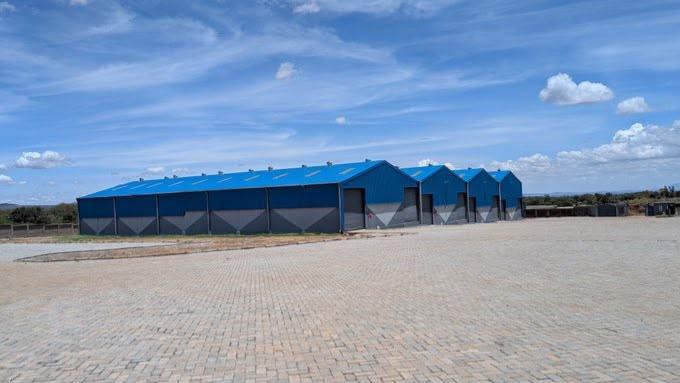
The government has completed the Ksh500 million Meru County Aggregation and Industrial Park (CAIP) which is expected to boost agricultural value addition and create new opportunities for farmers in the region.
The government has completed the Ksh500 million Meru County Aggregation and Industrial Park (CAIP) which is expected to boost agricultural value addition, attract private investment and create new opportunities for farmers in the region.
In a statement on Friday, October 9, the State Department for Industry said the park, funded jointly by the National and County governments, the industrial park will support the processing of agricultural produce, including bananas, macadamia nuts, miraa and avocados.
The department said the completed project would play a key role in transforming agricultural production into commercially valuable products while supporting agro-processing enterprises.
"The Ksh500 million project funded by the National and County governments, will be a game-changer in the value addition process, with farmers in the region set to benefit from their value chains, including bananas, macadamia nuts, miraa, avocado among others," the statement read.
Read More

The industrial park has also attracted private investors, some of whom have already started setting up processing facilities targeting different agricultural products.
According to the State Department for Industry, the investments focus on processing macadamia nuts, peanuts and cashew nuts, expanding the region's agro-processing capacity and supporting the growth of local industries.
"Private investors have already started setting up facilities focusing on value chains including macadamia nuts, peanuts and cashew nuts processing," the statement added.
The department, working alongside the Kenya Industrial Research and Development Institute (KIRDI) and the Embu County team, conducted a pre-tender site visit to engage prospective bidders and provide technical guidance on the common user facility.
The facility houses equipment intended to support enterprises operating within the industrial park.
"During a pre-tender site visit today, the department, Kenya Industrial Research and Development Institute (KIRDI) and Embu County team, engaged with prospective bidders, where they got technical advice from the Ministry's team on the common user facility, where the equipment will be set up," the statement further read.

Beyond agricultural processing, the industrial park is expected to strengthen regional trade by improving Meru's links to neighbouring countries through transport corridors.
Embu County Commissioner George Omollo noted that the project would promote regional trade and integration, with Meru linked to the Horn of Africa Gateway Development Project regional road corridor.
The corridor connects Kenya to Ethiopia, Somalia, Eritrea and Djibouti, potentially opening wider markets for processed agricultural products from the region.
Meanwhile, the government has stepped up efforts to revitalise fisheries and aquaculture in the Lake Region through investments aimed at expanding fish production.
In a statement on Wednesday, October 7, Interior Principal Secretary Raymond Omollo said the initiative is being implemented under the Blue Economy agenda of the Bottom-Up Economic Transformation Agenda (BETA).
The Kabonyo Kanyagwal Regional Fisheries and Aquaculture Training Centre of Excellence in Kadibo Sub-County, Kisumu County, is among the key projects.
Omollo said communities around Lake Victoria have faced declining incomes due to challenges affecting the fishing sector.
"For generations, communities along Lake Victoria have depended on the lake for their livelihoods, but reduced catches, limited market access and shrinking earnings have increasingly undermined household incomes," he wrote.
Omollo said the 25-acre facility is designed to provide training, support fish production and improve farmers' access to commercial markets and aquaculture services.
"Located on 25 acres, the modern facility will serve as a centre for aquaculture training, fish production and access to commercial cold-chain markets," he added.
According to Omollo, the centre will feature a large hatchery and 20 specialised fish ponds, alongside a flood-control canal designed to manage backflow from Lake Victoria and River Nyando.
It will also have administrative offices, staff quarters and accommodation for trainees undertaking aquaculture training at the facility.
The project is expected to support fish restocking efforts in Lake Victoria while providing inputs and technical support to farmers in several counties across the Lake Region.
"The centre is expected to produce about 28 million fingerlings annually for restocking Lake Victoria, supporting cage fish farming and supplying affordable fish feeds and aquaculture inputs to farmers in Kisumu, Homa Bay, Siaya, Migori and Busia counties," he further said.
 (1)-1791708588-md.jpg)
 (1)-1791175033-md.jpg)
-1791699761-md.jpg)
-1791696120-md.jpg)

 (1)-1791708588-sm.jpg)
 (1)-1791175033-sm.jpg)

-1791699761-sm.jpg)