
Editor's Review
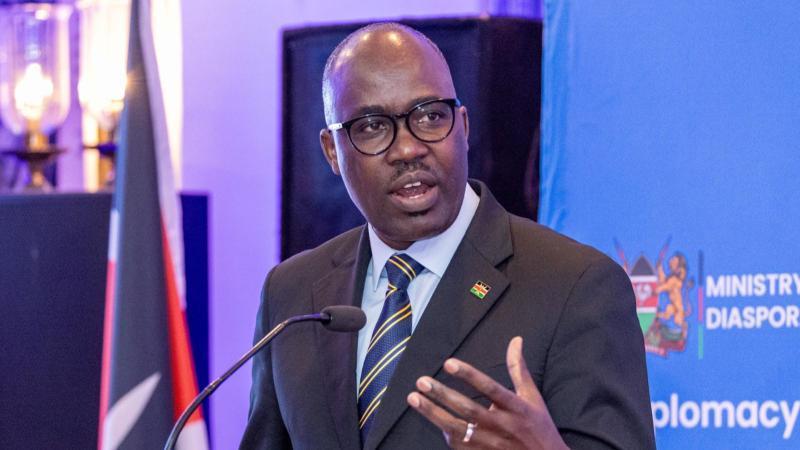
Foreign Affairs Principal Secretary Korir Sing’Oei has responded to the United States government's decision to raise its travel advisory for Kenya to Level 3.
Foreign Affairs Principal Secretary Korir Sing’Oei has responded to the United States government's decision to raise its travel advisory for Kenya to Level 3.
Speaking on Wednesday, October 21, PS Sing’Oei said the US is within its rights to advise its citizens on travel decisions.
The Foreign Affairs PS described the Ebola virus as a sensitive matter that warrants caution.
“The United States is duty-bound to advise its citizens with respect to decisions that it deems important.
“This issue around Ebola is a sensitive matter, and it is important for them to advise their citizens,” said PS Sing’Oei.
Read More

The PS also clarified that the upgrading of the travel advisory to level 3 does not amount to a travel ban against Kenya.
“As you can see, Kenya has been put in category 3, which is more cautionary, and there are no implications with respect to barring travelers coming from Kenya associated with that advisory,” he said.
The Foreign Affairs PS also mentioned that Kenya and the US have been working closely on the Ebola issue.
“We have been working closely with the United States over the last almost six months,” PS Sing’Oei added.
The US Department of State on Tuesday increased its travel advisory for Kenya from Level 2 to Level 3.
In a statement on Tuesday, October 20, the department urged American citizens to reconsider traveling to Kenya.
The department cited health risks, crime, kidnapping, terrorism, unrest, and traffic safety.
“Reconsider travel to Kenya due to risk of health, crime, kidnapping, terrorism, unrest, and traffic safety. Some areas have increased risk,” read part of the statement.
The department highlighted Ebola cases in Kenya, noting that the US Centers for Disease Control and Prevention (CDC) had already issued an advisory.
The department further mentioned that medical services in Kenya are limited and medical facilities often lack sufficient medicine and equipment.
“Medical services in Kenya are limited. They are often unavailable in rural areas. Medical facilities in Kenya often lack sufficient medicine and equipment. Except for a few private medical facilities based in the large urban centers with enhanced capability, many health issues may require medical evacuation at your own expense. Medical facilities will usually deny service if payment is not made upfront,” the department stated.
The US Department of State also cautioned US citizens against traveling to Eastleigh and Kibera due to the risk of crime and kidnapping.
It also advised American nationals not to travel to Garissa, Wajir, Mandera, Lamu, Tana River, or coastal areas north of Malindi due to the risk of kidnapping and terrorism.
The department listed West Pokot County and Western Turkana as other areas with crime risk in Kenya.
On Tuesday, the Ministry of Health confirmed one additional Ebola case in Kenya, bringing the total number of confirmed cases to nine.
The Ministry said the latest case involves a 24-year-old man who is a close family member of the index case.
It said the patient was already in quarantine when he developed symptoms and was immediately isolated, tested, and placed on treatment following confirmation of the infection.
"The new case is a known contact of the index case and was already in quarantine when he fell ill. All nine cases belong to one cluster, and as of today there is no evidence of transmission outside this group," the ministry stated.




 (1)-1792557802-md.jpg)




 (1)-1792557802-sm.jpg)