Editor's Review
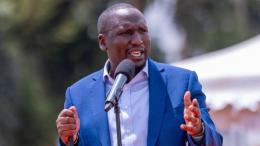
Democratic Party (DP) leader Justin Muturi has accused former Deputy President Rigathi Gachagua of engaging in political bullying and undermining unity within the United Opposition.
Democratic Party (DP) leader Justin Muturi has accused former Deputy President Rigathi Gachagua of engaging in political bullying and undermining unity within the United Opposition.
In a statement on Monday, November 2, Muturi argued that winning the presidency required national support beyond individual communities and regional political strongholds, insisting that no single community could independently determine who becomes Kenya's next president.
Join our WhatsApp Channel for the latest news updates.
"Gachagua must understand one fundamental truth: No Kenyan President has ever been made by one community alone. The presidency is won through national consensus, strategic alliances and the ability to unite Kenyans across ethnic and regional boundaries," he wrote.
Muturi also raised concerns over Gachagua's political direction, saying his approach risked raising doubts about whether he was genuinely committed to the United Opposition's shared presidential objective under the Wantam movement.
Read More
"I wish to put the United Opposition on notice: the current political trajectory being pursued by Gachagua raises serious questions about his commitment to the collective presidential ambition of the Wantam movement," he added.
Muturi further accused Gachagua of attempting to weaken existing political cooperation through his insistence on tripartite political arrangements, suggesting that the former Deputy President could be positioning himself for negotiations over political positions after the elections.
"His persistent attempts to undermine established cooperation and his insistence on tripartite political arrangements risk creating the impression that he is preparing for post-election political bargaining rather than prioritising the ultimate prize: State House," he further said.
Muturi questioned whether the opposition was focused on securing the presidency or prioritising the control of parliamentary and devolved political positions.
He argued that such an approach could undermine the broader objective of forming a government.
"Is the objective to win the presidency or to control MPs, legislators and devolved units while sacrificing the bigger national ambition? Those of us who have spent years in the trenches of Kenyan politics understand that building a winning national coalition requires compromise, maturity and strategic thinking," he noted.
Muturi also dismissed the idea that a tripartite political arrangement would automatically improve the opposition's chances of winning the presidency, warning that introducing divisions into the coalition could work against its ambitions.
"A tripartite arrangement is not a magic formula for State House. Fragmenting an opposition that needs unity raises serious questions about the political direction being pursued," he stated.

Muturi maintained that the United Opposition did not belong to any individual or political community, calling for political partnerships founded on mutual respect rather than intimidation and demands for supremacy.
"Let it be clear: No individual owns the United Opposition, and no community has a monopoly on Kenya's presidency. Political partnerships must be built on mutual respect, not ultimatums, political bullying or supremacy contests," he said.
In his criticism, Muturi also invoked the political history of Gachagua's family, citing the late Nderitu Gachagua's gubernatorial victory against the National Alliance (TNA), the party that produced former President Uhuru Kenyatta.
He argued that the contest demonstrated the complexity of political alliances and the fact that political formations could not be treated as personal property.
"I also remind Mr Gachagua of his own family's political history. His late brother, Nderitu Gachagua, won the gubernatorial contest against TNA, the political vehicle that produced President Uhuru Kenyatta, despite GNU supporting Uhuru. That history should remind us that political alliances are complex and no political formation belongs to one individual," he added.
Muturi concluded by challenging the United Opposition leadership to clarify whether it was committed to building a single national movement with a common presidential candidate or allowing individual leaders to pursue separate political interests ahead of the 2027 elections.
"The United Opposition must decide whether it is building one national movement with a shared presidential ambition or creating separate political kingdoms whose leaders will negotiate individual interests after the elections," he concluded.
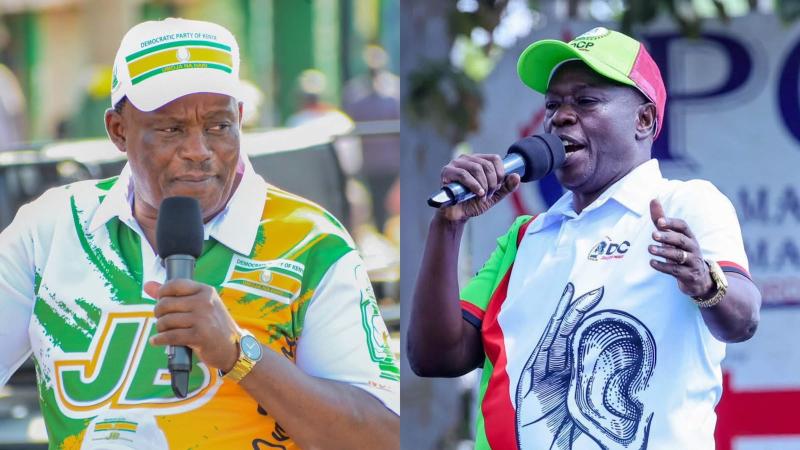
At the same time, Jubilee Party leader Fred Matiang’i has cautioned former Deputy President Rigathi Gachagua over what he described as arrogance and pride.
Speaking on Sunday night, November 1, Matiang’i warned that Gachagua's remarks risk splitting the opposition and making it hard to unite ahead of the 2027 General Election.
"With tremendous respect to the leader because he is a leader of a party, that arrogance and that particular pride is precisely what is going to split the opposition and make it very difficult for the opposition to unite," he said.
Matiang'i argued that the opposition should embrace an inclusive political approach, bringing together leaders and communities from across the country.
"Our country does not belong to three groups; our country belongs to more than 40 groups. If you remember in 2007 when we had challenges in this country, the whole politics started from that level of arrogance which finally resulted in 41 versus 1 and caused so much pain and anguish in the country," he stated.
Matiang’i also questioned what would happen to communities that political leaders dismiss as insignificant or unnecessary in their calculations for the 2027 General Election.
"Those that you think are useless and don’t matter, the numbers you say you don’t need what are they supposed to do? They leave Kenya tonight? Because if you say your ethnic group, my ethnic group, and that ethnic group is enough and we will lead that way, what happens to those you think don’t matter?" he posed.