
Editor's Review
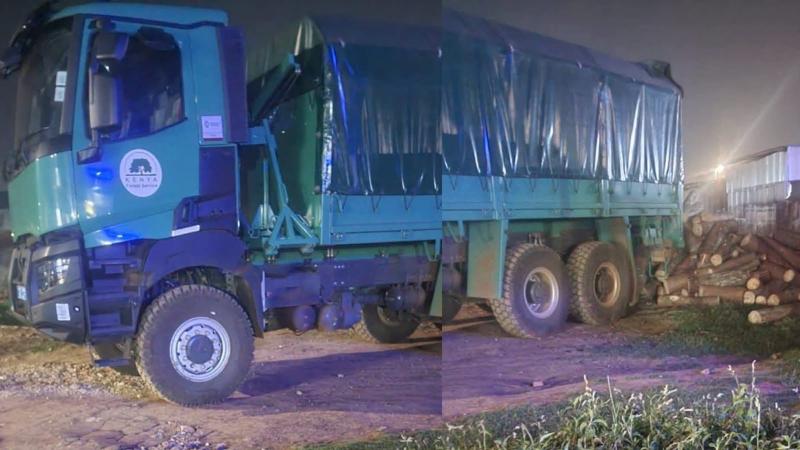
The Kenya Forest Service (KFS) has launched investigations after photos circulated online showing a KFS truck purportedly delivering logs to a private facility in Eldoret.
The Kenya Forest Service (KFS) has launched investigations after photos circulated online showing a KFS truck purportedly delivering logs to a private facility in Eldoret.
The sighting drew criticism, with concerns over why a government agency mandated to safeguard forests would be involved in transporting timber to a private establishment.
Join our WhatsApp Channel for the latest news updates.
"KFS is supposed to protect our forests, not to be the delivery service for their destruction. How can the same institution mandated to guard our forests be caught ferrying logs to a private facility?" a social media user asked.
Responding to the circulating photos, KFS said it had taken note of the claims and initiated investigations to establish what happened.
Read More
"Kenya Forest Service has noted photos making rounds online concerning a Service vehicle purportedly ferrying logs to a private facility.
"Investigations have commenced to establish the truth of the matter and the public will be informed of the findings as soon as possible," the agency said.
KFS also urged members of the public to report suspected illegal activities involving forestry management and forest destruction to authorities.
"The public is urged to remain vigilant and report any suspected incidence of illegality with regard to forestry management or forest destruction to the nearest police station," the agency added.
This comes a week after KFS responded to allegations of illegal forest activities in several forest stations in Kericho County.
In a statement on Monday, November 16, the Service said it had noted allegations circulating on social media regarding purported illegal activities in several forest stations across the county.
KFS maintained that the activities taking place in the affected stations were lawful and conducted in accordance with approved management plans.
"The Service wishes to categorically clarify that no illegal activities are taking place in the mentioned Forest Stations of Malagat, Tendeno, Londiani, Sorget, Kuresoi, Saburet and Makutano," the statement read.

KFS explained that the ongoing operations involved the harvesting of mature and over-mature forest plantations under approved Plantation Management Plans and Felling Plans for the respective stations.
"The activities currently underway involve the lawful harvesting of mature and over-mature forest plantations, in accordance with approved Plantation Management Plans and Felling Plans for the respective stations," the statement added.
KFS also addressed concerns about the restoration of harvested areas, saying replanting was already underway in collaboration with members of the respective Community Forest Associations (CFAs).
"The Service further wishes to inform the public that replanting of harvested sites is already underway in collaboration with members of the respective Community Forest Associations (CFAs).
"This is an established practice under the Service's Tree-First Policy, which prioritises prompt replanting of harvested areas while allowing CFAs to cultivate approved food crops as part of efforts to enhance community participation and livelihoods," the statement further read.
On allegations surrounding the removal of an indigenous tree, KFS clarified that the fig tree in question was within a plantation area and had been damaged during the felling of cypress trees.
The Service said the tree was subsequently removed during site clearing to allow the re-establishment of the plantation.
"Regarding allegations of the removal of an indigenous tree, the Service clarifies that the fig tree in question was located within a plantation area and was damaged during the felling of cypress trees. It was subsequently removed during site clearing to facilitate the re-establishment of the plantation," the statement explained.
KFS further explained that indigenous trees could naturally regenerate within plantation forests during their approximately 30-year rotation period, adding that such trees were assessed during harvesting operations.
"It is important to note that during the approximately 30-year rotation period of plantation forests, some indigenous trees may naturally regenerate within the plantations.
"Such trees are assessed and, where necessary, removed during harvesting operations and disposed of as fuelwood," the statement noted.


 (1)-1795671353-md.jpg)
 (1)-1795668756-md.jpg)



 (1)-1795671353-sm.jpg)
 (1)-1795668756-sm.jpg)