Editor's Review
President William Ruto has announced a proposed $3 billion (Ksh388.2 billion) investment to establish an electric vehicle manufacturing and green mobility ecosystem in Kenya.
President William Ruto has announced a proposed $3 billion (Ksh388.2 billion) investment to establish an electric vehicle manufacturing and green mobility ecosystem in Kenya.
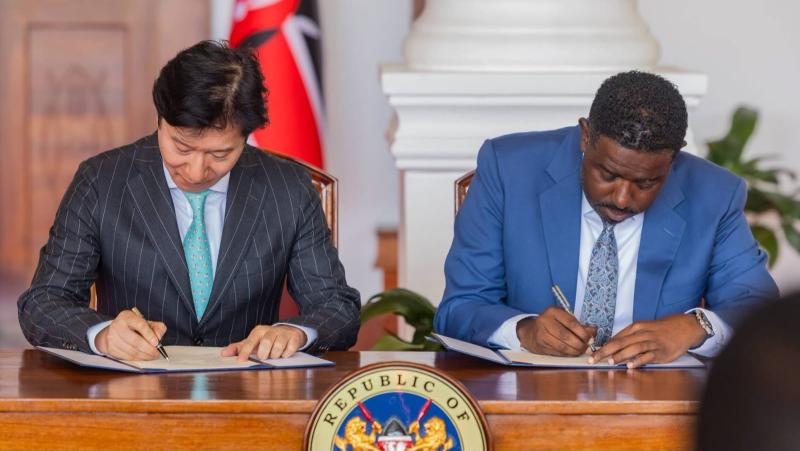
Speaking during the signing of a Memorandum of Understanding between the Government of Kenya and Endelevu Enterprise Corporation on Tuesday, October 6, Ruto said the partnership would help Kenya reduce its dependence on imported vehicles and fuel while creating jobs and retaining more economic value within the country.
"For decades, Kenya has imported the fuel that runs our vehicles, and the vehicles that burn that fuel. We have paid for both in hard currency. And with every shipment, we have exported jobs that should have been created here. We are determined to change that equation," he said.
Ruto said the agreement provides a framework for developing an integrated green mobility ecosystem, with the proposed investment expected to be among the largest electric mobility commitments in the region.
"This Memorandum establishes a framework for an integrated green mobility ecosystem, with a proposed investment of $3 billion. It is one of the largest electric mobility commitments in our region," he added.
Read More
According to Ruto, the proposed investment will include an assembly plant capable of producing 50,000 four-wheel vehicles annually and a second plant with an annual capacity of 100,000 two-wheelers and light-mobility vehicles.
The project will also involve the establishment of 1,000 solar-powered charging hubs and a digital platform designed to manage up to 100,000 green vehicles.
Ruto said the investment would have a significant impact on employment, with thousands of direct jobs expected to be created alongside opportunities across the wider supply chain.
"Behind these numbers are people. The project is expected to create about 2,000 direct jobs and more than 20,000 indirect jobs among suppliers, logistics firms and service providers," he further said.
Ruto said the project would also generate additional opportunities in fleet management, operations and other services, benefiting young people, engineers and workers in the transport sector.
"It is also expected to create up to 80,000 further opportunities in fleet management, operations and services. That is a young technician on an assembly line. It is a boda boda rider who keeps more of what he earns each day. It is a Kenyan engineer who designs what we once could only import," he stated.

Ruto said Kenya's ambition was not limited to producing electric vehicles for the domestic market, but to position the country as a manufacturing hub serving the wider African market.
He said vehicles produced in Kenya and meeting the Rules of Origin requirements of the East African Community would have access to a regional market comprising hundreds of millions of people.
"To our partners from Endelevu and Geely, our ambition goes beyond Kenya. We do not want to assemble for one market. We want to manufacture for East Africa and for Africa. Vehicles built here and qualifying under the Rules of Origin of the East African Community will reach a regional market of hundreds of millions of people.
"This is the industrial future we are building through the National Electric Mobility Policy and the National Automotive Bill now before Parliament," he noted.
Ruto said the government expected the partnership to deliver more than investment, including industrial capacity, employment, opportunities for small and medium-sized enterprises and the transfer of technology and skills.
"So, what does Kenya expect from this partnership? We expect investment and industrial capacity. We expect jobs for our young people and contracts for our SMEs. We expect technology and skills to be transferred, not just traded," he said.
Ruto also directed the Ministry of Investments, Trade, and Industry, through Invest Kenya, to facilitate the project and ensure the necessary government approvals and infrastructure are delivered within clear timelines.
"A signature does not build a factory. I therefore direct the Ministry of Investments, Trade, and Industry, through Invest Kenya, to provide end-to-end facilitation to Endelevu. The Ministry will work with every relevant national and county institution so that approvals, land, and infrastructure are delivered within clear timelines," he directed.
This comes months after Ruto announced a temporary exemption on import duty for electric vehicles (EVs).
Addressing the media on Friday, May 22, he said the first 100,000 electric vehicles imported into Kenya will not attract any import duty, noting that the incentive will apply to both public service and privately owned electric vehicles.
"I am making a declaration that the first 100,000 electric vehicles to be imported into Kenya, whether for the purpose of public service or personal use, will be duty free even as we continue to work with the private sector for investors in the electric vehicle manufacturing to establish production facilities in Kenya," he announced.
Ruto explained that the move was part of the government’s plan to ensure future generations are less exposed to global fuel instability.
He noted that the Ministry of Interior has already ordered 3,000 EVs for use by security and administration officials.
"We are accelerating investments in renewable energy, electric mobility, modern pubic transport and energy security so that future generations of Kenyans are less exposed to global fuel instability.
"We must embrace electric vehicles as a first step. The government has already ordered 3,000 electric vehicles through the Ministry of Interior for use by our security and administration officials," he added.


-1792658467-md.jpg)
-1768823097-md.jpg)