
Editor's Review
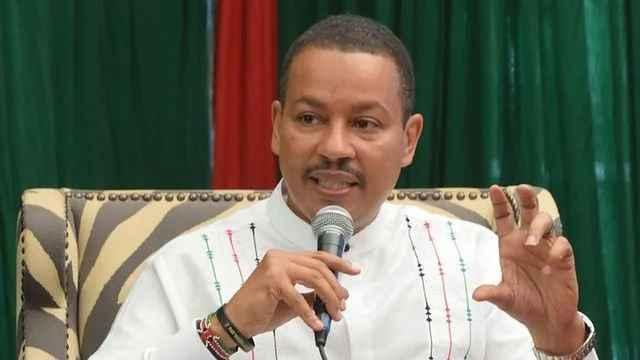
Irüngü Houghton will step down as Executive Director of Amnesty International Kenya in June 2026 after eight years at the helm.
Irüngü Houghton will step down as Executive Director of Amnesty International Kenya in June 2026 after eight years at the helm.
In a statement on Friday, February 6, Amnesty International Kenya Board Chairperson Stellah Bosire made the announcement, describing his tenure as a period of major growth, structural reform, and strengthened independence.
She outlined the expansion of the organization’s grassroots base and financial stability achieved over the years.
"After eight transformative years of service, Irüngü Houghton will conclude his tenure as Executive Director of Amnesty International Kenya in June 2026.
"Under his relentless stewardship, our membership grew eightfold to establish 165 Circles of Conscience across 35 counties. This growth was matched by financial resilience. Our budget grew 150% and significantly diversified fuelled by the very people we serve through member subscriptions, individual giving and multi-year funders," she said.
Read More
Bosire also highlighted institutional reforms under Houghton's tenure that reshaped Amnesty Kenya’s governance model.
"Beyond the numbers, Irüngü's time as Director leaves a deep institutional footprint. By fortifying our internal governance and establishing a Board directly elected by our members over this period, Amnesty Kenya has evolved into a truly democratic, independent Section within Amnesty International," she added.
Bosire said the transition marks a new phase for the organization, with the recruitment of a new leader already underway.
"The Board, staff and outgoing Executive Director view this transition as a profound testament to our strength. Today, the Board is initiating a professional, competitive and fair recruitment process to identify the successor. We look forward to announcing the outcome of this search later this year," she further said.
On his part, Houghton reflected on his time leading the human rights organization and the milestones achieved since 2018.
He recalled the commitments he made upon joining and said they had been fulfilled.
"As I approach the last lap and the end of my tenure as Amnesty International Kenya Executive Director in June, I feel only a sense of accomplishment and pride.
"When I joined in January 2018, I promised to grow membership, diversify funding, strengthen our campaigning muscle, and guide the transition from an International Secretariat office to an independent, democratic and member governed Section. We have delivered on every one of those promises," he said.

Houghton expressed confidence in the transition process being overseen by the board, and affirmed his continued connection to Amnesty beyond his formal role.
"A smooth leadership transition is not just procedural, it is a sign of a confident and mature organization. I have no doubt that our Board will oversee a professional, fair and independent recruitment process.
"The best Amnesty staff never really leave. They remain members, supporters, and lifelong defenders of the movement's mission. For me, this is certainly true. Last year, I became Amnesty Kenya's first Life Member," he added.
Houghton concluded by pointing to the broader human rights landscape and reaffirming his commitment to the movement.
"At a time when millions face threats to constitutional freedoms at home and the erosion of the international human rights system, Amnesty remains a vital force and a moral compass for us all.
"There will be time to share more in the coming months. For now, my appreciation, commitment and solidarity with all our members, supporters, staff and the wider movement of human rights defenders," he stated.
This comes a month after Houghton resigned from the Panel of Experts on Compensation of Victims of Demonstrations and Public Protests.
In a letter addressed to the Chairperson of the Panel, Prof. Makau Mutua on Friday, January 9, Houghton said his decision was driven by fidelity to the Constitution, the rule of law, and respect for judicial authority.
Houghton said he was formally stepping down with immediate effect following President William Ruto’s decision to extend the panel’s mandate by 180 days, despite a High Court judgment delivered in December 2025.
"I write to formally tender my resignation from the Panel of Experts with immediate effect. My decision follows the President's 5 January 2026 extension of the Panel's mandate for a further 180 days despite the 4 December 2025 ruling of the Kerugoya High Court," he said.
Houghton stated that the High Court ruling fundamentally changed the legal standing of the panel and made its continued operation untenable from a constitutional perspective.
"The 4 December 2025 judgment, in my considered view, materially alters both the legal basis and institutional legitimacy of the Panel's continued existence. As a constitutionalist, I am obligated to respect judicial determinations and act in a manner that safeguards the integrity of independent institutions," he added.
Houghton warned that continuing to serve under the extended mandate risked legitimising an arrangement that had already been declared unconstitutional and weakening the statutory role of the Kenya National Commission on Human Rights (KNCHR).
He also raised concerns about a court application filed in mid-December, saying his name had been improperly included as an appellant without his consent or involvement.
"Continuing to serve on the Panel under these circumstances, risks normalising an arrangement that the Court has expressly found to be unconstitutional and undermines the central role assigned to KNCHR by law. I note that the inclusion of my name as an appellant in the 15 December application for a stay is erroneous, not in good faith and falls short of trite law and the National Values and Principles of Governance (CoK Art. 10(2).
"I suspended my involvement on the panel on 11 September to await the court ruling and did not enter appearance when listed as an interested party, trusting that the High Court would offer a way forward. I was neither consulted nor do I support the 15 December application to stay the court ruling which was only communicated to Panel members for the first time on 8 January 2026," he continued.
Houghton stressed that constitutional compliance must outweigh political convenience, arguing that the High Court had already provided a lawful path for compensation through the KNCHR.
"However, fidelity to the Constitution, the rule of law, and institutional accountability must take precedence over expediency. Through the KNCHR, the High Court has offered the Presidency a legal and pragmatic way to compensate the affected and restore its integrity before the nation. Persistent pre-emptive litigation places more obstacles before the victims, their families and the Presidency then it removes," he concluded.


 (1)-1791178178-md.jpg)



 (1)-1791178178-sm.jpg)