Editor's Review
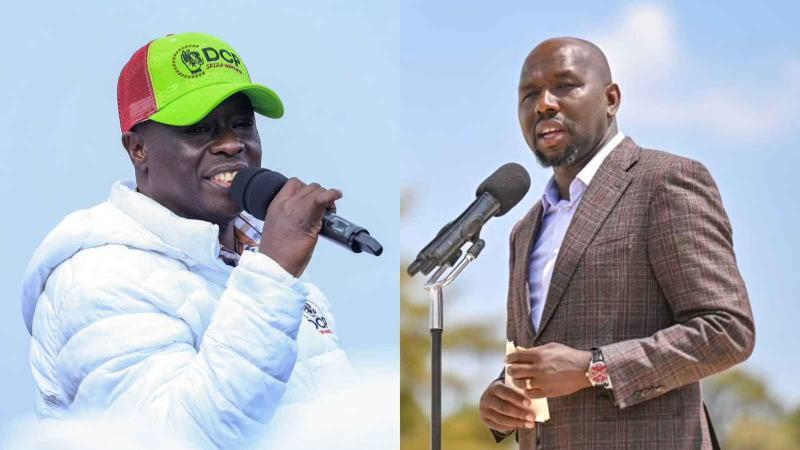
Interior Cabinet Secretary Kipchumba Murkomen has dismissed former Deputy President Rigathi Gachagua's claims that he knew in advance what President William Ruto would announce during his Special Address on Thursday.
Interior Cabinet Secretary Kipchumba Murkomen has dismissed former Deputy President Rigathi Gachagua's claims that he knew in advance what President William Ruto would announce during his Special Address on Thursday, July 30.
Speaking on Friday, July 31, Murkomen said there was nothing secretive about the planned announcement, terming Gachagua's assertions as misleading.
"I saw someone claiming they had uncovered the President's secret, saying they knew what the President was going to announce," he said.
Murkomen maintained that the government's long-term development agenda had already been discussed internally and was not a last-minute decision by the President.
"Kenya's future is not a secret, nor is it something the President just decided to announce yesterday evening. He had already discussed it with Prof. Anyang' Nyong'o and the rest of us, who are members of the Cabinet, a few weeks ago," he added.
Read More
Murkomen's remarks came after Gachagua alleged, ahead of the address, that Ruto was preparing to unveil an ambitious Vision 2060 development blueprint and appoint former President Uhuru Kenyatta to spearhead it.
While cautioning the former Head of State against accepting such a role, Gachagua urged him to steer clear of what he described as a political distraction.
"We are telling my elder brother Uhuru Kenyatta, don't allow yourself to be dragged into that mess," he said.

Gachagua argued that the government should focus on accounting for its recent performance instead of introducing another long-term national development agenda.
"That vision is something we will plan next year. Why are you worried about the next 60 years? Tell us what you have done in the last one year," he added.
Speaking during his address, Ruto acknowledged that Kenya is unlikely to fully achieve some of the ambitions outlined under Vision 2030.
Speaking on Thursday, July 30, he maintained that Vision 2030 had played a transformative role in shaping the country's development trajectory, but noted that the roadmap was now nearing the end of its lifespan.
"The reason why I believe this is our moment is that our current roadmap is approaching its destination. Vision 2030 has brought us this far, but it is approaching its horizon.
"It has served Kenya well. It transformed the way we think about national development, provided a common direction, inspired investment, guided public policy and demonstrated the power of long-term planning," he said.
Ruto admitted that despite the achievements recorded under the strategy, Kenya had not met all of the targets it had set for itself.
He specifically pointed to the goal of becoming an upper-middle-income economy by 2030, saying the country remains behind schedule.
However, Ruto emphasized that this should not be viewed as a failure of the development blueprint.
"But honesty also requires us to acknowledge that some of its ambitions remain unattained. In several respects, we are still falling short even of the very standards we set out for ourselves.
"Vision 2030 set a target of Kenya becoming an upper-middle-income country by 2030. So far, we are off target. This is not a criticism of Vision 2030. Nor is it a reason for disappointment," he added.
Ruto said the country's current position should instead serve as an opportunity to evaluate what has worked, identify the gaps that remain and collectively chart a new long-term development path for Kenya.
"Rather, it is an opportunity to proudly learn from our successes, reflect with honesty on where we have fallen short, and define, together, Kenya’s next long-term vision," he further said.