Editor's Review
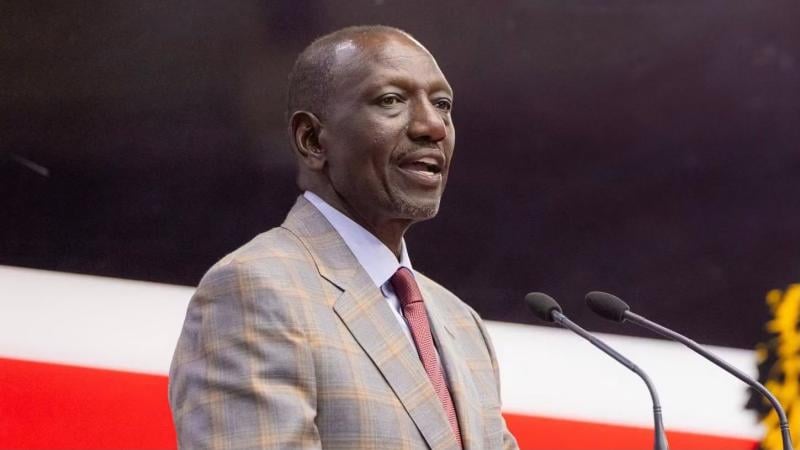
President William Ruto has announced a government training programme targeting up to one million young people to help them access procurement opportunities.
President William Ruto has announced a government training programme targeting between 600,000 and one million young people to help them access government procurement opportunities worth approximately Ksh230 billion annually.
Speaking on Wednesday, November 4, 2026, Ruto said the government had advertised the training programme, which was expected to expand the participation of young people in public procurement.
Join our WhatsApp Channel for the latest news updates.
"Yesterday, we advertised a training programme targeting between 600,000 and one million young people to equip them to access government procurement opportunities under AGPO, which reserves 30 per cent of government procurement, worth approximately Ksh230 billion annually, for youth, women, and persons with disabilities," he said.
Ruto said participants who successfully completed the training would receive certificates and benefit from free business name registration.
Read More
"Upon completing the training, participants will receive certificates and be able to register business names free of charge," he added.
At the same time, Ruto has announced plans to establish a modern leather manufacturing facility in partnership with a South Korean investor.
He said the proposed investment would complement the government's Ksh5.8 billion investment in the development of the Kenya Leather Industrial Park in Kenanie, Machakos County.
"In the leather sector, our KSh5.8 billion investment is supporting the development of the Kenya Leather Industrial Park in Kenanie, Machakos County, with modern, ready-to-use facilities for processing and manufacturing. Through our Buy Kenya, Build Kenya strategy, we are expanding markets for locally manufactured footwear, including supplies to the National Police Service and other security agencies.
"We are also engaging a Korean investor to establish a modern leather manufacturing facility with the ambition of producing one million pairs of shoes, creating new opportunities for value addition, investment, and jobs," he stated.
Ruto said government institutions, including the National Police Service (NPS) and other security agencies, were among the markets being targeted for locally manufactured footwear.
"Our ambition is not simply to supply raw materials to the world. It is to supply finished products, technology, innovation, and Kenyan brands. A factory must have a market, and the larger the market, the greater the opportunity to invest, expand and create jobs," he noted.

Ruto added that industrialisation and trade expansion needed to progress together to enable local manufacturers to access markets across Africa and beyond.
"That is why our industrialisation and trade agendas must move together. We must make more in Kenya, for Africa and the world," he said.
Elsewhere, county askaris and police officers have been accused of exploiting small-scale traders and boda boda riders through persistent harassment, threats of arrest and demands for bribes.
In its Kenya Economic Update report released on Wednesday, the World Bank identified boda boda riders and informal market traders, commonly known as mama mbogas, as among the groups most affected by bribery and harassment from traffic police and county authorities.
It noted that informal workers accounted for 83.8 per cent of Kenya's workforce, with boda boda riders estimated to number between 1.6 million and 2 million across the country.
The report explained that these workers already faced challenges such as unstable incomes, limited access to capital, intense competition and regulatory requirements, including driver's licences, motorcycle registration and daily market fees.
It stated that corruption further worsened their financial situation by reducing the money they took home after a day's work.
"Governance constraints contribute to the challenges of informal workers, most importantly by lowering 'post-corruption' earnings, and increasing uncertainty. Informal workers face demands for bribes from frontline institutions such as traffic police, inspection services, and municipal agencies," the report stated.
The World Bank estimated that boda boda riders spent between 5 and 20 per cent of their daily earnings on bribes, translating to approximately Ksh50 to Ksh100 daily, alongside occasional larger demands.
The report noted that the payments came on top of other expenses, including fuel, motorcycle import taxes, county charges and Savings and Credit Cooperative Organisation (SACCO) fees.
On earnings, the World Bank estimated that boda boda riders made approximately Ksh1,100 daily, depending on their location and operating costs, while informal market vendors earned between Ksh300 and Ksh1,500 in average daily net income.
The report also highlighted complaints from traders in Dagoretti Market, Nairobi, who accused county askaris of repeatedly harassing small-scale businesses and demanding payments beyond the amounts officially required.
In one social media complaint documented in the report, a trader questioned the failure of elected leaders to protect small businesses from exploitation.
"The county askaris are constantly harassing small traders in Dagoretti Market. The total amount of money mama mbogas (fresh produce vendors) are forced to pay to askaris per year is more than what they are required to pay. What has our MP done to protect these hustlers from exploitation and create a conducive environment for them to thrive?" the trader complained.
Another vegetable vendor described how local authorities allegedly threatened to close down businesses or impose fines when traders failed to meet weekly payment demands.
"I face constant harassment from local authorities. The city council collects money weekly, and if I don't have it, they threaten to shut down my stall or fine me. It's exhausting, and it puts a massive strain on my finances. I often have to borrow just to cover the bribes and still manage to feed my family and pay business rent," the vendor stated.