
Editor's Review
President William Ruto has assented to three bills aimed at strengthening Kenya’s position as an investment destination.
President William Ruto has assented to three bills aimed at strengthening Kenya’s position as an investment destination.
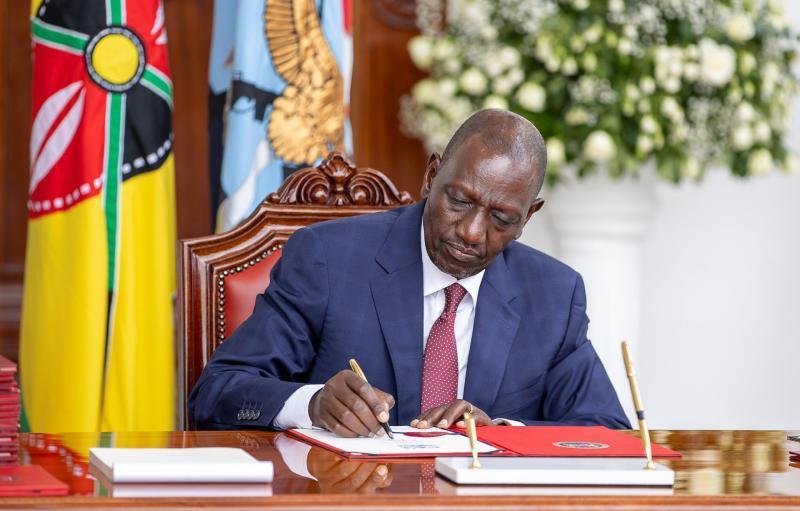
In a statement on Monday, May 11, President Ruto said he signed the Income Tax Bill, the Special Economic Zones (Amendment) Bill, and the Technopolis Bill into law.
“We are streamlining our laws to strengthen Kenya’s position as an attractive investment destination by creating a more efficient, predictable, and competitive business environment.
“Assented to the Income Tax Bill, the Special Economic Zones (Amendment) Bill, and the Technopolis Bill at State House, Nairobi,” read the statement in part.
The Head of State explained that the Income Tax Act will rationalize Capital Gains Tax and align the country’s tax regime with international best practices.
Read More

“The Income Tax Act seeks to rationalise the administration of Capital Gains Tax and align Kenya’s tax regime with international best practice and principles of taxation, while reinforcing the gains made in improving the ease of doing business,” he said.
President Ruto also highlighted that the Special Economic Zones Act will enhance Kenya’s competitiveness by expanding the scope of special economic zones to include oil and gas zones, and harmonizing tax incentives applicable to entities undertaking activities within the zones.
He noted that the new legislation will further expand the scope of special economic zones to support strategic sectors of the economy.
“The law also strengthens the special economic zones framework by aligning it with the operational realities of large-scale capital investments through the provision of a minimum licence tenure of 10 years to accommodate long project cycles associated with such investments,” said Ruto.
On the Technopolis Act, President Ruto said the law establishes a comprehensive legal framework for the creation, development, and governance of technopolises in Kenya.
The President explained that the law seeks to position Kenya as a leading destination for technology-driven enterprises, innovation, and research by establishing integrated one-stop hubs for the efficient delivery of government services.
“The framework is expected to attract global investment, talent, and innovation while accelerating Kenya’s transition into a knowledge-based digital economy,” Ruto added.
This comes weeks after President Ruto signed the Value Added Tax (VAT) Amendment Bill 2026 into law.
The Head of State signed the new law on Friday, April 17, during a ceremony at State House, Nairobi.
The bill was introduced into the National Assembly by Kilifi North Member of Parliament Owen Baya on Thursday, April 16, and passed by lawmakers on the same date.
Highlighting the new law, National Assembly Clerk Samuel Njoroge said the bill was introduced in the house following a dispatch from the National Treasury.
He noted that the bill amends section 6 of the VAT Act, which previously permitted the Treasury CS to vary VAT by not more than 25 percent of the standard 16 percent VAT.
Njoroge outlined that the 25 percent provided in the VAT Act was not enough to cushion the public from the rising fuel prices.
“Conscious that the 25 percent may not be able to cushion Kenyans appropriately, the National Assembly responded to your request and amended the act to provide that the VAT rate applicable to petroleum products for a period of 90 days shall be at 8 percent,” the National Assembly clerk stated.








 (1)-1791178178-sm.jpg)