
Editor's Review
Kenya and Rwanda have signed three key agreements that will allow Rwanda to import bulk refined petroleum products through the Port of Mombasa.
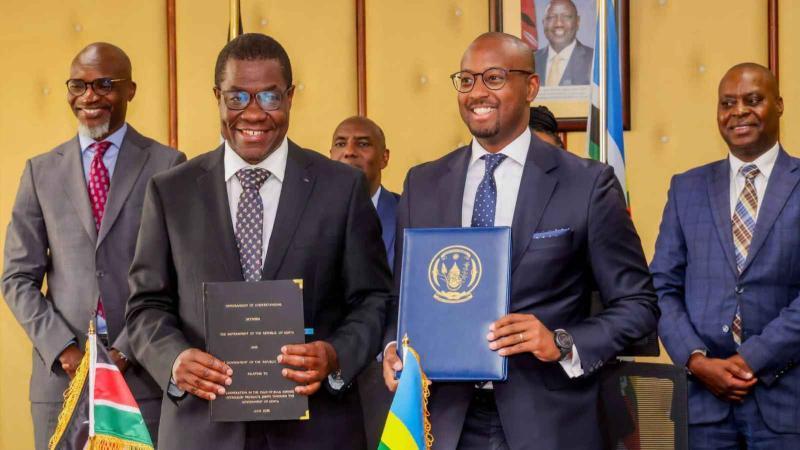
Kenya and Rwanda have signed three key agreements that will allow Rwanda to import bulk refined petroleum products through the Port of Mombasa under a Government-to-Government (G2G) arrangement.
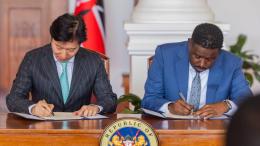
The agreements, signed on Monday, June 29, at KASNEB Tower in Nairobi, include a Memorandum of Understanding (MoU), a Tripartite Agreement (TPA), and a Transport and Storage Agreement (TSA).
Together, they fully open the Northern Corridor for Rwanda's bulk petroleum imports and are expected to significantly increase fuel volumes transported through Kenya.
The agreements conclude negotiations that began during a bilateral meeting in Kigali in November 2024; Kenya's Cabinet later approved the framework on June 16, 2026, paving the way for its implementation.
The new framework is projected to increase Rwanda's annual petroleum imports through the Northern Corridor from approximately 42,000 cubic metres recorded in 2025 to more than 500,000 cubic metres.
Read More
The first shipment under the arrangement, designated RNEC 001/2026, is expected to arrive at the Port of Mombasa between September 4 and 6, 2026.
Speaking during the signing ceremony, Energy Cabinet Secretary Opiyo Wandayi described the agreements as a long-term commitment between the two countries.
"What we are signing today is not just a legal framework but a commitment by the Ministry and all agencies related to the petroleum sub-sector: Kenya will provide a transit environment to guarantee security of supply of bulk refined petroleum products to Rwanda for the long haul.
"The volumes are set to grow more than tenfold. But the numbers are not the endgame; what this represents for our two great nations is deeper economic integration that will serve the East African Community and the Great Lakes Region for several decades to come," he said.

Rwanda's Minister of Trade and Industry Antoine-Marie Kajangwe said the agreements would strengthen his country's energy security while deepening cooperation with Kenya.
"Today marks a turning point for Rwanda's energy future. For years, we have worked alongside our Kenyan partners to build a framework that guarantees our people reliable, affordable, and secure access to petroleum products. These agreements are the product of trust - trust between our two governments, trust between our institutions, and trust between our people.
"Rwanda is proud to deepen this partnership and to stand alongside Kenya as we write a new chapter in East African energy cooperation. We look forward to welcoming the first cargo in September as the beginning of a long and prosperous journey together," he stated.
Kenya Pipeline Company (KPC) Acting Managing Director Pius Mwendwa said the agreement represented the culmination of years of efforts to regain a larger share of Rwanda's fuel market.
"Over the past decade, KPC PLC, with the support of the Ministry of Energy and Petroleum and EPRA, has relentlessly pursued this market, deploying all possible strategies. We found ourselves serving only 10% or less of Rwanda's market demands. I am elated that the page turns today for the better," he noted.
This comes days after Kenya and Japan have signed a new Ksh22.1 billion financial facility to accelerate the growth of Kenya's vehicle sector.
In a statement on Monday, June 22, President William Ruto said the partnership marks a significant milestone in the long-standing relationship between the two countries.
"Today, Kenya and Japan open a new chapter in a friendship built over decades as we strengthen our strategic partnership through new commitments in financing, investment, and development cooperation, reflected in the agreements we sign today," he said.
Ruto revealed that the Ksh22.1 billion mobilised through the partnership will be directed toward three key national priorities, with the largest share earmarked for the country's automotive industry.
He explained that JPY 15 billion, equivalent to approximately Ksh13.1 billion, will support the implementation of Kenya's National Automotive Policy.
Ruto said the initiative is designed to boost local vehicle assembly, create jobs, and strengthen Kenya's manufacturing sector.

 (1)-1791708588-sm.jpg)
 (1)-1791175033-sm.jpg)