
Editor's Review
To finance the expanded budget, the government is prioritizing enhanced non-tax revenue streams, including privatization and securitization initiatives.
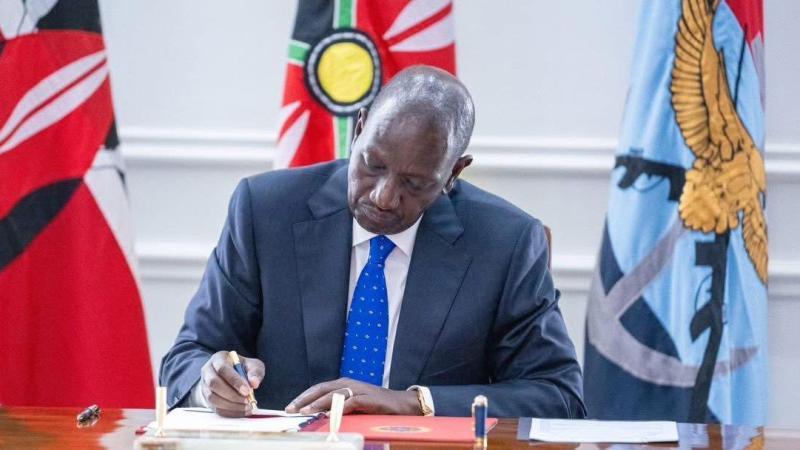
President William Ruto has assented to the Supplementary Appropriations Bill for the 2025/2026 financial year, increasing the national budget by Ksh393 billion.
The bill was considered and passed by the National Assembly of Kenya with amendments on Thursday, April 2.
The revised budget raises total government expenditure from Ksh4.301 trillion to Ksh4.695 trillion, representing a 9.1 percent increase.
Of the additional Ksh393.156 billion, Ksh363.882 billion has been allocated to the National Government, while Ksh29.273 billion goes to Consolidated Fund Services.
Current expenditure rises by Ksh229.4 billion, while capital expenditure grows by Ksh134.46 billion.
Read More
The government also approved Ksh41.3 billion in expenditures under Article 223 of the Constitution, targeting security operations, emergency relief for Arid and Semi-Arid Lands (ASAL), and key infrastructure projects.
The security sector emerges as the largest beneficiary, receiving Ksh60 billion in additional funding.
The State Department for Internal Security and National Administration has been allocated Ksh11.9 billion for various initiatives, including Ksh3.9 billion for security operations, Ksh2 billion for the National Integrated Security Command and Control System (NISCCS), Ksh2 billion for compensation of victims of demonstrations, and Ksh4 billion for police modernization.
Additionally, the Independent Electoral and Boundaries Commission has been allocated Ksh2.9 billion to settle pending legal bills.
The education sector has received substantial additional funding to address salary gaps, institutional needs, and student support.
The Teachers Service Commission has been allocated Ksh24.2 billion to cover salary shortfalls and health insurance contributions, alongside an additional Ksh3 billion for pending medical cover bills.
The Higher Education Loans Board receives Ksh4.1 billion, bringing its total allocation to Ksh45.6 billion.
Universities benefit from Ksh3.88 billion to clear salary arrears from the 2017–2021 Collective Bargaining Agreement, as well as Ksh6 billion directed to institutions, including Moi University and Kabarnet University.
Further allocations include Ksh1.5 billion to the University Funding Board and Ksh2.6 billion for the Kenya-China TVET Project Phase III.

In the health sector, Ksh4.7 billion has been allocated through the State Department for Medical Services, alongside Ksh775 million for Public Health and Professional Standards.
A significant portion, Ksh4 billion, will be used to settle pending bills of the defunct National Hospital Insurance Fund.
Additional funding includes Ksh675 million for upgrading Level 4 hospitals, Ksh5.4 billion for the doctors’ internship programme (bringing the total to Ksh9.8 billion), Ksh2.5 billion for Moi Teaching and Referral Hospital, and Ksh2.6 billion for vaccine programmes.
Infrastructure development continues to receive attention, with Ksh4.5 billion allocated to the Horn of Africa Gateway development projects under the State Department for Roads.
The Affordable Housing Programme receives a major boost of Ksh25 billion to accelerate implementation under the BETA agenda.
The agriculture sector has been allocated over Ksh17 billion, including Ksh10 billion for the fertilizer subsidy programme, raising its total funding to Ksh18 billion.
Other allocations include Ksh1 billion each for tea reforms and agricultural credit through the Agricultural Finance Corporation, Ksh2 billion for sugar reforms, and Ksh1.5 billion for food security and crop diversification.
The Blue Economy and Fisheries Department has been allocated Ksh350 million to organize an Oceanic Conference aimed at enhancing Kenya’s role in marine conservation and sustainable fisheries.
In environmental conservation, the Forestry Department receives Ksh2 billion for tree growing campaigns and rangeland restoration, as well as Ksh500 million under the Watershed Improvement Project (KEWASIP) to support reforestation and protect critical water sources.
To finance the expanded budget, the government is prioritizing enhanced non-tax revenue streams, including privatization and securitization initiatives.
The Kenya Revenue Authority has also received an additional Ksh17.6 billion to strengthen tax collection efforts and reduce reliance on public borrowing.
This comes weeks after Ruto assented to three bills aimed at strengthening civil registration, streamlining crop regulation and professionalising social work.
In an update on Thursday, February 19, the Head of State said he signed into law the Births and Registration (Amendment) Bill (2024), the Pyrethrum Repeal Bill (2024), and the Social Work Professionals Bill (2023).
Ruto explained that the Births and Registration (Amendment) Bill seeks to improve access to registration services across the country.
"The Births and Registration Bill, sponsored by Gilgil MP Martha Wangari, will enable the establishment of at least one births and deaths registration office in each sub-county," he said.
On agricultural reforms, Ruto said the Pyrethrum Repeal Bill will harmonise the management of strategic crops under one legal framework.
"The Pyrethrum Repeal Bill is sponsored by National Assembly Majority Leader Kimani Ichung'wah, who is also the Kikuyu MP. In the repeal of this Act, the administration and regulation of key strategic crops, including pyrethrum as a scheduled crop, would be vested under a single, coherent legislative framework," he added.
Regarding the regulation of the social work profession, Ruto noted that the new law will create institutions to oversee standards and practice in the sector.
"The Social Work Professionals Bill, sponsored by Kaiti MP Joshua Kimilu, establishes the Institute of Social Work Professionals and the Social Work Professionals Board to regulate the social work profession," he further said.
 (1)-1791708588-md.jpg)
 (1)-1791175033-md.jpg)
-1791699761-md.jpg)
 (1)-1791708588-sm.jpg)
 (1)-1791175033-sm.jpg)