Editor's Review
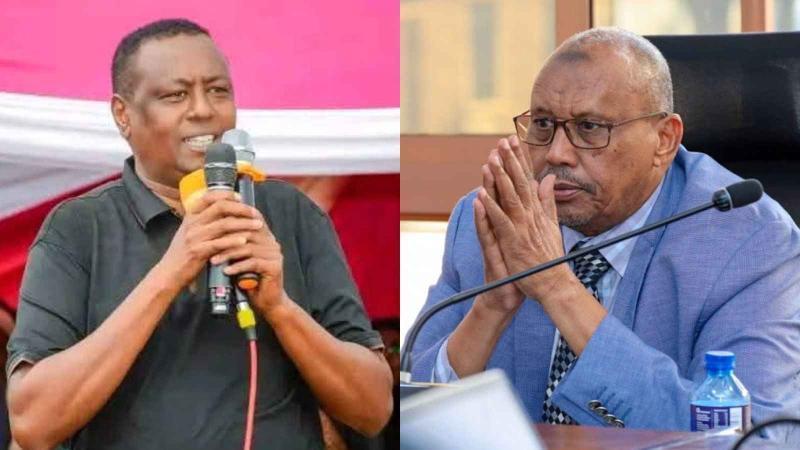
The Senate Standing Committee on Devolution and Intergovernmental Relations has hit back at Isiolo County Assembly Speaker Abdullahi Banticha after he declined to appear before the committee.
The Senate Standing Committee on Devolution and Intergovernmental Relations has moved to formally summon Isiolo County Assembly Speaker Abdullahi Banticha after he declined to appear before the committee on Tuesday, May 26.
The committee, chaired by Wajir Senator Mohamed Abbas, had invited the Isiolo County Assembly leadership to address concerns raised by Isiolo Senator Fatuma Dullo over the continued use of the Oldonyiro County Assembly Hall after the expiry of its gazetted five-month occupancy period.
In his response to the committee, Banticha rejected the invitation and questioned the legitimacy of the process.
"I am the duly elected and lawful Speaker of the Isiolo County Assembly," he stated, referencing Gazette Notice No. 8667 and a ruling by Lady Justice Hellen Wasilwa of the Employment and Labour Relations Court which, according to him, affirmed his position.
Banticha further objected to the Senate’s invitation of Mohamed Roba Qoto, whom he described as a stranger to the office of Speaker.
Read More
"With all due respect to the Committee and the Senate, I and the Isiolo County Assembly will not honour the invitation to appear, nor will we engage with this process, as it is fundamentally irregular and an affront to our Assembly," he added.
Banticha also accused the Senate of exceeding its constitutional mandate under Article 96 by interfering in the internal affairs of a county legislature.
"As the Speaker of a County Assembly, I am constitutionally and statutorily constrained from appearing before a Committee of another legislature to answer for the legality of a resolution of my Assembly.
"The moment Senate Committees begin demanding documents and justifying resolutions of County Assemblies will mark the beginning of the end of devolution," he further said.

However, senators sitting in the committee dismissed his arguments, insisting that the Senate has oversight powers over county governance matters beyond financial accountability.
Committee Chairperson Abbas defended the decision to summon the assembly leadership and called for firm action.
"The Devolution committee hereby summons the Isiolo County Assembly Speaker. The oversight role of autonomous institutions is responsible to a particular institution, which in this case is the Senate," he directed.
Committee Vice-Chairperson, Nominated Senator Catherine Mumma, also faulted Banticha’s objections, maintaining that the Senate was acting within the law.
"Asking for the documents is right because we are going to verify what's the situation. There is no way the Senate has overstepped. Speaker Banticha is wrong," she stated.
Members of the committee argued that Banticha’s outright refusal to cooperate left the Senate with no alternative but to invoke its legal enforcement powers.
"The speaker has categorically indicated that he will not honor the invitation to appear, nor will he engage with this process. This is a defiance to the invitation," Abbas added.
The committee subsequently directed that formal summons be issued immediately to both Banticha and the Clerk of the Isiolo County Assembly under the Parliamentary Powers and Privileges Act.
They are now expected to appear before the Senate committee next Thursday.
This comes weeks after the Senate penalized Trade Cabinet Secretary Lee Kinyanjui with a Ksh500,000 fine after he failed to appear before a parliamentary committee as required.
The decision was made by the Senate Standing Committee on Trade, Industrialization and Tourism, which had summoned the CS to present a detailed progress report on the rollout of County Aggregated Industrial Parks (CAIPs) nationwide.
Committee members, led by Tana River Senator Danson Mungatana, stressed the importance of accountability, arguing that officials in the Executive must treat parliamentary summons with seriousness.
Lawmakers also raised concerns about the implementation of the industrial parks, pointing to discrepancies between funds released and actual work completed on the ground.
Uasin Gishu Senator Jackson Mandago noted that oversight visits revealed troubling trends, where counties that had received up to 80 percent of allocated funds had only completed between 10 and 20 percent of the projects.
Further concerns were raised over some county governments allegedly spending national government allocations without contributing their agreed share of funding, contrary to established guidelines.
Senators emphasized that strict adherence to standards is essential in the establishment and operation of the industrial parks, noting that this would ensure quality production, eliminate inefficiencies, and protect public interests.


 (1)-1792130983-sm.jpg)