
Editor's Review
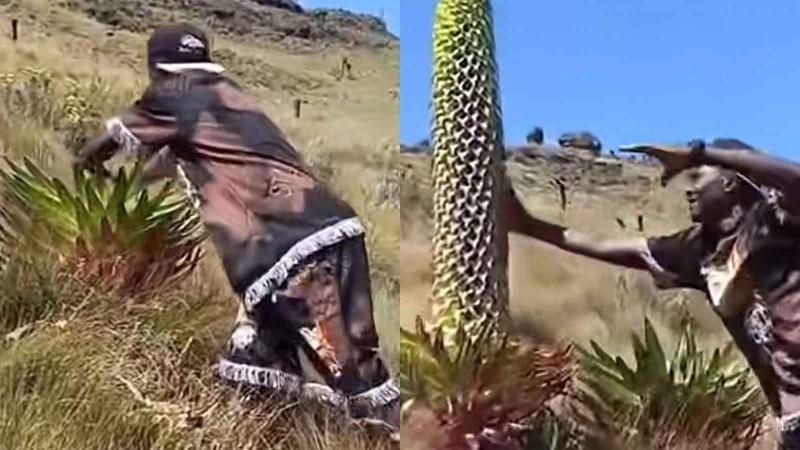
KWS has launched investigations into a viral social media video that shows the destruction of Giant Lobelias, a rare alpine plant species found in high-altitude mountain ecosystems.
The Kenya Wildlife Service (KWS) has launched investigations into a viral social media video that shows the destruction of Giant Lobelias, a rare alpine plant species found in high-altitude mountain ecosystems.
In a statement on Friday, June 12, the agency said it had taken note of the footage circulating online and was treating the matter with concern.
KWS also thanked members of the public for drawing attention to the incident saying it values the role played by citizens in protecting Kenya’s natural heritage.
"The Kenya Wildlife Service (KWS) has noted with concern a video circulating on social media allegedly showing the destruction of Giant Lobelias (Lobelia telekii), a unique alpine plant species found in Kenya’s high-altitude mountain ecosystems.
"KWS appreciates the vigilance of members of the public who have brought the matter to its attention and values the trust placed in the Service’s conservation mandate," the statement read.
Read More
KWS revealed that investigations are already underway to establish the authenticity of the footage, identify the location where the incident may have occurred, and determine those responsible.
"Investigations are currently underway to verify the authenticity of the footage, determine where the incident occurred, and establish the circumstances surrounding it, including the individuals involved.
"Should the allegations be substantiated, KWS will pursue appropriate action in accordance with the law," the statement further read.

KWS further highlighted the ecological importance of Giant Lobelias, noting that the plants are uniquely adapted to harsh mountain environments and contribute significantly to biodiversity conservation.
"Giant Lobelias (Lobelia telekii) are among the most distinctive plant species found in Kenya’s afro-alpine ecosystems, occurring on high-altitude mountains such as Mount Kenya, the Aberdares, and Mount Elgon.
"Adapted to some of the harshest environmental conditions, these slow-growing plants play an important ecological role in supporting biodiversity and maintaining the health of fragile mountain ecosystems," the statement explained.
KWS warned against activities that damage protected plants, wildlife, or sensitive ecosystems, saying such actions undermine conservation efforts and threaten the country's natural heritage.
"KWS strongly cautions against the destruction or unlawful interference with protected wildlife, plants, and sensitive ecosystems, as such actions threaten Kenya’s natural heritage and ongoing conservation efforts," the statement concluded.
Elsewhere, this comes weeks after KWS issued a health alert after residents in Thika, Kiambu County, killed and slaughtered a hyena.
In a statement on Saturday, April 11 night, KWS said the hyena was found feeding on dumped poultry remains in Kamenu Location.
Angry residents chased and killed the animal before KWS response teams arrived at the scene.
According to the service, several individuals escaped with parts of the carcass, including internal organs.
"This morning at around 0800hrs, a hyena was found feeding on dumped poultry remains in Kamenu Location, Thika West Sub-County, Kiambu County (near Thika). The animal was surrounded by residents, chased, killed, and slaughtered before response teams arrived. Several individuals fled with parts of the carcass, including internal organs," KWS stated.
The wildlife service cautioned members of the public against handling or consuming any meat from the animal.
KWS noted that hyenas are scavengers and carry dangerous diseases that can be transmitted to humans.
"Members of the public are strongly warned not to handle or consume any meat from the animal. Hyenas are scavengers and may carry dangerous diseases such as Rabies, Anthrax, Brucellosis, and foodborne infections like Salmonella infection and E. coli infection,"KWS warned.
Further, KWS urged anyone in possession of the hyena carcass to surrender it immediately to authorities.
The service also advised individuals who have come into contact with the meat to seek immediate medical attention.


-1792071927-md.jpg)



-1792071927-sm.jpg)