Editor's Review
Agriculture Cabinet Secretary Mutahi Kagwe has directed tea factories to enforce strict quality controls by rejecting green leaf that fails to meet the 'two leaves and a bud' standard.
Agriculture Cabinet Secretary Mutahi Kagwe has directed tea factories to enforce strict quality controls by rejecting green leaf that fails to meet the recommended 'two leaves and a bud' standard.
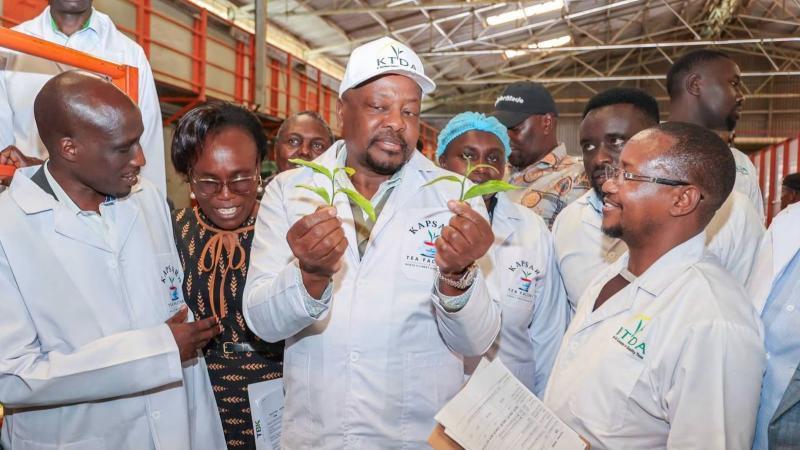
Speaking during a visit to Kapsara Tea Factory on Friday, August 14, where he handed over Ksh44.6 million for the installation of a new withering plant, Kagwe demonstrated different tea plucks to show the distinction between acceptable green leaf and material that should be rejected.
He warned that allowing poor-quality leaves to be mixed with good plucks compromises the quality of the final product and can reduce the returns earned by farmers.
"If we have agreed that quality tea is two leaves and a bud, then that is what must come to the factory. We cannot have farmers who are doing the right thing being punished because a few others bring poor-quality leaf which is then processed together with theirs," he said.
Kagwe said the government's quality drive was not intended to punish farmers but to establish standards that would improve the international value of Kenyan tea and translate into better earnings and annual bonuses for growers.
Read More
He pointed to Momul Tea Factory as an example of how improved green-leaf quality can affect farmer returns, noting that the factory had raised the value of its tea from about US$2 to more than US$3 per kilogram.
Kagwe said the modernisation programme would involve replacing outdated machinery, improving energy efficiency, cutting processing expenses and enabling factories to produce higher-value orthodox and specialty teas.
At Kapsara, the Ksh44.6 million allocation will be used to install a new withering plant to replace ageing equipment that consumes significant amounts of electricity.

Kagwe linked the investment to President William Ruto's wider agricultural transformation agenda, while stressing that modern equipment alone cannot improve the quality of tea when factories receive substandard raw materials.
He also called for increased diversification of Kenya's tea export markets, urging the sector to retain traditional buyers while pursuing new markets as production of orthodox, specialty and value-added teas expands.
Kagwe further criticised politicians opposing the tea levy, arguing that the charge is paid by buyers rather than farmers or tea factories.
He said revenue from the levy would be directed towards areas including price stabilisation, research, infrastructure, marketing, quality improvement, value addition and market development.
This comes weeks after the government handed over a Ksh28.7 million grant to Thumaita Tea Factory to support the modernisation of its operations and improve the quality of tea produced by farmers.
In a brief statement on Friday, July 24, the Ministry of Agriculture said the investment is also aimed at strengthening value addition and improving returns for tea farmers.
"Cabinet Secretary Mutahi Kagwe has handed over a Ksh28.7M Government grant to Thumaita Tea Factory to support modernisation, improve tea quality, and boost value addition for better farmer returns," the statement read.
The ministry also addressed concerns surrounding the Tea Levy, particularly regarding who pays the levy and how the funds are utilised.
"The CS reaffirmed the Government’s commitment to a stronger tea sector, clarifying that the Tea Levy is paid by buyers, not farmers, and is reinvested into research, market promotion, climate resilience, innovation, and value addition to enhance the industry’s long-term competitiveness," the statement added.