
Editor's Review
Judiciary Spokesperson Paul Ndemo said the proposed funding will address long-standing infrastructure challenges across the Judiciary.
The Judiciary has welcomed the Cabinet's approval of the second phase of the Judicial Performance Improvement Project (JPIP II).
In a statement on Wednesday, July 1, Judiciary Spokesperson Paul Ndemo said the proposed funding will address long-standing infrastructure challenges across the Judiciary, including the construction of new court facilities, accommodation for tribunals, and a permanent home for the Kenya Judiciary Academy.
He said the next phase of the programme will focus on expanding the Judiciary's physical infrastructure to meet growing operational demands.
"The second phase of funding is intended to support construction of new facilities for the Supreme Court, the Court of Appeal, and the Judiciary's Administration Headquarters," he wrote.
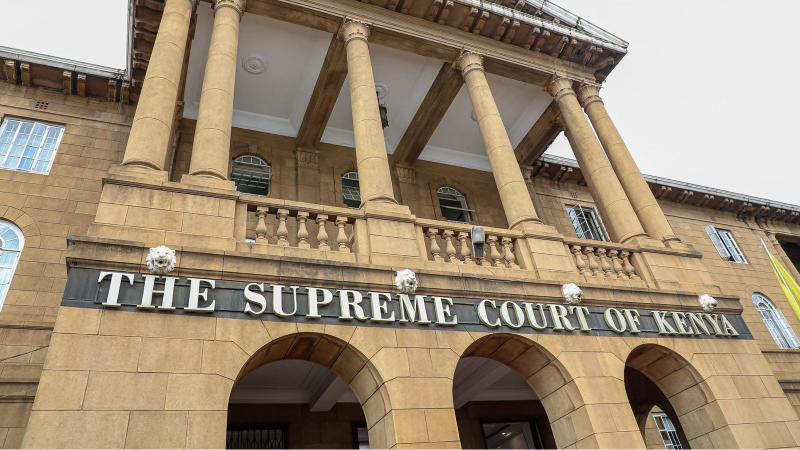
Ndemo noted that the expansion has become necessary because the current Supreme Court building no longer adequately serves the needs of the Judiciary.
Read More
"This is necessitated by acute space constraints at the Supreme Court Building, which was erected in 1930 for a much smaller Judiciary and currently houses the Supreme Court, the Court of Appeal, and the Judiciary's Administration Headquarters," he added.
Ndemo added that despite the planned expansion, the historic Supreme Court building will be preserved due to its protected status.
"As a protected national monument, the existing Supreme Court Building will undergo renovation rather than replacement, and will complement the new facility to be erected with World Bank funding," he further said.

Ndemo also revealed that the project seeks to provide adequate office and operational space for tribunals that have been established over the years following the promulgation of the 2010 Constitution.
"The support will also enable the Judiciary to provide facilities for 28 Tribunals that have come to operate under the Judiciary's auspices since the promulgation of the Constitution in 2010, but without a corresponding expansion of infrastructure to accommodate them," he stated.
Ndemo noted that the funding proposal further includes plans to construct a permanent campus for the Kenya Judiciary Academy, which has relied on rented premises since it was established.
"Additionally, the funding will support construction of a permanent home for the Kenya Judiciary Academy, which has operated in leased facilities since its establishment, an arrangement that has proved costly over the long term," he revealed.
Ndemo also outlined the steps that remain before the project can proceed, noting that Cabinet approval does not amount to immediate financing.
"Cabinet's approval paves the way for the National Treasury to formally engage the World Bank on the funding in line with the mandate of the National Treasury and the law governing funding from multilateral partners.
"Should the World Bank approve it, the funding will be subject to appropriation by the National Assembly and compliance with public procurement laws," he concluded.
This comes days after Chief Justice Martha Koome established a new Environment and Land Court in Mavoko, Machakos County.
In a gazette notice issued on Friday, June 19, Koome said the court will be based at the new Mavoko Law Courts building.
According to the notice, the new Environment and Land Court will officially begin operations on Wednesday, July 1, 2026.
"Take notice that the Chief Justice and President of the Supreme Court of Kenya has established an Environment and Land Court at Mavoko, based at the new Mavoko Law Courts Building, Machakos County, with effect from the 1st July, 2026," the notice read in part.
Koome also established an Environment and Land Court Sub-Registry at Maralal Law Courts in Samburu County.
The sub-registry at the Maralal Law Courts will similarly begin operations on July 1, 2026.
"Take notice that the Chief Justice has established an Environment and Land Court Sub-Registry at Maralal Law Courts, Samburu County with effect from the 1st July, 2026," the gazette notice read.

 (1)-1791708588-md.jpg)
 (1)-1791175033-md.jpg)
-1791699761-md.jpg)
-1791696120-md.jpg)


 (1)-1791708588-sm.jpg)
 (1)-1791175033-sm.jpg)

-1791699761-sm.jpg)