Editor's Review
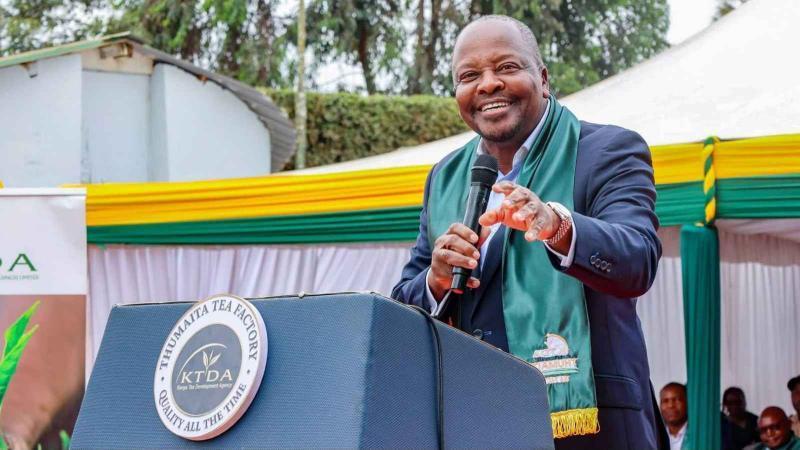
The government has handed over a Ksh28.7 million grant to Thumaita Tea Factory to support the modernisation of its operations and improve the quality of tea produced by farmers.
The government has handed over a Ksh28.7 million grant to Thumaita Tea Factory to support the modernisation of its operations and improve the quality of tea produced by farmers.
In a brief statement on Friday, July 24, the Ministry of Agriculture said the investment is also aimed at strengthening value addition and improving returns for tea farmers.
"Cabinet Secretary Mutahi Kagwe has handed over a Ksh28.7M Government grant to Thumaita Tea Factory to support modernisation, improve tea quality, and boost value addition for better farmer returns," the statement read.
The ministry also addressed concerns surrounding the Tea Levy, particularly regarding who pays the levy and how the funds are utilised.
"The CS reaffirmed the Government’s commitment to a stronger tea sector, clarifying that the Tea Levy is paid by buyers, not farmers, and is reinvested into research, market promotion, climate resilience, innovation, and value addition to enhance the industry’s long-term competitiveness," the statement added.
Read More

This comes weeks after the ministry announced a large-scale rice purchase programme that targeted more than 70,000 bags of locally produced Mwea rice.
In a statement on Tuesday, June 30, the ministry said the initiative brought together the Kenya National Trading Corporation (KNTC), the Agriculture and Food Authority (AFA), and farmers' cooperatives led by the Mwea Rice Growers Multipurpose Cooperative Society (MRGM).
Acting AFA Director General Calistus Kundu said the government remained focused on ensuring rice farmers had a reliable market for their produce.
He added that strengthening local production was key to reducing the country's dependence on imported rice.
KNTC Managing Director Lucy Anangwe said deliveries were expected to continue until mid-August before the rice was distributed to public institutions nationwide.
"We are here to assess the situation on the ground and reassure farmers that the Government remains committed to supporting the marketing of locally produced rice. KNTC is fully committed to mopping up the rice produced by farmers," Anangwe said.
According to officials, the MRGM Cooperative Society, which represented more than 80 per cent of rice farmers in the region, had over 30,000 bags of rice in storage.
The cooperative also expected another 25,000 bags from the ongoing third crop season, while self-help groups were holding more than 15,000 additional bags, bringing the total volume targeted under the programme to over 70,000 bags.
To speed up the collection process, KNTC and the cooperative agreed to transport at least two truckloads of rice every day.
The milling facility would also introduce a third production shift, increasing daily milling capacity to 56 tonnes while creating additional employment opportunities.
On his part, MRGM Cooperative Chief Executive Officer Anthony Waweru said delays in selling the rice had affected payments to farmers but expressed optimism that the new arrangement would help resolve the backlog.
"We had expected to pay farmers earlier, but marketing challenges delayed the process. With KNTC now taking up the rice, we expect to clear the current stock within a month and begin paying farmers by July 20," he said.