
-1789501743-xl.jpg)
Editor's Review
Bishop Gatimu Ngandu Girls High School has been put on the spot over a Ksh1 million investment in shares at the Nairobi Securities Exchange (NSE).
Bishop Gatimu Ngandu Girls High School has been put on the spot over a Ksh1 million investment in shares at the Nairobi Securities Exchange (NSE) after MPs raised concerns about its low returns and inadequate documentation.
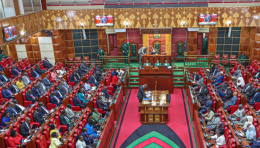
The matter came before the National Assembly Public Investments Committee on Governance and Education (PIC-G&E) on Tuesday, September 15, after the Auditor-General questioned Ksh1.58 million recorded as short-term investments in the school's financial statements for the year ended June 2021.
Auditors noted that the school had failed to produce investment certificates and other supporting documents, making it difficult to verify the existence and completeness of the Ksh1.58 million reported in its accounts.
Appearing before the committee, Chief Principal Jane Njuguna explained that the amount comprised several balances, including Ksh1 million invested in stock exchange shares, while the remainder was held in different accounts.
Njuguna told MPs that the investment generated finance income for the school.
Read More
However, her disclosure that the Ksh1 million investment had earned only Ksh5,381 in dividends over one year immediately drew scrutiny from the committee.
"Can you imagine we have Ksh1 million and this year you got Ksh5,000?" committee chairman, Luanda MP Dick Maungu, asked, questioning whether the investment was providing value for money.
The MPs also wanted to establish whether the school had obtained approval from the National Treasury before investing public funds.
Auditor-General's representative Patricia Esipeya told the committee that Section 119(2) of the Public Finance Management Act requires accounting officers to manage banking arrangements responsibly and keep public cash balances at a minimum instead of leaving funds idle without seeking optimal returns.
Esipeya further explained that public institutions are required to obtain Treasury approval through their parent ministry before making investments.
When asked whether Bishop Gatimu Ngandu Girls had secured the required approval, Njuguna asked for additional time to establish the details surrounding the investment.
The response prompted Maungu to defer the matter and direct the school to produce the relevant records before the committee.
"We need to provide that indeed there is value for money," Maungu added.
Maungu questioned why the school would keep money invested while simultaneously experiencing financial difficulties that required parents to contribute toward its needs.
"Girls will continue asking parents for money, yet they have money sitting in a platform, and that money is not adding value to the school," he further said.

Embakasi MP Mark Mwenje took issue with the decision to invest school funds, arguing that the institution's primary responsibility was to educate learners rather than operate an investment portfolio.
"Schools are there to educate children. They are not investment centres," Mwenje said, adding that the Ksh5,000 annual return on a Ksh1 million investment represented poor utilisation of public funds.
Mwenje argued that the money could instead have been channelled into projects and other requirements directly benefiting students.
School bursar Racheal Wambui told the MPs that the investment remained active and that dividend payments were received through Absa and Centum.
However, Wambui was unable to immediately name the specific companies whose equities had been purchased by the school.
The bursar explained that the investment had been made before 2010, while she only joined the institution in 2022.
Wambui nevertheless acknowledged that the returns suggested the investment was not generating sufficient value for the school.
"Economically, I would say that it could not maybe give the value for money," she stated.
This comes months after the management of Kandara Technical and Vocational College came under scrutiny over its fee collection practices.
Appearing before the Public Investments Committee on Education and Governance on Wednesday, April 8, the institution’s principal and senior officials were asked to account for why a significant portion of billed fees for the financial year ending June 2025 had not been recovered.
Findings by the Auditor-General show that the college managed to collect Ksh41.3 million, which represents 49 per cent of the total fees billed.
This left an outstanding amount of Ksh43.3 million, equivalent to 51 per cent.
The audit also raised concerns about the institution’s decision to continue providing services to students with pending fee balances, a move said to be inconsistent with its own Finance Manual and Credit Control and Debtor Policy.
Lawmakers questioned the effectiveness of the college’s debt recovery strategies and whether sufficient measures had been put in place to address the issue.
"This level of uncollected revenue raises serious concerns about financial discipline and sustainability of the institution. Why are you continuing to offer services without enforcing your own policies?" Public Investments Committee on Education and Governance Chair, Bumula MP Jack Wamboka, asked.
In their response, the college leadership pointed to delays in the release of funds for government-sponsored students as the primary cause of the outstanding balances.
"The Ksh41.3 million reflects actual fees paid by students. The outstanding Ksh43.3 million relates largely to unreleased funds from government-sponsored students, including capitation, HELB loans, scholarships and bursaries," the principal told the committee.
They clarified that such funds are disbursed directly by sponsoring agencies rather than the institution, noting that the college continues to provide training services while awaiting the release of the funds.
"We are operating within the prevailing government financing framework. Denying students access to training due to delayed disbursements would be punitive and counterproductive," the principal added.
 (1)-1791450846-md.jpg)
 (1)-1791450846-sm.jpg)