Editor's Review
The United Nations has issued a warning after two Kenyan activists were abducted and held incommunicado for more than a month.
The United Nations has raised alarm over Uganda’s repression of opposition figures and the media, issuing a warning after two Kenyan activists were abducted and held incommunicado for more than a month.
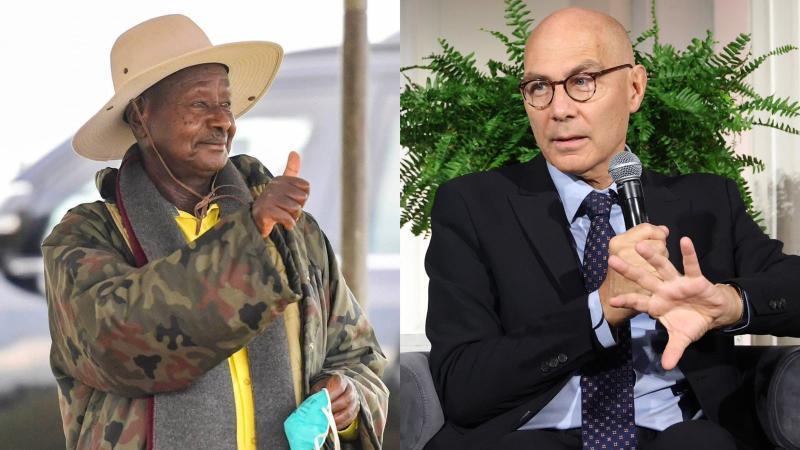
Bob Njagi and Nicholas Oyoo were abducted shortly after attending an opposition rally in October and were detained in what Uganda’s President, Yoweri Museveni, referred to as 'the fridge.'
In the wake of the harrowing ordeal, UN Human Rights Chief Volker Türk has urged Uganda to act decisively on allegations linked to these detentions.
"I urge the Ugandan authorities to fully and impartially investigate all allegations of enforced disappearance, arbitrary arrest and detention, and torture or ill treatment, punish those accountable and provide full reparation to the victims.
"I also call on them to end this pattern of repression. All individuals arbitrarily deprived of liberty should be released," he said in a statement on Wednesday, December 3.
Read More
Türk further condemned what he described as a worsening clampdown on opposition groups and the press ahead of Uganda’s general election scheduled for next month.
He appealed to the Ugandan government to uphold human rights throughout the electoral period.
According to Türk, evidence gathered shows that at least 550 people, including supporters and members of the National Unity Platform (NUP), have been arrested since the start of the year.
In addition, more than 300 of those arrests occurred after campaigns kicked off in September.
At the same time, many detainees are still being held and face charges ranging from public nuisance and disobedience of lawful orders to assault, obstruction, and incitement of violence.
Türk noted that security forces have also heightened their presence at locations designated for NUP rallies.

For instance, according to the UN Chief, in Iganga, officers reportedly fired live bullets, killing one person and injuring at least three others last week.
"It is deeply regrettable that election campaigns have once again been marked by widespread arbitrary arrests, detentions and the use of unnecessary or disproportionate force against the opposition, as well as undue restriction of press freedom.
"I urge Ugandan authorities to cease the use of such repressive tactics to enable Ugandans to fully and peacefully exercise their right to participate in their country’s public affairs on election day, and in its aftermath," he added.
Elsewhere, following their release, Njagi claimed that Ugandan soldiers took part in the Gen Z protests that recently rocked Kenya.
In an interview on Wednesday, November 12, Njagi said the Ugandan troops were sent across the border disguised as Kenyan police officers to suppress protesters.
"One shocking revelation is that there were some soldiers who revealed to me that they participated in the Gen Z protest in Kenya. They were moved from Uganda as military dressed in Kenyan police uniform to come and quell the riots in Kenya.
"This is a collaboration between States that is why you are seeing what is happening in Kenya resonating in Uganda and Tanzania," he said.
Njagi, who was recently released after 38 days in Ugandan custody, said his ordeal there was harrowing but still less brutal than what he endured during his abduction in Kenya.
"My abduction experience in Kenya was worse; it was nothing compared to what I went through even during these 38 days in Uganda. I’d rather in Uganda," he added.
Njagi alleged that Ugandan authorities detained him and others based on false intelligence suggesting they were planning to mobilize youth protests within Uganda.
Despite an extended period of detention, he said they were never charged with any crime.
"I think our captors had been given wrong intelligence that we were there on a mission to mobilize young people to protest. They went through our phones and they’ve had 38 days of doing investigations but they have not taken us to court to charge us with any crime.
"If we had been participating in any illegal activities, I am sure the Ugandan government would have charged us in court," he further said.
Following the abduction, Njagi described being taken to a military installation outside Kampala, where he was detained with both Ugandan civilians and other foreigners.
"After abduction, we were driven to a military camp outside Kampala. It’s a camp used specifically to train the special forces command who are responsible for the security and safety of the first family. We were held in cells alongside other foreign nationals and Ugandan civilians," he stated.
Despite his ordeal, Njagi expressed willingness to return to Uganda in the future.
"Given another opportunity to go to Uganda, I would like to go and visit Uganda for business purposes, for social purposes and even for political reasons if need be but within the Constitution of Uganda," he said.

 (1)-1792906717-md.jpg)
 (1)-1792904579-md.jpg)
 (1)-1792906717-sm.jpg)
 (1)-1792904579-sm.jpg)