
Editor's Review
The Cabinet said the approval marks a significant step in advancing Kenya’s long-term economic roadmap.
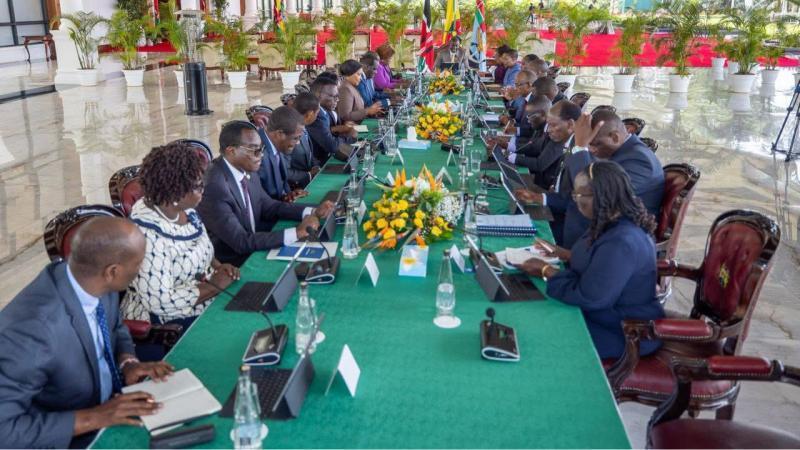
The Cabinet has approved the establishment of the National Infrastructure Fund and the Sovereign Wealth Fund.
According to the Cabinet Dispatch released on Monday, December 15, the two funds will serve as key vehicles for financing priority investments, improving fiscal discipline, and safeguarding inter-generational equity while reducing reliance on borrowing and taxation.
The Cabinet said the approval marks a significant step in advancing Kenya’s long-term economic roadmap.
"Kenya's bold and ambitious Ksh5 trillion roadmap to transform the nation into a first-world economy took a decisive step forward on Monday, following the Cabinet's approval of the establishment of the National Infrastructure Fund and the Sovereign Wealth Fund, which will anchor the country's long-term development and economic transformation," the report read.
According to the dispatch, the National Infrastructure Fund was approved as a corporate entity to coordinate and direct financial resources toward national priorities.
Read More
The Cabinet said the Fund will rely on innovative approaches to unlock private capital while easing pressure on public finances.
"Approved as a limited liability company, the National Infrastructure Fund will serve as the central engine for aligning the administration's financial resources with national development priorities.
"Through innovative mobilisation of domestic resources, strategic monetisation of mature public assets, democratisation of ownership through capital markets and the deployment of national savings, the Government will unlock large-scale private sector capital to finance priority investments while reducing reliance on borrowing and taxation," the report added.
According to the Cabinet, the framework also provides strict safeguards on how privatisation proceeds will be used, with an emphasis on long-term value creation.
"Under the new framework, all privatisation proceeds will be ring-fenced and invested strictly in public infrastructure projects that generate and preserve long-term value. Every shilling invested through the Fund is expected to crowd in up to KSh10 additional shillings from long-term investors, including pension funds, sovereign partners, private equity funds and development finance institutions," the report further read.
In addition, the Cabinet approved a policy framework to guide the establishment and operation of the Sovereign Wealth Fund.
"The Cabinet also approved the Sovereign Wealth Fund Policy, establishing a comprehensive framework for the prudent management and investment of revenues from mineral and petroleum resources, dividends from public investments and a portion of privatisation proceeds through a dedicated national fund," the report noted.

The Cabinet explained that the Sovereign Wealth Fund is intended to enhance fiscal stability and protect future generations.
It said the policy gives effect to constitutional principles while supporting the administration’s growth agenda.
"Anchored on inter-generational savings, protection against external shocks and strategic investments with commercial returns, the Sovereign Wealth Fund will strengthen fiscal discipline, enhance resilience and support long-term national competitiveness.
"It also operationalises Article 201 of the Constitution on inter-generational equity and advances the Kenya Kwanza Manifesto's investment-led growth agenda," the report continued.
The two funds will jointly support key sectors critical to Kenya’s economic transformation.
"Together, the Sovereign Wealth Fund and the National Infrastructure Fund will finance Kenya's transformation agenda focused on strengthening food security and positioning Kenya as a net-exporting economy, expanding modern transport and logistics to drive productivity and trade, and scaling up energy generation to power industrialisation and the digital economy," the report explained.
The Cabinet emphasised that both funds will operate under strong governance and accountability structures.
"Both funds will be professionally and independently managed under clear governance, transparency and accountability frameworks.
"The National Infrastructure Fund will be overseen by a competitively appointed Board and CEO, while the Sovereign Wealth Fund will operate under a robust policy framework to ensure prudent investment, fiscal discipline and inter-generational equity," the report added.
Elsewhere, this comes a month after the World Bank threw its weight behind Kenya's ambitious plan to establish a National Infrastructure Fund aimed at transforming the country's economic landscape.
In a statement on Tuesday, November 18, President William Ruto revealed that the global financial institution has endorsed the bold initiative designed to expand the nation's road and rail networks, irrigation systems, and energy generation capacity.
Ruto said the World Bank particularly commended Kenya's proposal to construct 50 mega dams, which would expand irrigated land by 2.5 million acres, describing it as the country's only pathway to sustainable and increased agricultural production.
"The World Bank has supported Kenya's bold decision to set up a National Infrastructure Fund to expand the road and rail network, irrigation and energy generation," he stated following a meeting with World Bank Africa Executive Director of Africa Group One Zarau Kibwe at State House, Nairobi.
The Bank's endorsement acknowledges that irrigation represents a new frontier for food production in Kenya, where 85 percent of the land is classified as arid or semi-arid.
The institution noted that rain-fed agriculture in the country's 15 percent arable land has reached its capacity limits.
The National Infrastructure Fund has been designed to mobilize financing for an extensive development agenda that includes the construction of 50 dams, 20,000 kilometers of roads, particularly in rural areas, and the dualization of 2,000 kilometers of highways.
The fund will also support the generation of an additional 10,000 megawatts of electricity to facilitate manufacturing and industrialization across the country.


 (1)-1791178178-md.jpg)




 (1)-1791178178-sm.jpg)