Editor's Review
The Kenya Space Agency (KSA) has announced the successful launch of the Climate Camera (ClimCam) Payload destined for the International Space Station (ISS).
The Kenya Space Agency (KSA) has announced the successful launch of the Climate Camera (ClimCam) Payload destined for the International Space Station (ISS).
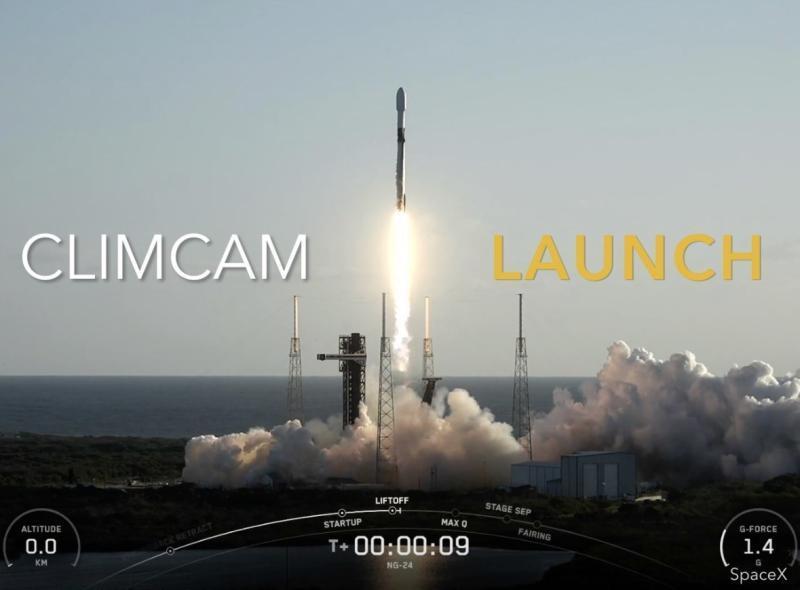
In a statement on Saturday, April 11, KSA said the CimCam payload was deployed aboard the Northrop Grumman Cygnus XL commercial resupply mission (NG-24).
The liftoff took place from Cape Canaveral Space Force Station in Florida at 1:41 PM on Saturday.
“The ClimCam is among several payloads and other supplies to the ISS aboard the Northrop Grumman’s Cygnus XL commercial resupply mission (NG-24).
“The liftoff aboard SpaceX Falcon 9 rocket took place from Cape Canaveral Space Force Station in Florida on Saturday, 11 April 2026 at 1.41 pm East African Time,” read part of the statement.
Read More

According to the agency, the spacecraft is expected to rendezvous with the ISS on the morning of Monday, April 13, 2026.
Upon arrival, the spacecraft will dock with the station as part of its scheduled resupply mission.
The ClimCam is a product of collaborative effort between the Kenya Space Agency (KSA), the Egyptian Space Agency (EgSA), and the Uganda National Space Programme.
Its development involved multiple stages, including design, assembly, integration, testing, and validation.
“Key milestones included successful Assembly, Integration, and Testing (AIT) at EgSA facilities in Cairo, followed by comprehensive end-to-end testing and fit-checks at Airbus facilities in Houston, Texas,” KSA stated.
The agency noted that the ClimCam is equipped with AI-powered capabilities and designed to deliver near real-time weather and climate data.
The innovation is expected to play a crucial role in environmental monitoring, natural resource management, disaster preparedness, and climate resilience initiatives across Eastern Africa.
The project was selected under a competitive Announcement of Opportunity issued by the United Nations Office for Outer Space Affairs (UNOOSA) in partnership with Airbus Defence and Space, as part of the Access to Space for All initiative.
KSA termed the successful launch of ClimCam as a significant step in strengthening Africa’s presence in the global space ecosystem.
“This successful launch marks a major step forward in strengthening Africa’s presence in the global space ecosystem and reaffirms Kenya’s commitment to leveraging space technology for sustainable development, environmental stewardship, and regional cooperation,” the agency added.
This comes three years after Kenya launched its first operational earth observation satellite into space.
The satellite dupped Taifa 1 was launched on April 14, 2023, aboard a SpaceX Falcon 9 rocket from Vandenberg Space Force Base in California, US.
The satellite was developed entirely by Kenyan engineers, who underwent intensive training provided by EnduroSat.
The project took approximately two years to complete, with an estimated cost of about Ksh50 million.