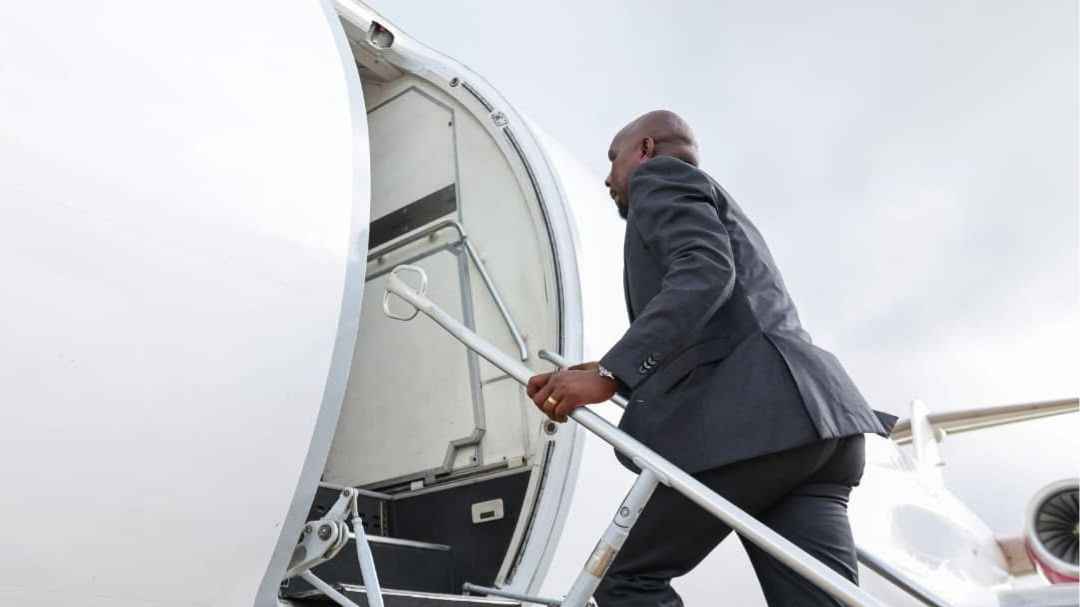
Interior Cabinet Secretary Kipchumba Murkomen has departed the country for an official assignment in the Republic of Congo.
In an update on Thursday, April 16, Murkomen said he is representing President William Samoei Ruto in the inauguration of Denis Sassou-Nguesso in Brazzaville.
"This morning, I departed for Brazzaville, Republic of the Congo, to represent William Samoei Ruto at the inauguration ceremony of President Denis Sassou Nguesso, following his victory in the March 15 elections," he said.
Murkomen is accompanied by a delegation of Members of Parliament, including Phelix Odiwuor (Lang'ata), and Mohamed Abdi Abdirahman (Lafey).
Others are Irene Njoki (Bahati), Linet Chepkorir (Bomet County), John Bwire (Taveta) and Bernard Kitur (Nandi Hills).
Read More

Sassou-Nguesso first became president in 1979 after internal political struggles within the ruling party forced then-president Joachim Yhombi-Opango to resign.
The Congolese Labour Party (PCT) installed Sassou-Nguesso as head of state and party leader.
He was re-elected in 1984 and 1989 under the one-party system and also served as chairman of the Organization of African Unity from 1986 to 1987.
However, economic decline in the late 1980s and growing pressure for reform led to the introduction of multiparty politics.
In the 1992 elections, the country held its first democratic vote, and Sassou-Nguesso lost in the first round to Pascal Lissouba.
After losing power, Sassou-Nguesso became a key opposition figure as political tensions escalated into armed conflict.
In 1997, a civil war broke out between forces loyal to Sassou-Nguesso and Lissouba; Sassou-Nguesso eventually regained power through the conflict, with Lissouba forced into exile.
Sassou-Nguesso has ruled continuously since 1997, making him one of Africa’s longest-serving leaders.
He won the 2002 election after an opposition boycott, though the legitimacy of the vote was disputed.
He was re-elected in 2009 with a large majority, and again in 2016 after constitutional changes removed presidential term limits.
In 2021, Sassou-Nguesso secured another victory with over 88 percent of the vote amid opposition boycotts and criticism.
In 2026, he was re-elected again with an overwhelming majority, further extending his decades-long hold on power.
A major turning point came in 2015, when a constitutional referendum removed presidential term limits and raised the age limit for candidates.
-1776351427.jpg)