
Editor's Review
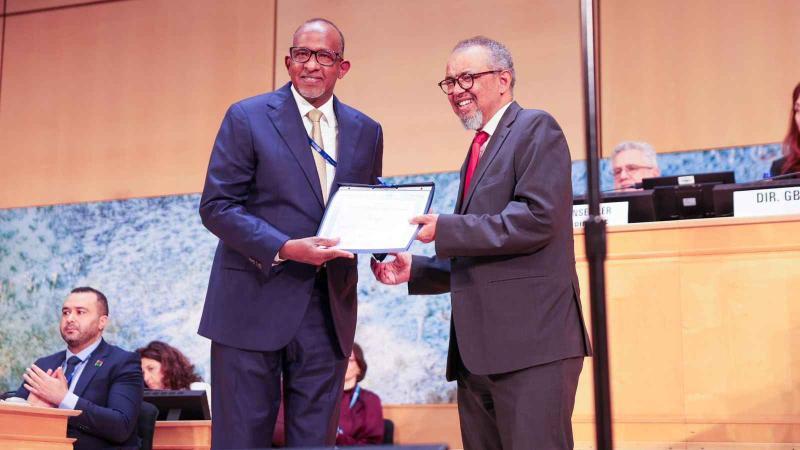
Kenya has received global recognition for eliminating Human African Trypanosomiasis, commonly known as sleeping sickness, during the 79th World Health Assembly.
Kenya has received global recognition for eliminating Human African Trypanosomiasis, commonly known as sleeping sickness, during the 79th World Health Assembly.
In a statement on Tuesday, May 19, Health Cabinet Secretary Aden Duale said the award was presented by the global health body in acknowledgment of Kenya’s sustained efforts in fighting the disease.
"The World Health Organization (WHO) presented the certificate, with Director-General Tedros Adhanom Ghebreyesus commending Kenya's leadership, sustained commitment and strong multi-sectoral collaboration," the statement read.
Duale noted that sleeping sickness had previously posed a serious threat in several counties before the country successfully contained and eliminated indigenous cases.
"Once a major threat across counties such as Busia, Bungoma, Siaya, Homa Bay, Migori and Narok, Kenya has sustained zero indigenous cases since 2009, following WHO validation in June 2025 and national confirmation in August 2025," the statement added.
Read More
Duale further praised communities and healthcare workers who played a key role in the elimination campaign through surveillance, diagnosis, treatment and awareness programs.
"I commend the affected communities for their trust and participation, alongside frontline health workers, researchers, laboratory teams, county governments and national experts who strengthened surveillance, diagnosis and response systems," the statement further read.

Duale, however, cautioned that maintaining the achievement will require continued monitoring and investment in public health systems to prevent any future resurgence of the disease.
"Even as we celebrate, elimination is not the end. Sustaining these gains requires continued vigilance through surveillance, early detection, vector control, community awareness and integration of services into routine healthcare," the statement concluded.
This comes weeks after Kenya secured a leadership role on the global health stage after being elected vice president of International Vaccines Institute (IVI).
In an update on Tuesday, April 28, Foreign Affairs Principal Secretary Korir Sing’oei confirmed that the election took place during a high-level meeting in Asia.
"This morning, in Manila, Philippines, the Global Council of the International Vaccines Institute (IVI) elected Kenya vice president of the institution.
"I commend our team in Seoul, Kenya Medical Research Institute (KEMRI) and Kenya BioVax Institute for the great outcome," he wrote.
The International Vaccines Institute (IVI) is an international, non-profit organization dedicated to improving global health through the discovery, development, and delivery of vaccines.
Its work includes conducting vaccine research and clinical trials, supporting countries in building local vaccine manufacturing capacity, strengthening immunization programs, and training scientists and health professionals.
The vice president role involves guiding the institution’s direction and supporting its governance at the highest level.
The vice president contributes to strategic leadership by helping shape IVI’s global priorities and long-term plans.
This includes working with other council members to determine focus areas, including which diseases and regions require urgent attention.


 (1)-1791708588-md.jpg)
 (1)-1791175033-md.jpg)
-1791699761-md.jpg)
-1791696120-md.jpg)


 (1)-1791708588-sm.jpg)
 (1)-1791175033-sm.jpg)