Editor's Review
Total government expenditure and net lending will amount to Ksh4.82 trillion, while total revenue is projected at Ksh3.63 trillion, resulting in a fiscal deficit of Ksh1.15 trillion that will be financed through domestic and foreign borrowing.
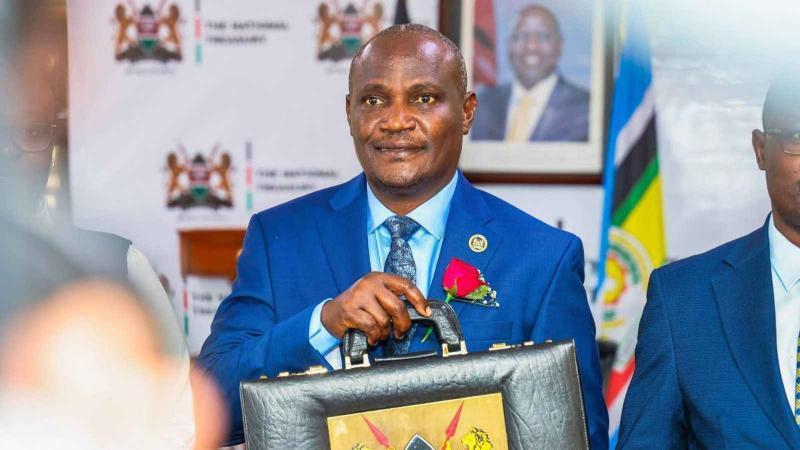
The National Treasury on Thursday, June 11, unveiled a Ksh4.82 trillion budget for the 2026/27 financial year, with education, infrastructure, public administration and national security emerging among the biggest beneficiaries.
According to the Treasury, total government expenditure and net lending will amount to Ksh4.82 trillion, while total revenue is projected at Ksh3.63 trillion, resulting in a fiscal deficit of Ksh1.15 trillion that will be financed through domestic and foreign borrowing.
Nevertheless, the education sector remains the biggest winner in the budget after receiving Ksh784.5 billion, accounting for 26.8% of total ministerial allocations.
Key allocations under the sector include Ksh408.5 billion for the Teachers Service Commission (TSC), Ksh96.4 billion for the Higher Education Loans Board (HELB) and scholarships, Ksh61.6 billion for free primary and day secondary education, Ksh30.9 billion for junior secondary school capitation and Ksh8.2 billion for intern teachers.
The government has also allocated Ksh4.9 billion to convert 20,000 intern teachers into permanent and pensionable terms from January 1, 2027.
Read More
Other allocations include Ksh7.3 billion for Technical and Vocational Education and Training (TVET), Ksh4.1 billion for school infrastructure development and Ksh3 billion for the school feeding programme.
The Energy, Infrastructure and ICT sector emerged as the second-largest recipient with an allocation of Ksh531.3 billion.
The government has set aside Ksh220.4 billion for road construction, rehabilitation and maintenance.
This includes Ksh118.1 billion for road maintenance, Ksh58 billion for rehabilitation and Ksh44.3 billion for the construction of roads and bridges.
Railway transport and infrastructure projects will receive Ksh38.1 billion, while Ksh30.9 billion has been allocated for expanding access to electricity through rural electrification, national grid development and alternative energy technologies.
In the digital sector, Ksh8.6 billion has been allocated to support the Digital Superhighway and Creative Economy agenda.
Major projects include the Kenya Digital Economy Acceleration Project, government shared services, expansion of fibre optic networks and development of smart city infrastructure at Konza Technopolis.
Public Administration and International Relations will receive Ksh373.7 billion, while Governance, Justice, Law and Order has been allocated Ksh363.9 billion.
National Security, which includes funding for the National Police Service, Kenya Defence Forces, National Intelligence Service and prison services, has been allocated Ksh316.2 billion.
Additionally, Ksh13 billion has been set aside for lease financing of police motor vehicles, Ksh7 billion for police modernisation, and Ksh1.3 billion for the construction and modernisation of national forensic facilities.
The government has allocated Ksh386.1 billion across the five BETA pillars, with agriculture remaining one of the key focus areas.
Major allocations include Ksh18 billion for the Fertiliser Subsidy Programme, Ksh9.4 billion for settlement of the landless, Ksh5.4 billion for the Food Systems Resilience Project, Ksh4.7 billion for the National Agricultural Value Chain Development Project and Ksh4.6 billion for Blue Economy projects.

Other allocations include Ksh2.7 billion for sugar reforms, Ksh2 billion for the Seed Subsidy Programme and Ksh1.3 billion for the Kenya Livestock Commercialisation Programme.
Meanwhile, the housing sector will continue to receive significant government support as part of the BETA agenda.
The government has allocated Ksh50.6 billion for the construction of affordable housing units and Ksh20.9 billion for social housing projects.
Other allocations include Ksh18.6 billion for the Kenya Urban Programme, Ksh18.2 billion for social and physical infrastructure and Ksh2.7 billion for the Kenya Informal Settlement Improvement Project.
To advance Universal Health Coverage (UHC), the health sector has been allocated Ksh177.2 billion.
Among the major allocations are Ksh19.1 billion for the Primary Healthcare Fund, Ksh18.5 billion for the Global Fund supporting HIV, malaria and tuberculosis programmes, Ksh9.3 billion for health interns and Ksh8.6 billion for Universal Health Coverage initiatives.
The government has also allocated Ksh 6.4 billion for vaccines, Ksh 3.6 billion for Community Health Promoters, Ksh 3 billion for the Emergency, Chronic and Critical Illness Fund and Ksh 2 billion for the construction of a new 2,000-bed multi-speciality hospital at Moi Teaching and Referral Hospital.
Environmental protection, water and natural resources programmes have received Ksh121.2 billion.
Of this amount, Ksh70.4 billion will go toward expanding access to clean and adequate water for domestic and agricultural use.
The government has also allocated Ksh15.1 billion for wildlife conservation, Ksh13.4 billion for forest conservation, Ksh 8.9 billion for climate action programmes and Ksh3.2 billion for the national tree-growing campaign and rangeland restoration.
Recognising the role of Micro, Small and Medium Enterprises (MSMEs) in job creation and economic growth, the government has allocated Ksh5.4 billion to the Supporting Access to Finance and Enterprise Recovery (SAFER) programme and Ksh4.9 billion to the National Youth Opportunity Towards Advancement (NYOTA) project.
The National Youth Service will receive Ksh12.5 billion, while Ksh2.4 billion has been allocated to the Kenya Jobs Economic Transformation programme and Ksh1.6 billion to youth employment support initiatives.
The budget also maintains funding for social protection programmes targeting vulnerable groups.
Cash transfers to elderly persons will receive Ksh24.6 billion, while Ksh8.9 billion has been allocated to orphans and vulnerable children.
Other allocations include Ksh4.3 billion for the Hunger Safety Net Programme, Ksh1.5 billion for persons with severe disabilities and Ksh100 million for the Presidential Bursary for Orphans.
On the other hand, county governments will receive a total of Ksh502 billion during the 2026/27 financial year.
This comprises Ksh428 billion as equitable share, Ksh16.6 billion as conditional allocations from the national government and Ksh57.4 billion from development partners.
The Treasury noted that the budget has been prepared amid heightened global uncertainties, including geopolitical tensions that continue to exert pressure on food and energy prices.
Despite these challenges, the government says Kenya’s economy has remained resilient, recording average growth of 5% between 2022 and 2025, outperforming both the global and Sub-Saharan African averages.
Economic growth is projected at 5% in 2026 and is expected to improve to 5.2% in 2027 as global conditions stabilise.
"The fiscal policy stance for FY 2026/27 and the medium term is anchored on a growth-friendly fiscal consolidation strategy that supports the priorities of the Bottom-Up Economic Transformation Agenda while safeguarding debt sustainability and protecting critical public services," the Treasury said.
The government further projects that the fiscal deficit will gradually decline from 5.5% of GDP in FY 2026/27 to 3.3% by FY 2028/29 through enhanced revenue mobilisation and expenditure rationalisation.
 (1)-1791178178-sm.jpg)