
Editor's Review
Kirinyaga County has reported a major decline in new HIV infections, placing it among the leading counties in HIV control efforts.
Kirinyaga County has reported a major decline in new HIV infections, placing it among the leading counties in HIV control efforts.
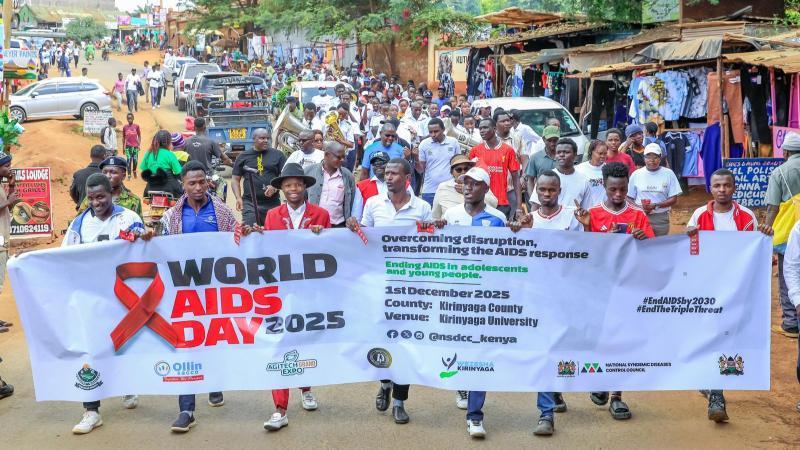
Data released during World AIDS Day celebrations on Monday, December 1, at Kirinyaga University showed the county has recorded only 91 new HIV cases in 2024, a sharp drop from the 779 cases reported in 2013.
County Executive Committee Member for Health, Medical Services and Sanitation George Karoki said the improvement is linked to increased prevention campaigns, wider testing, and stronger enrolment into treatment programmes.
He noted that investments in diagnostic equipment, expanded awareness initiatives, and support from Community Health Promoters have contributed to better outcomes.
Additionally, the county has met the UNAIDS 95-95-95 target, meaning the majority of residents know their HIV status, those diagnosed are on treatment, and most of those on treatment have achieved viral suppression.
Read More
According to county records, about 13,000 people are living with HIV, with 12,998 receiving antiretroviral therapy.
Among them are 447 children under 14, a trend that health officials say underscores the need for more family-based testing.
The county also reported that 97 percent of people on treatment have suppressed viral loads.

The county data also highlighted that 41 percent of new HIV infections are among those aged between 14 and 24.
Governor Anne Waiguru, in her recent state of the county address, noted continued progress in HIV management and maternal health indicators.
"Mother-to-child transmission of HIV reduced from 13% to 6.5%, TB Treatment Success Rate increased from 81% to 89%, antenatal coverage improved from 45% to 63%, reduction of maternal mortality ratio from 88 to 55 deaths in every 100,000 live births, and neonatal mortality rate from 26 to 10 deaths in every 1000 live births. Skilled birth attendance of mothers delivering in a health facility also improved from 87 to 92%, while the coverage of children immunised by 12 months improved from 81 to 91%," she said.
County HIV/STI Programme Coordinator Joseph Kanyi highlighted the increased vulnerability of adolescents and children, noting that many have grown up without seeing advanced stages of AIDS, which has led to lower risk perception.
"This year we are targeting adolescents and children because new infections are increasing among them, and they are also facing the biggest burden of gender-based violence and teenage pregnancies," he said.
Officials also raised concern over persistent cases of sexual and gender-based violence, which continue to fuel new infections.
County Executive Committee Member for Gender and Youth, Millicent Nyawira, said the county aims to address HIV, gender-based violence, and teenage pregnancies as part of a broader prevention strategy.
"We are empowering youth, women and men to reduce poverty. All children should be in school, and women should be able to provide for their families," she said, adding that young people should use social media to raise awareness.


 (1)-1791708588-md.jpg)
 (1)-1791175033-md.jpg)
-1791699761-md.jpg)
-1791696120-md.jpg)


 (1)-1791708588-sm.jpg)
 (1)-1791175033-sm.jpg)