
Editor's Review
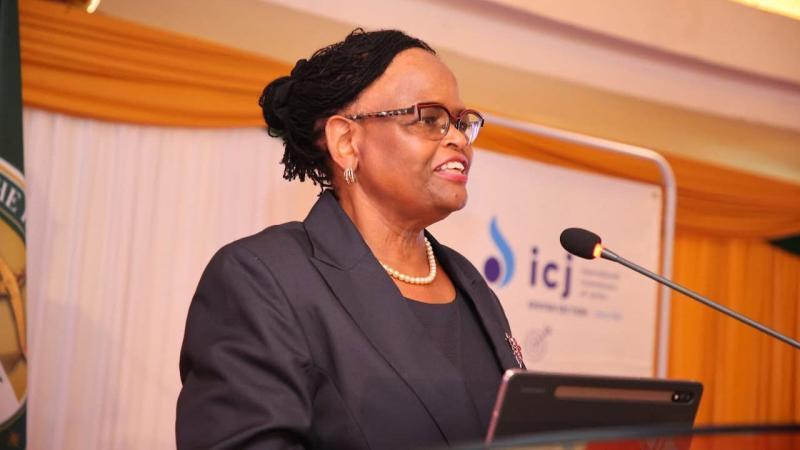
Chief Justice Martha Koome has announced the upcoming Easter recess for the Supreme Court of Kenya.
Chief Justice Martha Koome has announced the upcoming Easter recess for the Supreme Court of Kenya.
In a notice on Tuesday, March 17, the Chief Justice clarified the timeline for the recess, revealing that it will run until April.
"The Chief Justice gives notice that the Supreme Court Easter recess will commence on Thursday 26th March, 2026, and terminate on Wednesday 8th April, 2026 both days inclusive," the notice read.
Despite the recess, the court will continue to handle critical and time-sensitive cases through designated judicial arrangements.
"The duty Judge will be available during recess to deal with urgent matters," the notice added.
Read More
Additionally, the Supreme Court registry will remain operational throughout the recess, ensuring that essential services remain accessible to court users on working days.
"During this period, the Supreme Court Registry shall be open to the public from 8.30 a.m to 5.00 p.m. on all weekdays other than public holidays," the notice concluded.
This comes a week after the Judiciary announced an expansion of its court network across the country following a move by Koome aimed at improving access to justice.
In a statement on Monday, March 9, the Judiciary confirmed that Koome had gazetted new Court of Appeal stations and Small Claims Courts to strengthen the country’s judicial infrastructure.
"The move is intended to enhance access to justice for citizens by bringing critical judicial services closer to the people and improving the efficiency of the courts.
"Chief Justice Martha Koome has gazetted additional new Court of Appeal stations as well as Small Claims Courts (SCC) in a bid to expand access to justice across the country," the statement read.

The Judiciary explained that two new Court of Appeal stations had been created in Kakamega and Meru, expanding the presence of the appellate court system in the country.
"The CJ established a Court of Appeal at Kakamega Law Courts and another at Meru, sitting at Nkubu Law Courts, bringing the total number of Court of Appeal stations to eight," the statement added.
Additionally, the Chief Justice had introduced a new administrative office to support appellate operations in the eastern region.
"Chief Justice Koome has also established a Court of Appeal Sub-Registry at the Embu Law Courts in line with the Court of Appeal (Organization and Administration) Act. The total number of Sub-Registries are now five," the statement continued.
The Judiciary further clarified that several other Court of Appeal stations had already been operating across the country before the latest expansion.
"Other Court of Appeal stations include Nairobi, Mombasa, Nakuru, Nyeri, Kisumu and Eldoret, while Malindi, Garissa, Kisii and Busia, are the other Sub-Registries established earlier by the CJ," the statement further read.
According to the Judiciary, the expansion of the appellate court network would reduce the burden on litigants who previously had to travel long distances to access appellate services.
"The establishment of additional Court of Appeal stations in the country is part of ongoing efforts to decentralize appellate services and enhance access to justice. The expansion is expected to reduce distances travelled by litigants, advocates and other court users to access courts. The move will also reduce costs for litigants seeking appellate justice, particularly in the Eastern and Western regions of the country," the statement noted.
At the same time, the Judiciary expanded the Small Claims Court system by establishing several new courts across multiple counties.
"The Judiciary has scaled up the reach of the Small Claims Court in the country by establishing new courts in Maua, Mumias, Molo, Kapsabet, Ngong, Kenol, Kiambu, Mavoko, Makueni, Kilifi, Kikuyu, Vihiga, Homa Bay, Bungoma and Nyamira.
"The additional stations bring the total number of Small Claims Courts across the country to 55. This will significantly expand the availability of fast, affordable and simplified resolution of commercial and civil disputes involving relatively low monetary value," the statement read.