
Editor's Review
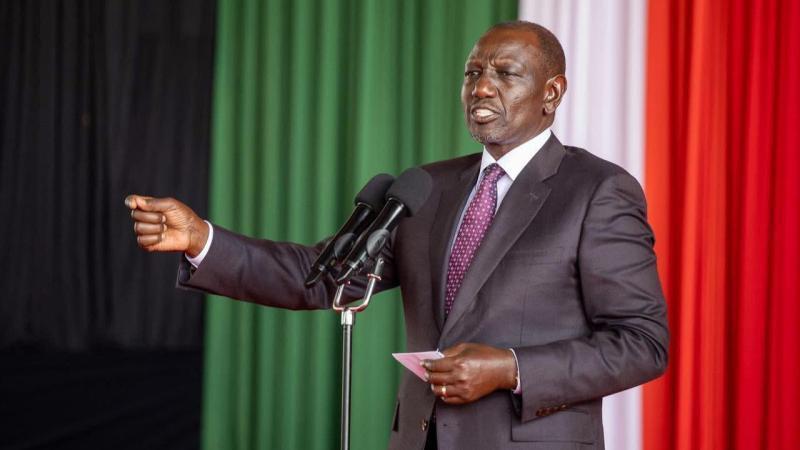
President William Ruto has issued a directive aimed at easing the financial burden on parents and ensuring that no child is denied education.
President William Ruto has issued a directive aimed at easing the financial burden on parents and ensuring that no child is denied education.
Speaking on Thursday, January 22, he acknowledged reports that some children are missing classes due to lack of school fees or uniforms.
Ruto emphasized the importance of inclusive access to education, particularly for children from economically challenged households.
"We have been informed that in some schools, many children are not attending classes because their parents lack money to pay school fees and buy uniforms. I want to direct every chief to ensure that every child goes to school," he said.
Ruto also provided guidance on the temporary use of Junior Secondary School (JSS) uniforms, allowing children to continue their education while parents raise funds for proper secondary school uniforms.
Read More
"If a child has a JSS uniform, they may use it to attend secondary school while waiting for their parent to raise money to buy a secondary school uniform. I am directing that no child should remain at home because they do not have school fees," he added.
Elsewhere, this comes days after the government announced a significant progress in implementing the 100% School Transition Policy.
In a statement on Sunday, January 18, the Ministry of Interior said the progress demonstrates near-universal compliance with the Competency-Based Curriculum (CBC).
"The Government and Parents of Kenya have recorded significant national progress in implementing the 100% School Transition Policy, with 97% of learners who completed Grade 6 in 2025 successfully transitioning to Junior Secondary School (JSS) - a major milestone that demonstrates near-universal compliance with the Competency-Based Curriculum (CBC) progression framework," the statement read.

According to the ministry, this progress is backed by coordinated monitoring and reporting at both national and county levels.
"A report compiled by the National Government Administrative Officers (NGAOs), in collaboration with County Directors of Education, confirms that Kenya is sustaining strong momentum in learner access, retention, and progression," the statement added.
The ministry noted that full school transition is not optional but a constitutional obligation, calling on all stakeholders to prevent avoidable dropouts linked to cost, placement delays, or social risks.
"We reaffirm the Government’s commitment to full transition as a national imperative: every child has a human and constitutional right to education, and all stakeholders must work together to avoid preventable dropouts driven by cost barriers, delayed placement, or social vulnerabilities," the statement continued.
Beyond Junior Secondary School, the ministry said more than half of eligible learners have already joined Senior Secondary School.
"The report further indicates that 61% of eligible learners have joined Senior Secondary School, noting that enrollment is ongoing," the statement further read.
To accommodate families facing challenges, authorities have adjusted reporting deadlines and rolled out measures aimed at capturing learners who are yet to complete placement.
"Reporting timelines have been extended in response to concerns raised by stakeholders, while addressing challenges individual families may be facing. This is an inclusive measure aimed at reaching learners who are yet to report or complete placement processes, with coordinated community-level actions continuing across counties," the statement added.
The ministry also acknowledged the role of communities in supporting school transition, noting that grassroots action remain central to reaching every learner.
"We appreciate all Kenyans who are part of community-led interventions anchored in local accountability. Targeted interventions are being intensified to ensure every eligible learner transitions smoothly across all pathways," the statement noted.
Despite the strong overall performance, the report identified factors that are slowing down Senior Secondary School transition for a segment of learners.
In response to these challenges, the government says it is working closely with parents and local leaders to accelerate solutions and support affected learners.
"While progress is significantly strong, the report notes specific barriers that are pragmatically delaying Senior Secondary School transition, including financial constraints, isolated cases of early pregnancies, learner absenteeism or reluctance, and placement delays linked to families seeking alternative schools.
"In response, both Government actors and parents are strengthening bursary mobilization, counseling and re-entry support, community engagement through local leadership structures, and faster placement guidance," the statement concluded.


 (1)-1791178178-md.jpg)





 (1)-1791178178-sm.jpg)