Editor's Review
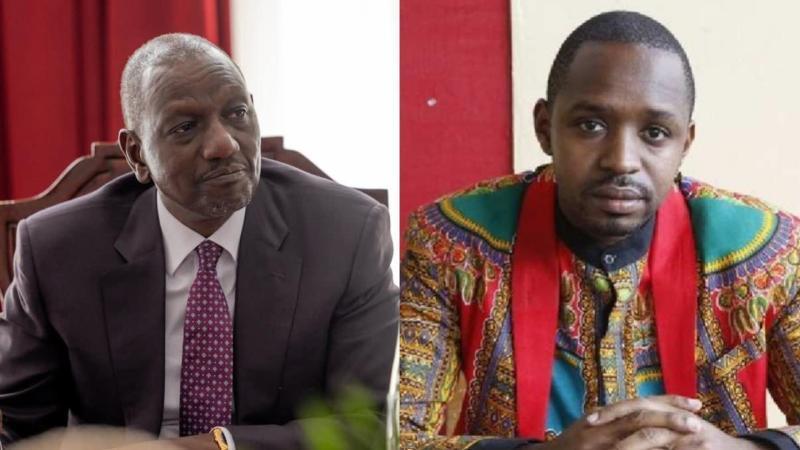
Activist Boniface Mwangi has claimed he was approached and offered money to testify in favour of President William Ruto during their proceedings at The Hague.
Activist Boniface Mwangi has claimed he was approached and offered money to testify in favour of President William Ruto and former President Uhuru Kenyatta during their proceedings at the International Criminal Court (ICC).
Speaking in an interview on the Iko Nini Podcast, he said the alleged approach happened when the two leaders were facing charges at the ICC over the violence that followed the disputed 2007 General Election.
He explained that the offer came from a lawyer linked to the government side and was aimed at influencing his testimony about the nature of the violence.
"When these guys, Uhuru and Ruto, were in The Hague, one of the lawyers from the government side approached me and offered me money to testify as a witness and say that the 2007 post-election violence was spontaneous," he said.
Mwangi noted that he rejected the offer outright, insisting that no amount of money would have convinced him to give a false testimony.
Read More
"I can’t discuss how much I was offered because it was not a consideration; the moment we start discussing the amount, it’s like I considered it. Whether it was Ksh1 or Ksh1 billion, I wouldn’t have taken it," he added.
This comes days after Mwangi launched an attack on former Interior Cabinet Secretary Fred Matiang’i, warning that backing him for the presidency would amount to reviving the Uhuru Kenyatta era.
Speaking on Sunday, January 25, Mwangi said Matiang’i bears responsibility for major national policy failures and was deeply entangled in the previous administration, including controversies surrounding the Competency-Based Curriculum (CBC) and corruption allegations.
"I think Matiangi is a problem. The mess in CBC, you know Matiangi was co-president for Uhuru. This CBC was a rushed thing, it was done by Matiangi. And then if you go online, he was investigated by EACC for the Ruaraka land scandal," he said.

Mwangi further argued that supporting Matiang’i would effectively reinstall Uhuru's influence in government, drawing parallels with Jubilee-era pledges and current UDA frustrations.
"I also think electing Matiangi or considering Matiangi is bringing Uhuru back into power. Uhuru is the guy who promised kids laptops, never gave them, and then those lies of the Jubilee and now the UDA lies," he added.
Mwangi had in August 2025, during the celebration of Katiba Day, declared his intention to seek Kenya's highest office in the 2027 General Election.
He chose the symbolic occasion of the first-ever Katiba Day to make his presidential announcement.
"We are gathered here today to fulfill the Katiba and see how it can be fulfilled to the letter. I have selected this special day to announce that I will be running for the president of the Republic of Kenya," he declared.
Mwangi expressed his deep commitment to the country while painting a stark picture of Kenya's current state.
"I deeply love our country as you do, and like everyone else who came before us and sacrificed so much so we could be here today, and the people who met in this room many years ago to pass this Katiba that was born from toil, bloodshed, and tears. Now we must work together to ensure it lives in spirit," he said.
Mwangi launched his manifesto, promising that his government would uphold the constitution of Kenya while serving the people.
"My dream for Kenya is possible. Education will be free from Kindergarten to University, and there will be free, quality healthcare for all, and water will be free for all in Kenya. Finally, I will build a country that is safe for everything. All this will be possible because in my administration, there will be no corruption," he promised.
Mwangi also condemned what he described as the brutal treatment of young protesters in recent demonstrations, criticizing the government's handling of peaceful protesters.
"The true criminals are protected while our youths are brutalized for carrying flags and water," he stated, referring to the treatment of peaceful protesters during recent anti-government demonstrations.