Editor's Review
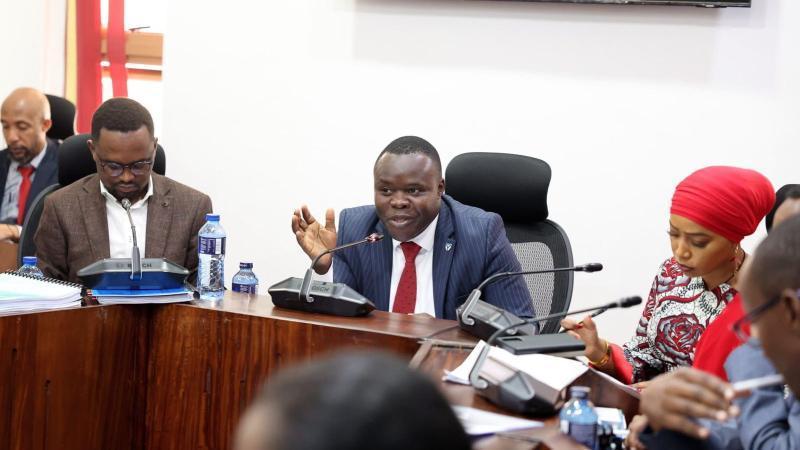
Samburu Governor Lati Lelelit and members of his executive team came under tough scrutiny when they appeared before the Senate County Public Investment Committee and Special Funds.
Samburu Governor Lati Lelelit and members of his executive team came under tough scrutiny when they appeared before the Senate County Public Investment Committee and Special Funds.
The session, held on Wednesday, March 11, focused on the Auditor General’s reports for the 2024/2025 financial year, examining the operations of the county water company, Maralal Municipality, and two public hospitals.
The hearing was chaired by committee Vice Chair, Migori Senator Eddy Oketch, who warned that the Senate would not allow continued administrative lapses or attempts to undermine parliamentary oversight.
Tensions rose early in the proceedings when senators reviewed the case of the Samburu Water and Sanitation Company (SAWASCO).
The entity had received a disclaimer of opinion from the Auditor General after auditors reported they had been denied access to essential financial documents and supporting records.
Read More
The situation was further complicated when the water company’s chief executive officer and accountant failed to attend the session.
Lelelit told the committee the two officers had travelled to Ngara to print documents, but they could not be reached when the meeting began.
"This committee does not accept the explanation that officers whose entity received a disclaimer opinion are somewhere in Nairobi printing documents. When the auditor says they were denied records, and the officers responsible disappear on the day of accountability, that is not administration. That is obstruction," Oketch said.
Following the exchange, the committee resolved to uphold the disclaimer opinion issued by the Auditor General.
Senators also warned that failure to provide the required financial records could attract penalties under Section 62 of the Public Audit Act.
Nominated Senator Raphael Chimera then questioned the governor over what appeared to be a pattern of selective cooperation with oversight authorities.
"Governor, the board chair of the water company is seated here, but the accounting officers who should explain missing trial balances, unsigned management reports and unexplained variances are absent. Is the county executive deciding what this committee should or should not examine?" he posed.

Lelelit rejected suggestions that his administration was trying to obstruct the investigation, explaining that the officers were working to finalize the required documents.
He added that disciplinary action would be taken if it was established that they intentionally avoided appearing before the committee.
When the discussion shifted to Maralal Municipality, senators raised concerns about an adverse audit opinion.
The opinion stemmed from the county’s failure to operationalize important municipal functions despite responsibilities having been legally transferred under the Urban Areas and Cities Act.
Chimera criticized the municipality’s status, describing it as a structure that exists in law but not in financial reality, while pointing out that the entity had not received direct funding in its accounts during the audited financial year.
The committee subsequently instructed the county government to ensure that the municipality becomes operationally and financially independent before the current financial year ends.
Attention later turned to Samburu County Teaching and Referral Hospital and Baragoi Sub-County Hospital, where auditors flagged irregularities involving Ksh9.41 million collected from patients through the Facilities Improvement Financing framework.
The funds had reportedly been redirected to the County Revenue Fund, which senators said violated legal provisions governing the program.
"This money belongs to the facilities that generated it. Patients paid it expecting better services. It must be returned," Nominated Senator George Mbugua stated.
Senators also questioned hospital administrators over the storage of expired pharmaceutical supplies even as the facilities reported severe shortages of essential drugs.
The contradiction, they said, pointed to serious weaknesses in inventory management and procurement planning.
Auditors further reported that the hospitals had lost Ksh7.9 million in claims from the Social Health Authority due to missing documentation.
Responding to the concerns raised, Lelelit said the county government would address the issues highlighted in the audit.
"We acknowledge the gaps identified in the audit, and we will cooperate fully with the committee and the Auditor General to address them. Where resources meant for facilities were transferred to the County Revenue Fund, we will refund them through the supplementary budget process and strengthen our systems to prevent recurrence," he said.
The Senate committee directed Samburu County to provide the missing financial documents within fourteen days and to submit a detailed report on the rejected SHA claims within thirty days.
"This committee works with evidence, not promises. The audit opinions stand, and we will follow up until Samburu County answers every question raised," Oketch added.
This comes months after Nairobi Governor Johnson Sakaja defended his administration's decision to designate Sidian Bank as the principal banker for county health facilities.
Appearing before the Senate Standing Committee on Devolution and Intergovernmental Relations on Monday, November 24, 2025, the county boss faced questions about the rationale behind selecting Sidian Bank over other established commercial banks.
Senator Richard Onyonka raised concerns about the choice, questioning whether the decision was influenced by the ownership structure of Sidian Bank rather than purely by business considerations.
Sakaja defended the decision as purely administrative and based on the principle of competitive advantage.
"They have given us the best deal. And it's an administrative decision. We have reviewed all the other banks. We invited them. We've looked at different commercial banks," he explained.
Sakaja emphasized that Sidian Bank's offer stood out particularly because of the favorable terms on processing fees and rates.
"No one is charging us a processing fee as a percentage. No one is giving us that rate. It's the best. So it's an administrative decision," he added.