Editor's Review
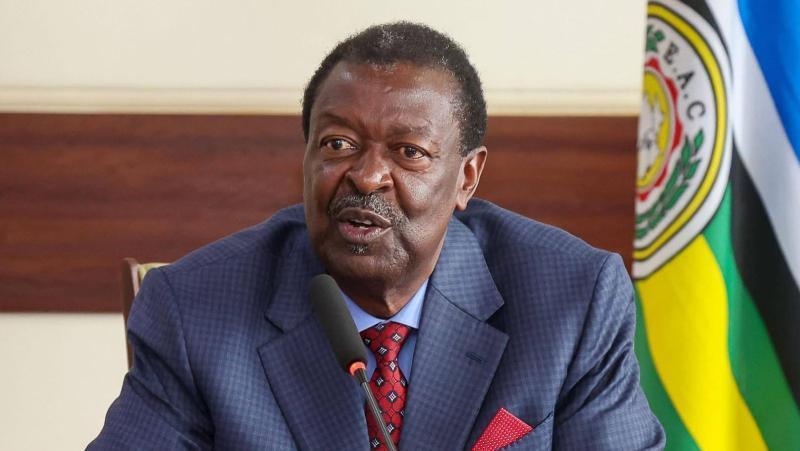
Prime Cabinet Secretary Musalia Mudavadi has revealed that most Kenyans who ended up in the Russian military enlisted voluntarily.
Prime Cabinet Secretary and Cabinet Secretary for Foreign Affairs Musalia Mudavadi has revealed that most Kenyans who ended up in the Russian military enlisted voluntarily.
Speaking on Thursday, April 2, Mudavadi explained that while there have been claims of deception in some cases, many of those involved knowingly entered into agreements that led them into military roles.
"We came to find out that a lot of these people signed off voluntarily. Some may have been caught up in deception, but they signed off voluntarily, they signed their own contracts, they made those commitments," he said.
Mudavadi noted that the individuals were not only aware of their roles but also the financial incentives attached to them.
According to the PCS, lucrative offers played a major role in attracting recruits.
Read More
"They signed contracts to participate either as logistics officers or for combat. The lucrative compensation ranging from Ksh1.5 to Ksh3 million upon joining and a monthly salary of 250,000 to 350,000, promise of citizenship and hefty gratuity upon completion of the contract were major motivation for this process," he added.
Mudavadi also disclosed that the recruitment process was not always direct, with some Kenyans leaving the country and later transitioning into the Russian military from other regions where they were already working.
"The other thing is that some of these people did not leave directly from Kenya. They were moving through other countries. So you would find that some had regular security jobs in the Middle East and then from the Middle East they moved directly to Russia," he further said.

This comes weeks after Mudavadi announced that Kenya will no longer allow the recruitment of its citizens into military operations linked to Russia.
Speaking on Monday, March 16, Mudavadi confirmed that the government had reached a clear decision regarding the recruitment of Kenyans for military-related activities connected to Russia.
"I want to confirm that His Excellency has discussed with us the welfare of Kenyans in Russia, including those involved in military operations. I want to make it clear that we have agreed that Kenyans will no longer be enlisted for special operations through the Defence Ministry," he said.
At the same time, Mudavadi confirmed that the move does not undermine the long-standing diplomatic relationship between Kenya and Russia, which has existed for decades.
"Kenya and Russia have had a partnership for over 60 years. This mission is primarily meant to underscore that long-standing relationship," he added.
Prior to that, the Russian Embassy in Kenya had dismissed allegations linking it to the recruitment of Kenyans to fight in the ongoing Ukraine war.
In a statement on Thursday, February 19, the embassy accused sections of the Kenyan media of spreading misleading narrative regarding Kenyans who travelled to Russia and later participated in combat operations.
"The Embassy of the Russian Federation has noted with great concern that a dangerous and misleading propaganda campaign has been unfolding in the Kenyan media and public space around cases of Kenyan citizens who travelled to the Russian Federation, joined the Armed Forces of the Russian Federation and saw combat in the conflict in Ukraine," the statement read.
The embassy claimed that the reports had escalated beyond general commentary and now included direct accusations against its Nairobi-based mission and staff.
"Even as the Russian and Kenyan governments have been in close contact on the related issues, the campaign has recently culminated in direct accusations against the Embassy of the Russian Federation in Nairobi and its staff of involvement in rogue schemes of recruitment of Kenyans to become combatants in the conflict in Ukraine," the statement added.
Addressing the recruitment claims, the mission denied any involvement in illegal enlistment of Kenyan citizens into Russia’s military structures.
"The Embassy refutes such allegations in the strongest possible terms. The Government authorities of Russia have never engaged in illegal recruitment of Kenyan citizens in the Armed Forces of the Russian Federation," the statement continued.
The mission also responded to assertions that the embassy may have facilitated travel for Kenyans intending to participate in the war.
It maintained that it has neither encouraged nor coordinated with any parties to persuade Kenyans to join the conflict under false pretenses.
"At no point in time throughout the ongoing crisis in Ukraine the Embassy ever issued visas to Kenyan citizens who sought to travel to Russia with the stated purpose of participating in the Special Military Operation (SMO) in Ukraine.
"Nor has the Embassy been encouraging any Kenyan citizen to do so, let alone colluding with any entities or individuals to coerce or lure Kenyans into participating in the SMO under false pretext," the statement further read.