Editor's Review
The head of state showed up unexpectedly in the company of , among others, Governor Johnson Sakaja.
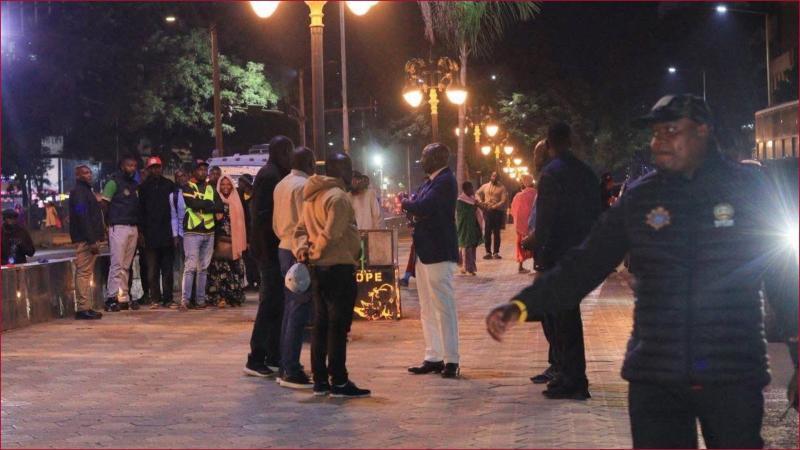
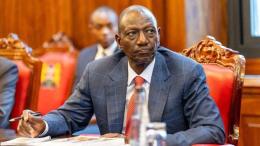
President William Ruto surprised Nairobians with an impromptu visit late Saturday night, May 9.
The Head of State, accompanied by, among others, Governor Johnson Sakaja, Roads and Transport Cabinet Secretary Davis Chirchir and Kikuyu MP Kimani Ichung'wah, was spotted on the streets in the city centre, as members of the public looked on.
As hinted by Ichung'wah, the president was inspecting the ongoing beautification and infrastructural projects jointly undertaken by City Hall and the national government.

Read More
On Ruto's radar during the night walk were the ongoing non-motorised transport walkways, street lighting, and roadworks in the Nairobi CBD.
In February this year, Governor Sakaja formalised a cooperation agreement with the national government at State House, Nairobi.
He outlined that Nairobi would be governed through two committees: the Steering Committee, chaired by Prime Cabinet Secretary Musalia Mudavadi, and the Implementation Committee under him.

The Steering Committee, consisting of Cabinet Secretaries and county secretaries, was tasked with setting policy goals and guiding the county’s direction.
The Implementation Committee, made up of Principal Secretaries and County Executive Committee members, was charged with handling the day-to-day execution of projects and programmes.
Ruto defended the arrangement, stressing that it is legally grounded and clarifying that the national government has no intention of taking over Nairobi County’s functions.
Whilst Ruto and Sakaja vouched for their cooperation as one which would turn Nairobi around for the better, some quarters were opposed to it.
Nairobi senator Edwin Sifuna urged the governor to abandon the pact, arguing that it was unconstitutional since it was signed without public participation, adding that involving residents afterwards would be disrespectful.

Sifuna criticised the steering committee overseeing the agreement, saying it is dominated by national government officials and would reduce Sakaja to a subordinate of the Prime CS.
Sifuna further accused the national government of retaining functions meant for counties, insisting that agencies such as KURA, KERRA, and Roads should be dissolved and their budgets transferred to devolved units.
He noted that there are already legal mechanisms for channelling funds to counties with unique needs through conditional grants and additional allocations.
The senator warned that the cooperation deal would complicate oversight and accountability by the Nairobi County Assembly, the Senate, and the Auditor General’s office.
-1784539615-md.jpg)


-1784539615-sm.jpg)